Best Food In Vienna By District
Vienna's food character changes sharply from one district to the next, and knowing which district does what is the difference between a good eating trip and a great one.
Short answer
Innere Stadt holds the classic coffee houses and cake temples. The Naschmarkt belt covers market food and international stalls. Leopoldstadt centres on the Karmelitermarkt and quieter Beisln. Spittelberg offers lanes, small plates and a Bib Gourmand vegetarian bistro, while Josefstadt keeps traditional Wirthaus cooking near the theatres.
Vienna's 23 districts each carry a different food identity, and the city's most useful eating map is not organised by cuisine but by Bezirk. The 1st district, Innere Stadt, holds the gilded coffee houses and the Sachertorte rivalry. The 4th and 6th, wrapping the Naschmarkt, are where market stalls and Vietnamese kitchens cluster. Leopoldstadt, across the Danube Canal, keeps the Karmelitermarkt and a quieter, neighbourhood style of eating. Spittelberg's Biedermeier lanes and Josefstadt's theatre-quarter Wirthäuser round out the picture with small plates and old Austrian cooking. Vegan visitors can work through the same districts with the help of our guide to vegan menus, markets and tours in Vienna, which points to the plant-forward Beisl, coffee houses and market stalls that welcome meat-free eaters.
Eating well here is mostly a matter of matching the district to the moment: cake at four in Innere Stadt, market grazing late morning at the Naschmarkt, a Heuriger-style glass of young wine only after you have crossed into the wine districts further out. This guide walks through the five districts visitors eat in most, names what each one is actually good at, and shows how a single guided food walk can stitch several of them together in a day.
Which District Has The Best Food In Vienna?
No single district wins, because each one owns a different part of the cuisine: Innere Stadt has the coffee houses and cake institutions, the Naschmarkt belt in the 4th and 6th has market and international food, Leopoldstadt has the Karmelitermarkt and neighbourhood Beisln, Spittelberg has lanes with small plates and creative cooking, and Josefstadt has traditional Wirthaus food near the theatres. Planning by district beats planning by dish. Once you know which district's food suits you best, our guide to picking the right Vienna neighbourhood for eating well helps you choose a base that keeps you close to it.
The reason district matters so much is history. Innere Stadt was the walled city, so it collected the imperial-era institutions: Café Landtmann, Demel, the Hotel Sacher. The districts outside the old walls became residential and kept the everyday cooking, the markets and the sausage stands. That layering still governs where Viennese actually eat on a Tuesday.
It also governs price. Coffee and cake inside the ring cost more than the same Melange a few streets outside it. A Melange at Café Landtmann costs around 6.90 euros and a Sachertorte slice there around 8.50 euros, while the cluster of classic houses, Museum and Schwarzenberg included, sits around the same Melange level. Check the menu on arrival; these figures move.
One more planning layer: Vienna's dining room culture is densest in the inner five districts, but its wine culture lives in the outer northern and southern edge districts, Grinzing, Nussdorf, Stammersdorf and Mauer among them, where the Heurigen sit. The Heuriger visitor guide covers that half of the city separately, and the Vienna wine tasting options guide lists the bookable cellar and countryside tastings that reach it.
| District | Food character | Signature stops | Best time of day |
|---|---|---|---|
| Innere Stadt (1st) | Coffee houses, cake temples, classic hotels | Café Landtmann, Demel, Hotel Sacher café | Mid morning or 4pm cake break |
| Naschmarkt belt (4th and 6th) | Market stalls, international kitchens, flea market | Naschmarkt stands, Kettenbrückengasse eateries | Late morning to early afternoon |
| Leopoldstadt (2nd) | Karmelitermarkt, neighbourhood Beisln, quiet cafés | Karmelitermarkt and surrounding streets | Saturday morning market |
| Spittelberg (7th) | Lanes, small plates, creative bistro cooking | Spittelberg lanes, TIAN Bistro am Spittelberg | Evening, or Saturday market season |
| Josefstadt (8th) | Traditional Wirthaus food, theatre dining | Streets around the theatres | Pre theatre dinner |
A word on how to use the table: treat it as a sequencing tool rather than a ranking. Nothing here says one district is better than another, because the honest answer is that they do different jobs. Visitors who try to eat only in Innere Stadt because it is famous end up paying central prices for everything and missing the market mornings entirely. Spread the days the way the table spreads the clock.
Where Do You Find Coffee Houses And Cake In Innere Stadt?
Innere Stadt, the 1st district, holds the canonical coffee houses and cake institutions: Café Landtmann on the Ring, Demel behind the Hofburg, and the Hotel Sacher café facing the opera. One caution: Café Central has been closed for major renovation since 16 March 2026, with a reopening planned for winter 2026 and a pop-up called Decentral operating at Freyung 3 in the meantime.
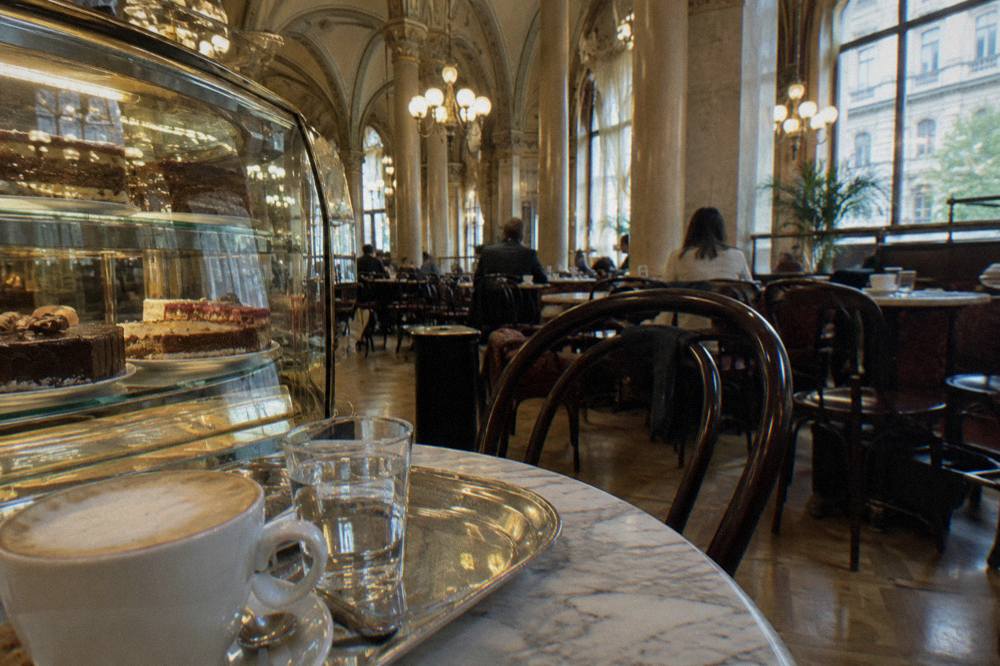
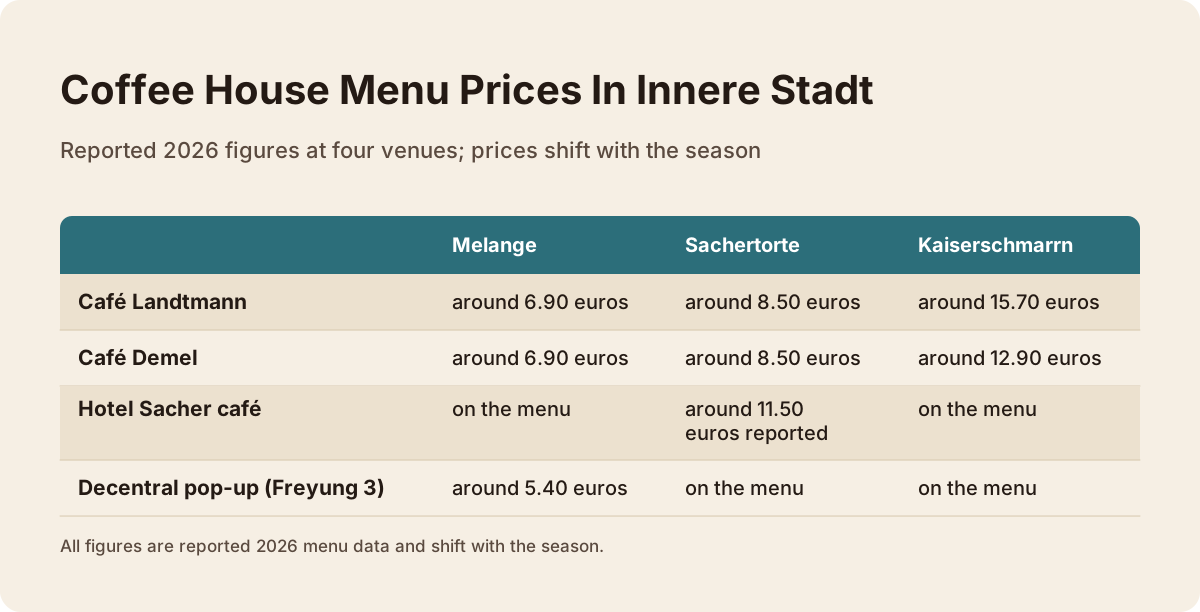
The coffee house is the district's real institution. Viennese coffee house culture was recognised on Austria's national inventory of intangible cultural heritage in 2011 and is cited by the Vienna Tourist Board as UNESCO heritage, and Innere Stadt is where that culture is most concentrated. A Melange, a glass of water on a silver tray, newspapers on sticks, and unhurried sitting are the whole point. Reported 2026 figures put a Demel Melange around 6.90 euros, a Sachertorte slice there around 8.50 euros, and an Apfelstrudel around 9.50 euros; Landtmann lists Sachertorte around 8.50 euros, Apfelstrudel around 8.20 euros and Kaiserschmarrn around 15.70 euros. Menus change, so treat these as ballparks and check the printed card on the day. Coffee houses come with their own unwritten rules, so skim the guide to Vienna do's and don'ts for etiquette, tipping, and what to expect on the bill.
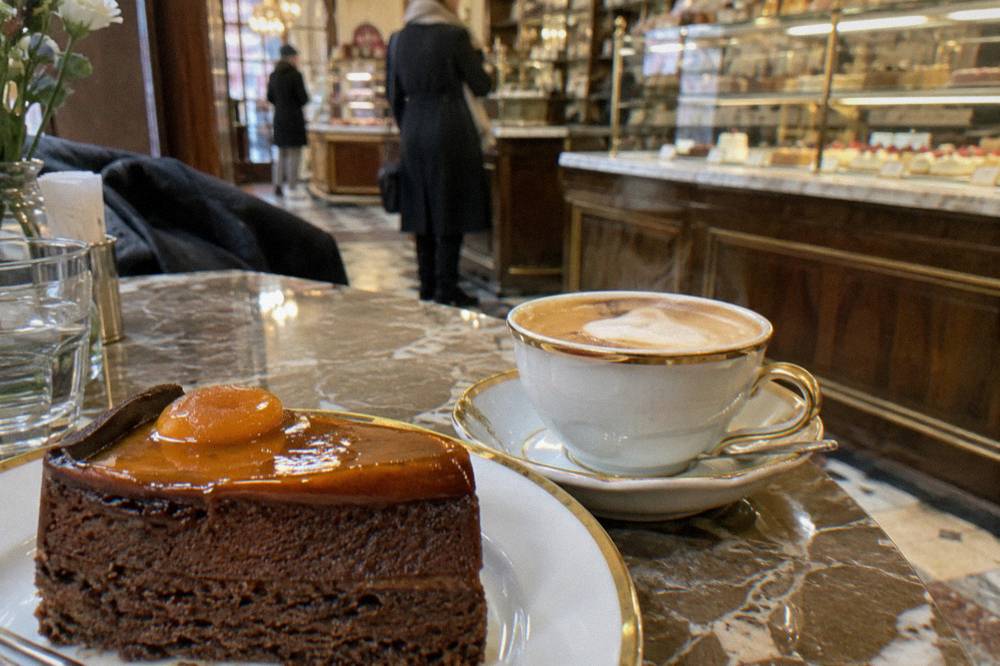
The Sachertorte question also lives here, because Hotel Sacher holds the "Original" sealed version with two apricot layers while Demel serves its rival with one layer and a triangular seal, a legal distinction that has persisted for decades. The Sachertorte or Demel guide compares the two in full. Practically: Sacher's queues run longer in the afternoon, Demel's are usually shorter, and Landtmann accepts reservations while Demel generally does not. A reported price for the Original slice at the Sacher café sits around 11.50 euros, with other 2026 reports noting a range of roughly 8.90 to 10.50 euros; expect it to sit at the top of the cake price scale.
| Coffee house | Melange | Sachertorte | Apfelstrudel | Kaiserschmarrn | Reservations |
|---|---|---|---|---|---|
| Café Landtmann | around 6.90 euros | around 8.50 euros | around 8.20 euros | around 15.70 euros | accepted |
| Café Demel | around 6.90 euros | around 8.50 euros | around 9.50 euros | around 12.90 euros | generally not |
| Hotel Sacher café | on the menu | around 11.50 euros reported | on the menu | on the menu | accepted |
| Decentral pop-up (Freyung 3) | around 5.40 euros | on the menu | around 5.90 euros | on the menu | check the café's site |
All figures shift with the season; the table's job is to show the spread, not to fix prices. Note what the spread says: the same Melange costs about a euro and a half more at the grand houses than at the pop-up, and Kaiserschmarrn, the shredded pancake dish that doubles as a meal, carries the widest range of all.
If you want the coffee house layer explained while you taste, the Vienna Coffeehouse Tour: Pastries, Bites & Local Stories runs 3 hours 30 minutes, starting at Reumannplatz in the 10th district, passing the Naschmarkt and ending in the Inner City; check its price and meeting point on the operator's listing.
Beyond the famous houses, Innere Stadt's smaller cafés, the ones without guidebook entries, charge a little less and serve the same Melange ritual. Sit for it properly rather than grabbing and going; that is the local custom. For the broader culture, the Vienna coffee house culture guide covers reading the menu and ordering like a local, and the best coffee houses guide lists houses across the whole city, not just the centre.
What Should You Eat Around The Naschmarkt Belt?
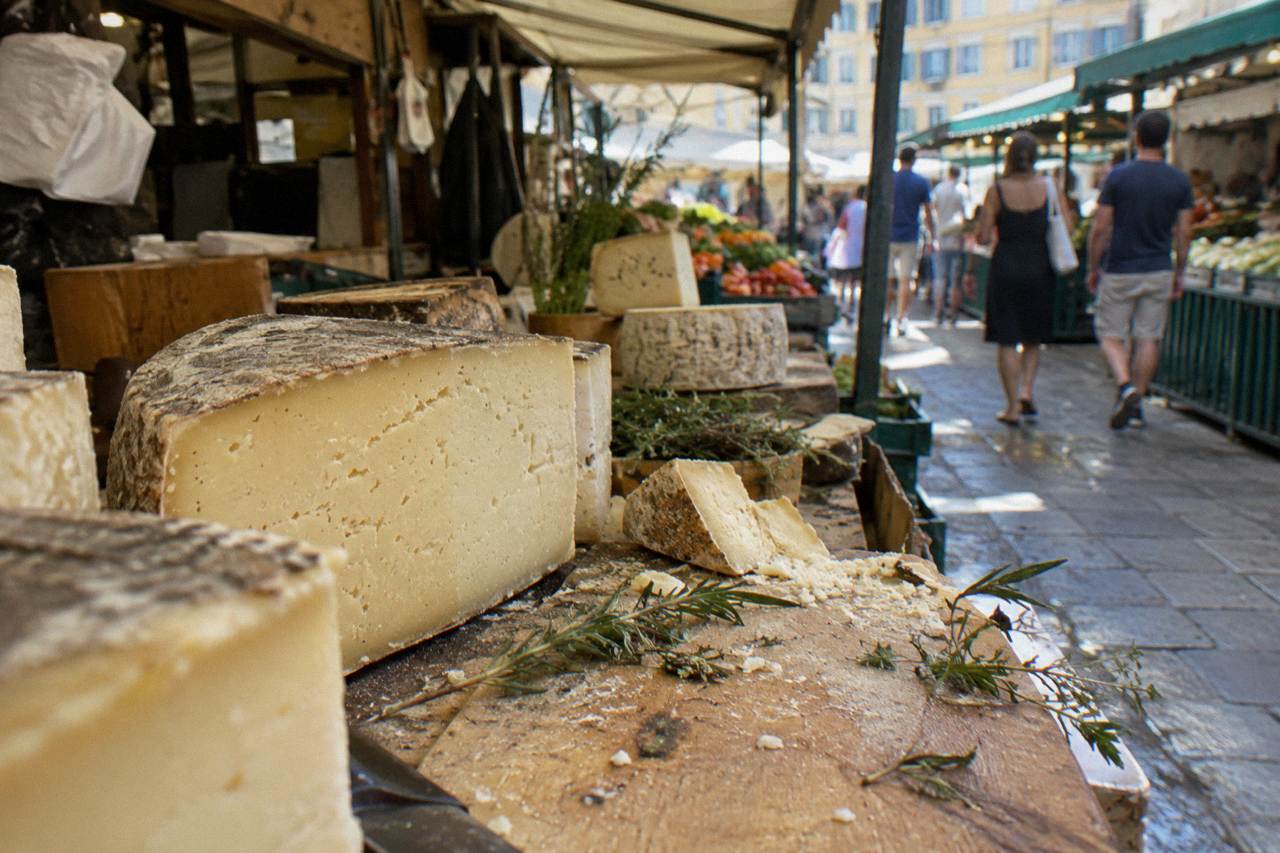
The Naschmarkt, straddling the 4th and 6th districts along the Wienzeile, is Vienna's great market strip, and eating it well is about timing: stalls must be open Tuesday to Friday 15:00 to 18:00 by city rule, Saturday runs fullest alongside the flea market, and the strip's international kitchens peak from late morning. Graze olives, cheese, bread and falafel rather than sitting down immediately.
The market's official hours come from the City of Vienna: sales stands may operate within maximum windows of 6:00 to 21:00 Monday to Friday and 6:00 to 18:00 Saturday, restaurants within 6:00 to 23:00 Monday to Saturday, and the Saturday flea market beside it runs from about 6:30 to 15:00, with restrictions on 12 and 19 December 2026 for the Christmas tree market and no market at all on 25 and 26 December. The guaranteed window is Tuesday to Friday afternoon, when every stand must be open; Saturday is the fullest day, with the flea market next door drawing a second crowd.
The market's own redevelopment is mid flight: the Naschpark green space with 70 trees is finished, the timber Marktraum hall has opened with 13 stands selling regional bread, meat, fish and cheese, and full completion of the wider redevelopment is now expected in February 2027. Some stands sit in temporary positions while works finish, so a stall you read about may have moved a few metres. One Marktraum stand, the Italian cheese seller Fratelli Valentino, vacated at the end of March 2026, and the city is seeking a replacement regional vendor.
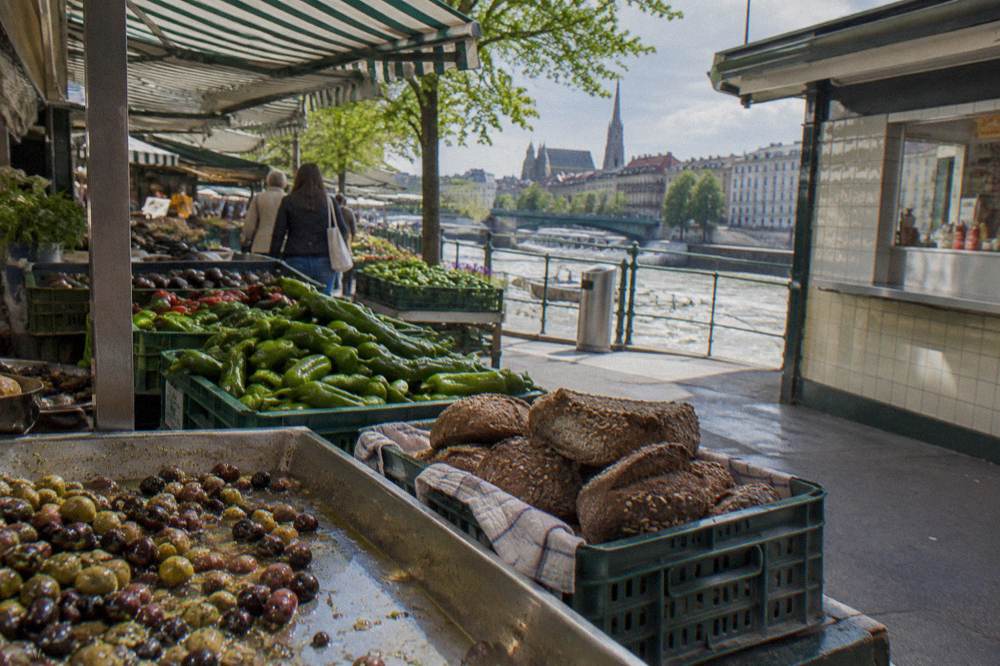
What to actually eat: this is the least Austrian-food part of central Vienna, and that is its strength. Stalls sell olives, cheeses, cured meats and breads; the strip's restaurants run from Austrian to Vietnamese, which the 6th district around it has a long-standing community of. The Naschmarkt food guide details the stall landscape, and the Naschmarkt opening hours guide covers the flea market and the December restrictions.
Two bookable walks cover the market directly. Peters Naschmarkt Enjoyment walks runs 2 hours through the market, and the Vienna: Naschmarkt Food Tasting Tour runs 2 hours 30 minutes; both list prices, tastings and meeting points on their booking pages. If you want the market folded into a bigger day that also takes in coffee houses and street food, the Vienna Food Tour: Coffeehouses, Markets, Lunch & Street Food does exactly that across 5 hours 30 minutes, with a vegetarian lunch option stated on its listing.
What About Leopoldstadt And The Karmelitermarkt?
Leopoldstadt, the 2nd district across the Danube Canal, is Vienna's neighbourhood-eating district: the Karmelitermarkt follows the same official stand hours as the Naschmarkt, and its farmers' market component is strongest on Friday and Saturday, when regional producers take the extra stalls and the surrounding Beisln do their busiest lunches of the week.
This is where the city eats like locals do. Official city rules give the Karmelitermarkt the same windows as the Naschmarkt: sales stands within 6:00 to 21:00 Monday to Friday and 6:00 to 18:00 Saturday, restaurants up to 23:00 Monday to Saturday with a Sunday cap of 9:00 to 19:00, and the same guaranteed Tuesday to Friday 15:00 to 18:00 opening. The difference is scale and rhythm: fewer tourists, a weekly rather than daily cadence, and a market square that empties back into a quiet neighbourhood by evening. The full index of guides sits on Vienna Food Tours.
The district also marks the boundary of the Wirtshaus renaissance that Vienna's food press has tracked through 2025 and 2026: revived century-old taverns blending tradition with fresher, more vegetable-forward cooking. That movement's named addresses sit mostly in the 9th, 11th and 15th districts, Rosi in the 15th and Gasthaus Tante Liesl in the 9th among the 2026 Bib Gourmand additions, but Leopoldstadt shares the same spirit at lower volume. If your trip has room for one market morning outside the centre, make it this one, and pair it with a walk along the canal or through the Prater afterwards.
For a structured pass through the market layer, the Vienna: Naschmarkt Guided Food Tour covers a different market with a guide; for Leopoldstadt itself, no dedicated guided market walk is listed, so go independently and check stall days before you set out. The markets beyond Naschmarkt guide maps the other neighbourhood markets, including Viktor-Adler in the 10th and the long Brunnenmarkt in Ottakring. If you eat gluten-free, the guide to gluten-free eating in Vienna covers how to read allergen labels at market stalls and how to confirm a food walk can adapt before you book.
Is Spittelberg And Josefstadt Worth The Food Walk?
Yes: Spittelberg, in the 7th district, is a compact set of Biedermeier lanes with small-plate restaurants, cocktail bars and one of Vienna's new 2026 Bib Gourmand addresses, the vegetarian TIAN Bistro am Spittelberg, while neighbouring Josefstadt, the 8th, keeps traditional Wirthaus cooking around its theatres. Together they make the best single evening food stroll outside the centre.
Spittelberg's moment is evening. The lanes close to traffic, the restaurant terraces fill, and the walk between them takes minutes. The Michelin Guide's Austria 2026 edition, released in March 2026, awarded 61 Bib Gourmands nationally with 26 new ones, and TIAN Bistro am Spittelberg was among the new Vienna additions; the same guide counted 101 starred restaurants in Austria, with Vienna retaining two three-star houses, Steirereck im Stadtpark and Amador, for the nights that call for them. Gault&Millau's 2026 guide gives four Vienna restaurants its top five-Hauben rating, Amador, Konstantin Filippou, Silvio Nickol Gourmet Restaurant and Steirereck, if you want the formal-dining layer of the map.
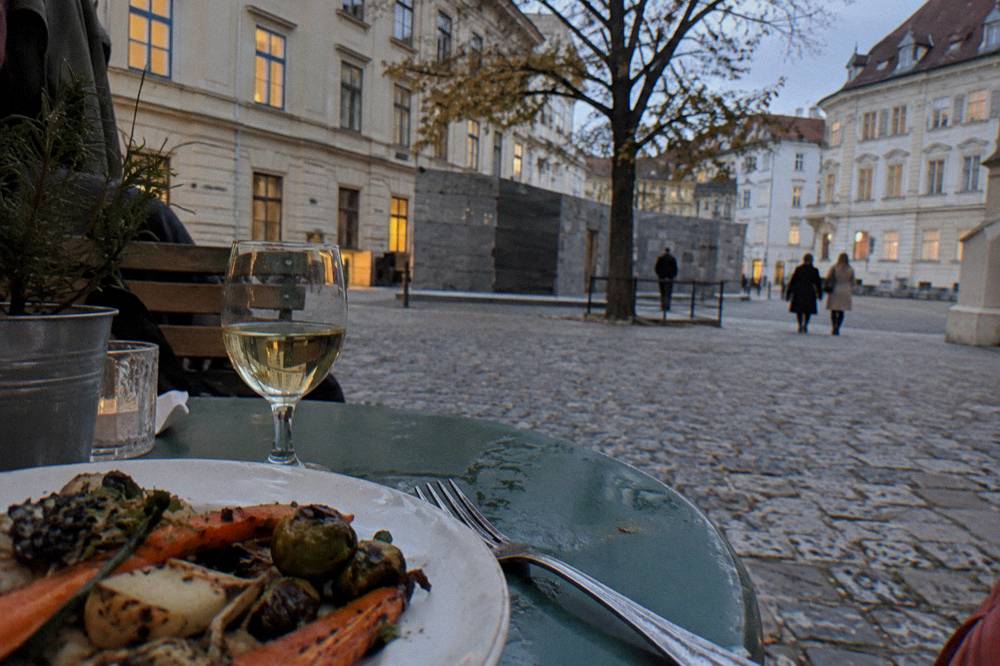
Josefstadt, one district north, is the theatre quarter, and its food clock runs on curtain times: pre-show dinner seatings, post-show sausage stands. The cooking is the old Austrian repertoire, Schnitzel, Tafelspitz, goulash, served in rooms older than the ring boulevards. It is the district to book a table rather than drift, because theatre nights compress the seatings. For the dish background, the where to eat Wiener Schnitzel guide and the traditional dishes overview cover what to order.
Vienna is Austria's Schnitzel capital by delivery order volume, 142,318 orders between January and August 2026 against a national average price that rose about 6 percent to 13.09 euros, but the district Beisln of the 7th and 8th are where you eat the plate rather than unwrap it. One pub-yard note: the Ottakringer Bierfest, the summer brewery festival with more than 20 tapped beers and street food, ran to 4 September 2026 and is over for this year, so the beer garden layer of these districts is the standing option; the Vienna beer guide covers it.
If an evening format appeals more than a daytime walk, the Vienna Dinner, Wine & Cocktails: Small-Group Evening Tour runs 4 hours across a comparable central terrain; its price and inclusions are on the booking page.
How Do You Link The Districts Into One Eating Day?
The practical answer for most visitors is one of two routes: start at the Naschmarkt late morning, walk north through Spittelberg, finish with cake in Innere Stadt at four; or book the 5 hour 30 minute guided food walk that covers coffeehouses, markets, lunch and street food in a single itinerary, which is the only listed tour spanning several of these districts in one booking.
Doing it yourself is straightforward because the districts stack along a north-south line: the Naschmarkt belt at the south, Spittelberg and Josefstadt in the middle, Innere Stadt at the north end. The whole spine is walkable, roughly 2 to 3 km end to end with stops, and public transport parallels it the whole way. Check the current fare products before you ride; the ticket range changed in 2026 and the old 48 and 72 hour tickets were discontinued, so read the Wiener Linien tickets guide rather than trusting older advice.
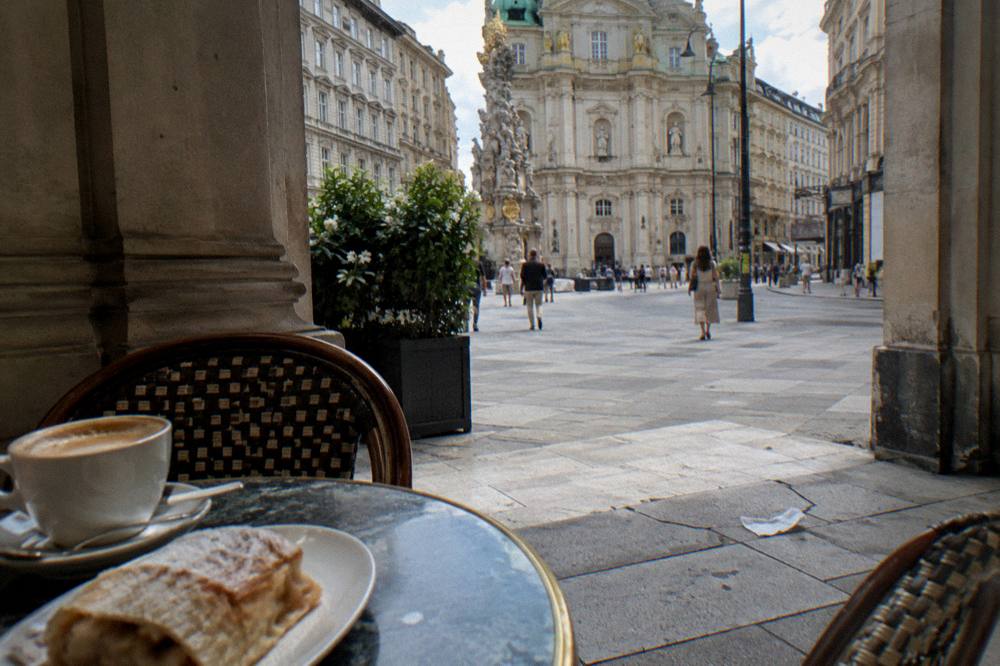
The booked alternative is what this site exists for. The Vienna Food Tour: Coffeehouses, Markets, Lunch & Street Food runs 5 hours 30 minutes and is one of the walks that crosses from the coffee house layer to the market layer to street food with lunch included and a vegetarian option stated. Shorter formats trade scope for time, and the table below shows how the main options divide the same city.
| Tour | Length | Districts and layers covered | Lunch | Dietary note |
|---|---|---|---|---|
| Vienna Food Tour: Coffeehouses, Markets, Lunch & Street Food | 5 hours 30 minutes | Coffee houses, markets, street food across several central districts | included | vegetarian lunch option stated |
| Authentic Vienna Food Tour | 5 hours | Lunch, street food and 3 drinks | included | vegetarian lunch option stated |
| Taste Vienna by Do Eat Better | 3 hours 30 minutes | Full-meal walking route | included as the format | message the operator before booking |
| Vienna: Typical Austrian Food Tour with Coffee House Visit | 4 hours | Coffee house visit plus Austrian classics | per the listing | message the operator before booking |
| Vienna Dinner, Wine & Cocktails evening tour | 4 hours | Evening dinner and drinks route | dinner format | message the operator before booking |
Prices, meeting points and current availability for all of these are on their booking pages, and anything not stated in a listing, vegan and gluten-free adaptations in particular, is a question to message the operator about before booking rather than an assumption to make on the street.
One budgeting note that belongs here and nowhere else in this guide: a Gedeck cover charge of 2 to 5 euros per person appears in traditional restaurants and is legal only if printed on the menu, and tap water can be charged if the menu lists it, with a 2026 sample of 30 Vienna venues finding 23 charged 0.80 to 3.60 euros per half litre. Neither is a scam; both are menu items. Read the menu before you order and the bill holds no surprises.
Whichever way you build the day, keep the districts' clocks in mind: markets are a morning-to-early-afternoon activity, cake is a four o'clock institution, Spittelberg and Josefstadt are evening places, and the wine districts beyond them are an afternoon of their own. Vienna Food Tours exists to help you sequence exactly that; the rest is appetite. For travellers stretching past one day, the Vienna in three days itinerary folds these districts into a fuller plan.
Common Questions About Eating Across Vienna's Districts
Which District Has The Best Food In Vienna?
None wins outright. Innere Stadt owns coffee houses and cake, the Naschmarkt belt owns market and international food, Leopoldstadt owns neighbourhood market eating, and Spittelberg and Josefstadt own the evening stroll and traditional Wirthaus cooking. Match the district to the time of day.
Is Café Central Open In 2026?
No. It has been closed for major renovation since 16 March 2026, with reopening planned for winter 2026. The Decentral pop-up at Freyung 3 operates meanwhile; confirm status on the café's own site before visiting.
Which Vienna District Is Best For A First-Time Visitor?
Innere Stadt for the institutions and the Naschmarkt belt for the market colour, with Spittelberg added for an evening. A guided walk such as the 5 hour 30 minute coffeehouses, markets, lunch and street food tour links these in one booking.
What Should I Eat At The Karmelitermarkt?
Go Friday or Saturday when the farmers' market component fills out with regional meats and produce, then eat at a Beisl on the surrounding streets. Stands must be open Tuesday to Friday 15:00 to 18:00 by city rule.
Can You Walk Between Vienna's Food Districts?
Yes. The main eating districts stack along a roughly 2 to 3 km walkable spine from the Naschmarkt belt north through Spittelberg and Josefstadt to Innere Stadt, with public transport paralleling the whole route.