Vegan Food In Vienna: Menus, Markets And Tours
Vienna's traditional menu leans heavily on meat, schnitzel and butter-heavy pastry, yet the city also runs one of Central Europe's more developed plant-based scenes, from a Michelin-listed vegetarian bistro to fully vegan cake shops. Here is where to eat, how to shop the markets, and which tasting walks can work for vegan travellers.
Short answer
Vegan travellers can eat well in Vienna. Dedicated venues such as Cafe Ausnahmsweise and Gruener Salon serve fully plant-based cake and dishes, while modern Beisl like Rosi and the Michelin-listed TIAN Bistro lean vegetarian with vegan options. No guided food walk in the city states a vegan menu: three listings state a vegetarian lunch option, so message the operator before booking.
Vienna built its reputation on schnitzel, sausage and Sachertorte, which is exactly why the plant-based counter-scene here surprises people. The city's 2026 dining landscape includes a Bib Gourmand vegetarian bistro, fully vegan cake shops, natural-wine Beisl serving vegetable-forward plates, and a street food culture where a Bosna or a grilled cheese krainer is never the only option. Eating vegan here is not a survival exercise of side salads, but it does reward knowing where to go, because the classic venues a first-time visitor gravitates toward are the least likely to help. If gluten is off the table for you as well, the gluten-free guide to Vienna explains which schnitzel and cake workarounds actually exist and how to check that a food walk can adapt before you commit.
This guide covers the practical questions: what vegan dishes actually appear on Viennese menus, which restaurants and coffee houses do it best, how to shop the markets, what a realistic vegan day looks like, and, honestly, where guided tasting walks fit. That last point needs care. Across the bookable food walks in the city, none states a vegan menu. Several state a vegetarian option for lunch, which is close but not the same thing, and the difference matters when you have paid for five hours of tastings. If drinks fit your plans more easily than food walks, the Vienna beer guide explains which breweries and Beisl pours you can actually book a tasting around.
What Can Vegans Actually Eat In Vienna?
Yes, vegans can eat well in Vienna. Fully plant-based venues like Cafe Ausnahmsweise and Gruener Salon anchor the scene, vegetarian-leaning modern Beisl such as Rosi and TIAN Bistro offer real options, and Velani serves vegan Hausmannskost, while market stalls shine with produce, bread and olives. Since classics like schnitzel and Kaiserschmarrn have no traditional vegan version, the city's plant-based story is modern and chef-driven.
Start with what cannot be adapted. Wiener schnitzel is a veal cutlet in egg-and-breadcrumb coating. Kaiserschmarrn is shredded pancake with raisins. Sachertorte is chocolate, apricot and eggs. None of these exist in vegan form at the classic houses, and the traditional Beisl menu, goulash, schnitzel, roast pork, will leave a vegan ordering the side salad. The Heuriger buffet, the wine tavern spread described in the Heuriger visitor guide, is heavier on cold cuts and cheese than on plant dishes, though bread, spreads and pickled vegetables usually appear.
The modern scene is where the story turns. The 2026 Michelin Guide Austria added three Vienna Bib Gourmands, and one of them, TIAN Bistro am Spittelberg, is vegetarian, a signal of how seriously plant-forward cooking is now taken in this city. Alongside it sits a wave of revived Wirtshaus, old tavern buildings reopened with contemporary kitchens. Rosi in the 15th district, reopened in late 2024 by a former Steirereck team, is the best known example: a renovated 1906 gasthaus running a vegetarian-leaning menu with natural wines. Vegan mains are common at this type of venue, though not guaranteed, so the menu decides.
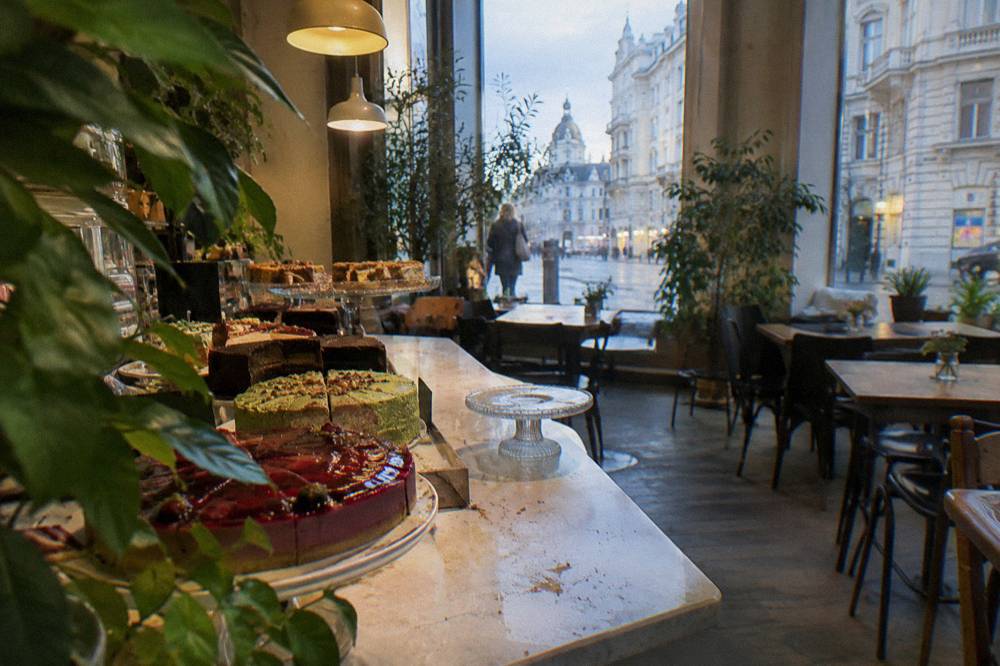
Fully plant-based venues cluster in the 6th district. Cafe Ausnahmsweise does vegan and gluten-free cakes. Gruener Salon is another fully vegan cafe in the same area. Gasthaus Zum Wohl adds lactose-free to its gluten-free and vegan brief, and Velani serves vegan Hausmannskost, meaning plant-based versions of the hearty home cooking the Beisl tradition is built on, across several locations. Hollerei, a long-standing vegetarian restaurant, rounds out the list. None of these is a museum-piece venue; they are working neighborhood restaurants, which is the point.
For context on how the mainstream eats, the numbers are blunt. Vienna ordered more schnitzel per capita than any other Austrian city in 2026, 7.4 orders per 100 inhabitants. That is the tide a vegan visitor is swimming against in the old town, and it is why the districts matter: the plant-based density sits in Mariahilf and Neubau, not around Stephansplatz.
Which Vienna Food Walks Work For Vegan Eaters?
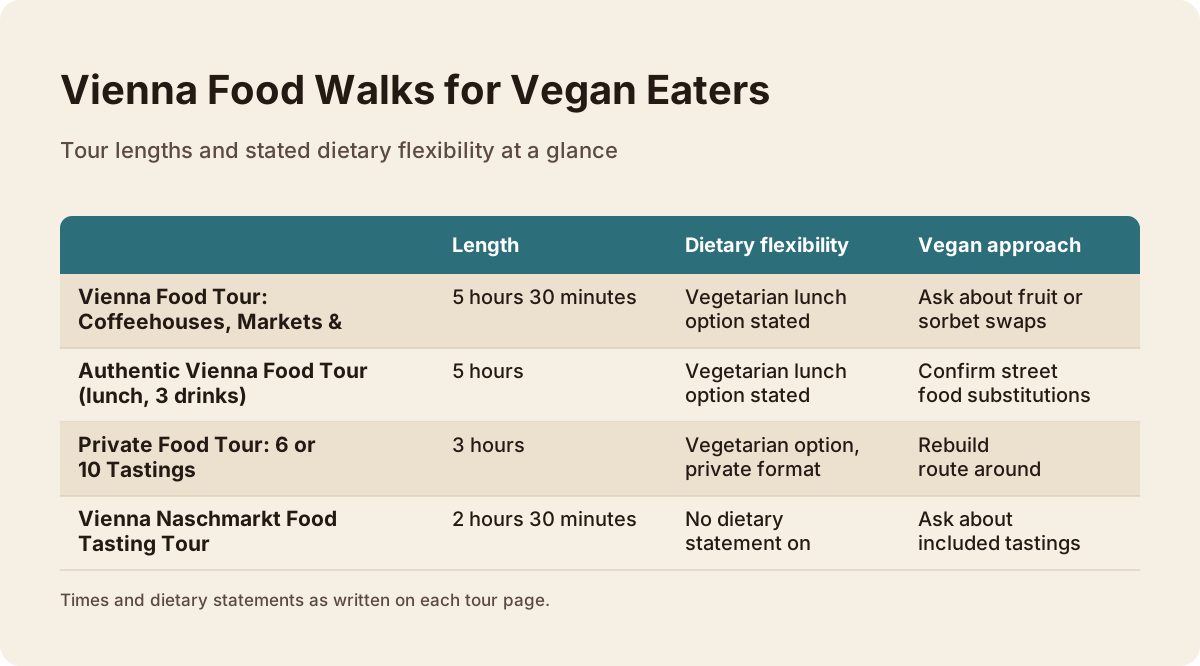
Honest answer: no guided food walk in Vienna states a vegan tasting menu on its booking page. Three listings, the Vienna Food Tour with coffeehouses and markets, the Authentic Vienna Food Tour and the private tasting tour, state a vegetarian lunch option, which is the closest match. The right move is to message the operator about vegan needs before booking and confirm what the guide can substitute on the day.
The detail matters more than the headline. A "vegetarian option" on a Viennese lunch stop often still means cheese, egg or a broth base, and a street food tasting route built around sausage stands is hard to reroute entirely. What the three vegetarian-flagged walks offer instead is structure: a guide who knows the market, the coffee house ritual and the back streets, and who can, if warned in advance, steer the group's vegan member toward the plant-based venues that do exist along the route. That conversation happens before payment, not at the meeting point.
The Authentic Vienna Food Tour runs about 5 hours, includes lunch, street food and three drinks, and is the listing most worth the pre-booking message for vegans: its vegetarian lunch option is stated outright, so the operator has already built dietary flexibility into the product. The longer Vienna Food Tour, 5 hours 30 minutes, adds coffee houses and market stops to the same format, which means more coffee house pastries you will probably skip and more market produce you will not. The private tour, 3 hours with a choice of 6 or 10 tastings, is the strongest vegan bet in principle: a private guide can rebuild the route around your diet rather than work around it, and the tasting count is agreed in advance. Prices for all three sit on the booking pages, so compare there rather than trusting any rounded figure quoted secondhand.
A fourth route deserves a mention even though it is not a food walk: a general city-centre walking tour costs nothing up front and leaves lunch entirely in your hands, which some vegan travellers prefer to a tasting format. The trade-off is real, though. A guided walk adds tastings, market navigation and coffee house decoding that a free tour simply does not attempt, and for a first visit those are the parts worth paying for. If you want the fuller comparison of formats, the guide to choosing a Vienna food walk breaks down the options by length and style.
| Walk | Length | Stated dietary flexibility | Best vegan approach |
|---|---|---|---|
| Vienna Food Tour: Coffeehouses, Markets, Lunch & Street Food | 5 hours 30 minutes | Vegetarian lunch option stated | Ask which coffee house stop can swap in fruit or sorbet |
| Authentic Vienna Food Tour inc. lunch, street food, 3 drinks | 5 hours | Vegetarian lunch option stated | Confirm the street food substitutions in advance |
| The Most Delicious Private Food Tour of Vienna: 6 or 10 Tastings | 3 hours | Vegetarian option stated, private format | Rebuild the tasting route around vegan venues |
| Vienna Naschmarkt Food Tasting Tour | 2 hours 30 minutes | No dietary statement on the booking page | Market produce is vegan-friendly but ask about included tastings |
The table's last row is the pattern to watch: many shorter market tours make no dietary statement at all, and an unmarked tour should be treated as a meat-and-cheese route until the operator says otherwise.
Where Do Vegans Eat Well In Vienna?
The strongest plant-based eating sits in the 6th district and the revived Beisl scene: Cafe Ausnahmsweise and Gruener Salon for fully vegan cake and cafe food, Gasthaus Zum Wohl for gluten-free and lactose-free vegan dishes, Velani for plant-based Austrian home cooking, and Rosi and TIAN Bistro for chef-driven vegetable menus. TIAN Bistro holds a 2026 Bib Gourmand, the budget-quality award in the Michelin system.
Neighborhood strategy beats dish strategy here. Around Neubau and Mariahilf, several dedicated venues sit within a short walk of one another, so a vegan traveller can base an afternoon around the 6th district and never fall back on a fallback meal. The 15th district, less touristy, is where Rosi anchors a wider revival of old tavern buildings with fresh kitchens; reservations are the sensible default at any venue of that ambition.
| Venue | District | Diet focus | What to expect |
|---|---|---|---|
| TIAN Bistro am Spittelberg | 1070 | Vegetarian, vegan options | Bib Gourmand 2026, refined vegetable cooking |
| Rosi | 1150 | Vegetarian-leaning, natural wine | Revived 1906 gasthaus, modern Beisl menu |
| Cafe Ausnahmsweise | 1060 | Fully vegan and gluten-free | Cakes and cafe dishes |
| Gruener Salon | 1060 | Fully vegan | Cafe menu |
| Gasthaus Zum Wohl | 1060 | Vegan, gluten-free, lactose-free | Traditional-format dishes, all-adapted |
| Velani | Multiple locations | Vegan Hausmannskost | Plant-based Austrian home cooking |
| Hollerei | 1060 | Vegetarian, vegan options | Long-standing vegetarian restaurant |
The Bib Gourmand detail is worth understanding rather than just name-dropping. It is Michelin's value award: serious cooking at a moderate price. A vegetarian bistro holding one in 2026 means the plant-based kitchen in Vienna has crossed from substitute cooking into cooking, full stop, and a vegan diner there is eating at a venue judged on its vegetables rather than its accommodations. The Michelin Guide's Austria 2026 selection details the full national list if you want to see how the city's fine-dining tier is composed; Vienna also retains two three-star restaurants, Steirereck and Amador, for anyone curious about the top of the market.
For travellers combining diets in one group, these venues solve a real problem: a mixed party of omnivores and vegans eats happily at Rosi or TIAN, where the vegetables are the point rather than the concession. A dedicated vegan cafe, by contrast, is a pilgrimage for the cake, and the cake is worth it.
Book with the venue directly where you can, and note one Vienna-wide habit before you sit down anywhere: a Gedeck cover charge of 2 to 5 euros per person appears on the bill in traditional restaurants, legal only when listed on the menu. The restaurant etiquette guide covers this and the tap-water question, which a 2026 sample found charged at 23 of 30 Vienna venues, often 0.80 to 3.60 euros per half liter.
One honest note on the box above: the vegetarian lunch option on that tour is a stated feature, but a vegan version depends on the operator and the day's stops. Ask the question in writing when you book, and if the answer is vague, the private tour format remains the safer spend.
Can You Eat Vegan In A Traditional Coffee House Or Beisl?
In a classic Viennese coffee house, a vegan can drink the coffee and eat very little else: the pastry cases run on butter, eggs and cream, and melange is milk-based. Plant-based milk is increasingly available but not universal, so ask. The vegan cake experience in Vienna happens instead at Cafe Ausnahmsweise and Gruener Salon, both fully plant-based, and the Beisl answer is the modern wave, Rosi and Velani, rather than the old guard.
Coffee house culture here is a heritage item, recognised on Austria's national inventory of intangible cultural heritage in 2011, and the ritual is worth doing even on a vegan diet, just manage expectations about the plate. A classic house will serve you a black coffee or a espresso with confidence; a melange with plant milk depends on the house. The coffee house culture guide explains the full ritual, the newspapers, the Gedeck, the unhurried table, which costs nothing extra and is the part no dietary restriction touches.
Prices at the classic houses tell you what you are skipping. Cafe Landtmann lists a melange at about 6.90 euros and a Sachertorte slice at about 8.50 euros; Cafe Demel runs similar figures, and a Kaiserschmarrn at either house lands between about 12.90 and 15.70 euros. None of it is vegan, and the vegan cake alternative at a dedicated plant-based cafe typically costs less than the heritage houses charge, so check the counter for exact prices. The full index of guides sits on Vienna Food Tours.
| Item | Cafe Landtmann (reported) | Cafe Demel (reported) | Vegan at classic houses? |
|---|---|---|---|
| Melange | 6.90 euros | 6.90 euros | No, milk-based; plant milk varies |
| Sachertorte slice | 8.50 euros | 8.50 euros | No |
| Apfelstrudel | 8.20 euros | 9.50 euros | No |
| Kaiserschmarrn | 15.70 euros | 12.90 euros | No |
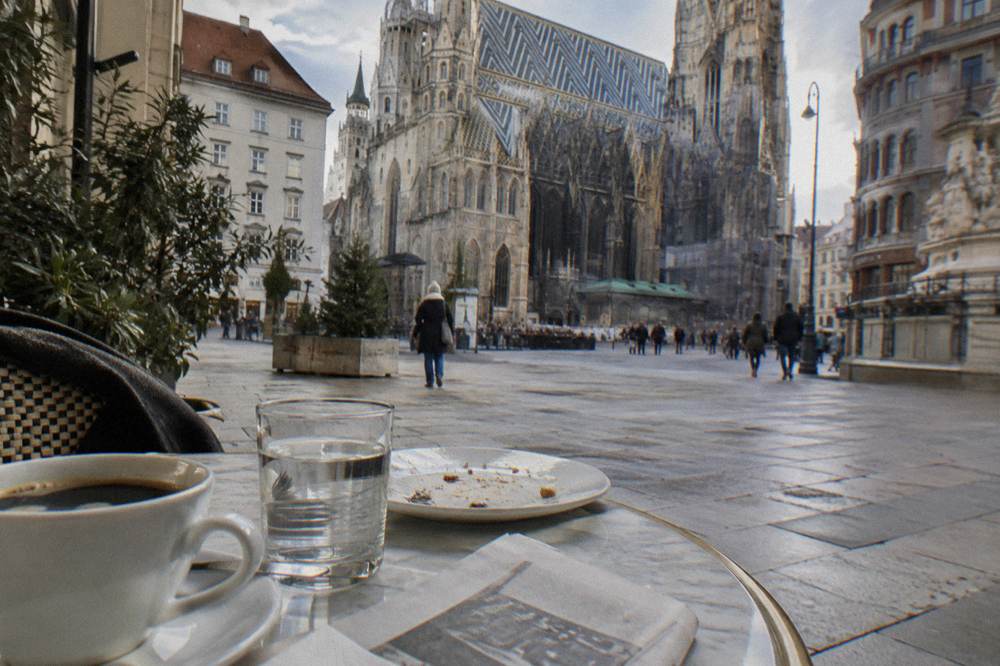
One planning note for 2026 visitors: Cafe Central, the most famous of all, has been closed for major renovation since 16 March 2026, with a reopening planned for winter 2026 and a pop-up called Decentral operating at Freyung 3 meanwhile, where a melange was reported at 5.40 euros. Confirm the situation on the cafe's own site before making the trip, and do not build an itinerary around Central being open as normal.
For the Beisl question, the honest split is generational. The old-guard Beisl around the centre will do their best and it will be a plate of vegetables. The revived generation, venues like Rosi and the wider Wirtshaus renaissance noted in 2025 and 2026 reporting, treats vegetables as cuisine. A vegan visiting Vienna who wants the Beisl atmosphere without the Beisl menu should book the latter and skip the former without guilt.
Is Naschmarkt Good For Vegan Shopping?
Yes, Naschmarkt is one of the best free vegan resources in Vienna: browsing the produce, bread, olive and spice stalls costs nothing, sales stands may trade from 6:00 to 21:00 on weekdays and to 18:00 on Saturdays, and every stand must be open Tuesday to Friday between 15:00 and 18:00. The market is free to enter and wander; what you spend is up to you.
The market's official hours, published by the City of Vienna, set the frame: stands may open weekdays from 6:00 to 21:00 and Saturdays to 18:00, restaurants to 23:00 Monday to Saturday, and the city mandates the Tuesday-to-Friday afternoon window so the market can never be entirely asleep midweek. Sunday is the gap: the produce stands do not trade, and the restaurants may open only 9:00 to 21:00 on Sundays and holidays. Plan the vegan shopping trip for a weekday morning or a Saturday.
| Naschmarkt area | Mon-Fri | Saturday | Sunday |
|---|---|---|---|
| Sales stands | 6:00-21:00 max | 6:00-18:00 max | Closed |
| Restaurants and bars | 6:00-23:00 max | 6:00-23:00 max | 9:00-21:00 max |
| Saturday flea market | n/a | 6:30-15:00 | Closed |
The vegan angle is simple: a market that stretches along the Wienzeile with produce stalls, olives, bread, spices and international grocers is effectively a vegan buffet you assemble yourself. The new Marktraum hall, opened with 13 stands offering regional and seasonal products including bread and cheese, adds a covered option. The Naschmarkt food guide maps what to buy stall by stall, and the city's own market page carries the official hours and rules.
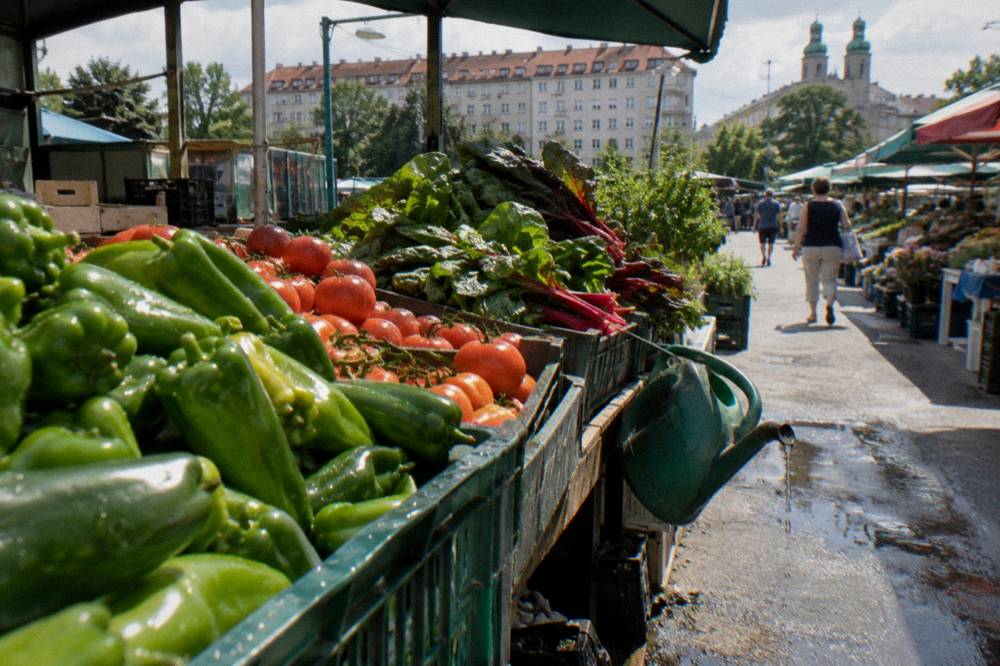
If a guided market visit appeals, the Vienna Naschmarkt Food Tasting Tour runs 2 hours 30 minutes and the shorter guided Naschmarkt tour 2 hours; neither states a dietary position on its booking page, so the vegan question goes to the operator first. What a market walk genuinely adds for a plant-based traveller is the navigation and the vendor relationships, knowing which stall's olives are worth the money and which bread is baked without dairy, and for that reason alone it earns its place in a vegan itinerary.
Beyond Naschmarkt, the same logic applies citywide: Karmelitermarkt in the 2nd district runs a large farmers' market component on Fridays and Saturdays, and Brunnenmarkt in Ottakring, the city's longest street market, runs roughly 160 to 170 stalls with around 120 active on Saturdays. The markets beyond Naschmarkt guide covers them in detail. All are free to browse, which makes them the budget backbone of a vegan stay in a city where restaurant heritage tilts expensive.
What Does A Vegan Food Day In Vienna Look Like?
A realistic vegan day pairs a market morning with a plant-based cafe lunch, a heritage coffee house stop for the ritual rather than the food, and dinner at a modern vegetable-forward Beisl: Naschmarkt stalls before 11:00, a 6th-district vegan cafe at midday, a black coffee at a classic house in the afternoon, and Rosi, TIAN Bistro or Velani in the evening. Total spend lands well below the classic schnitzel-and-cake version of the city.
Morning first. Weekday and Saturday mornings are when the markets are at their fullest, and a breakfast assembled from market bread, fruit and olives costs a fraction of a hotel breakfast. On Sundays the stalls close, so the vegan Sunday breakfast shifts to a cafe, and this is where the dedicated venues earn their place: a fully plant-based bakery cafe in the 6th district does what no classic house can.
Midday is the flexible meal. The vegan cafe scene covers it, or a market restaurant with a vegetable-forward menu does. The afternoon belongs to the coffee house ritual, which survives any diet: a black coffee or a plant-milk melange where offered, a newspaper, and an hour at a marble table in a room that has looked the same for a century. The Gedeck, where charged, runs 2 to 5 euros and is listed on the menu if it is legal.
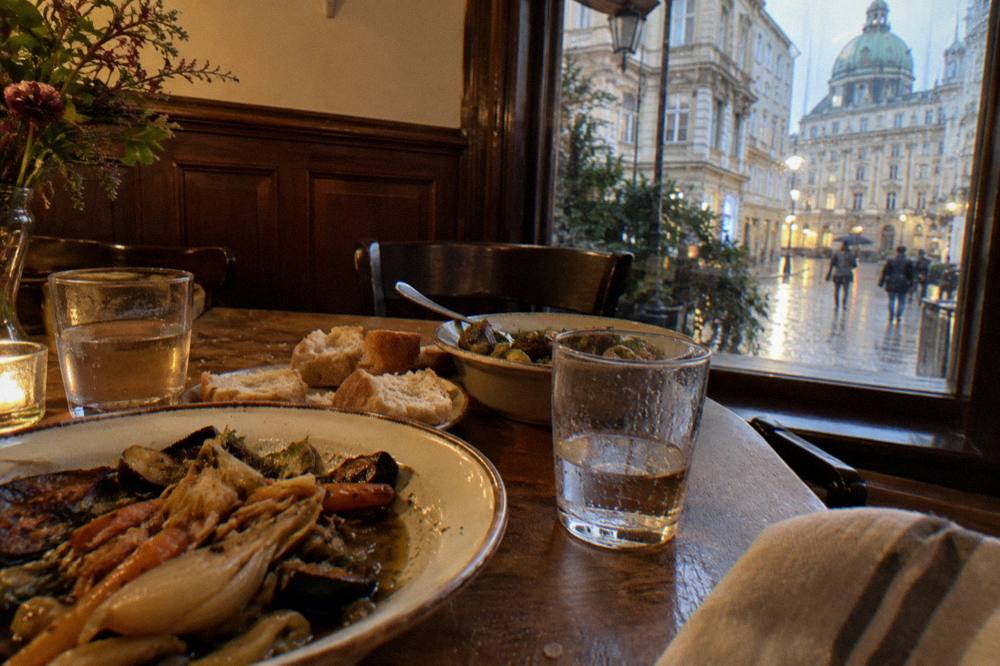
Evening is the meal to book ahead. A Bib Gourmand bistro and a revived 1906 gasthaus both fill up, and the vegan diner who arrives without a reservation in the 7pm window is the vegan diner who eats somewhere second-choice. Tipping is 5 to 10 percent, stated as the total you want when you pay, and the etiquette holds at plant-based venues exactly as anywhere else.
Across the day, one structural advantage repeats: almost everything vegan in Vienna is either free to browse or moderately priced, while the expensive heritage items, the 8.50 euro Sachertorte slice, the 15.70 euro Kaiserschmarrn, the Heuriger buffet plate, are precisely the items a vegan skips by default. The diet quietly edits the most tourist-priced items off the bill.
What Should Vegan Travellers Ask Before Booking A Tasting Walk?
Ask three questions in writing before paying: does the operator confirm vegan substitutions for the tastings, not just a vegetarian lunch; which specific stops on the route have a plant-based option; and what happens to the price or the format if a tasting cannot be substituted. No listing in the city states a vegan menu, so the written answer, not the booking page, is the guarantee you have.
The distinction between vegetarian and vegan is where these bookings succeed or fail. Three walks state a vegetarian lunch option, and a vegetarian lunch in Austria very plausibly includes cheese spaetzle or egg in the batter. A written confirmation that the lunch stop can serve a vegan plate is a different question, and operators who answer it specifically, naming the dish or the stop, are the ones worth paying. Operators who promise to accommodate most diets without offering detail are signaling that the accommodation will be improvised, and an improvised plate is rarely what a five-hour tasting tour should deliver.
The private format changes the math entirely. A private guide building a route for one party can take the vegan requirement as the design brief rather than a constraint, and the 6-or-10-tastings structure means the route is agreed before the day. That is why, for a strict vegan, a shorter private walk often delivers more than a longer group walk with substitutions patched in. The private tour guide covers when the format pays for itself.
For group-format walks built around the classic Austrian canon, one more listing deserves the pre-booking email: the Typical Austrian Food Tour with Coffee House Visit runs 4 hours and its stops are exactly the canon a vegan cannot eat, so the operator's answer about substitutions decides everything. The same caution applies to the full-meal walk by Do Eat Better, 3 hours 30 minutes, and the Best of walk at 2 hours 30 minutes; neither states a dietary position, so treat both as unanswered until the operator replies.
There is also a case for skipping the tasting format altogether, and it is not a defeatist one. Vienna's vegan scene is compact and legible: a traveller armed with this guide, a market map and two dinner reservations has effectively self-guided the same territory. What a guided walk still adds, the format's honest remaining value, is the market decoding and the coffee house context that turn a list of venues into an understanding of the city's food culture. Whether that understanding is worth the price is a fair question to ask yourself after the operator answers your three questions.
A final budget note for the wider trip, since vegan travellers often plan the whole day around food: the free tier of Vienna is genuinely strong, from browsing markets to the city's walkable centre, and the plant-based restaurant tier undercuts the heritage tier on price. For the fuller picture of free and cheap eating in the city, see the budget and free things guide.
Common Questions About Vegan Food In Vienna
Is Vienna Good For Vegan Travellers?
Yes, with the right districts. Fully vegan cafes cluster in the 6th district, the modern Beisl wave serves vegetable-forward menus, and one vegetarian bistro holds a 2026 Bib Gourmand. The classic heritage food, schnitzel, Sachertorte, Heuriger buffets, is off the menu, so the experience rewards planning.
Are Any Vienna Food Tours Vegan?
No bookable walk in the city states a vegan tasting menu. Three listings state a vegetarian lunch option: the Vienna Food Tour with coffeehouses and markets, the Authentic Vienna Food Tour, and the private tasting tour. Message the operator about vegan substitutions before booking.
Can You Get Vegan Cake In Vienna?
Yes. Cafe Ausnahmsweise and Gruener Salon, both in the 6th district, are fully plant-based and serve vegan cakes, with Ausnahmsweise also gluten-free. Classic coffee houses do not offer vegan pastry; their cases run on butter, eggs and cream.
Do Viennese Coffee Houses Have Plant-Based Milk?
Increasingly, but not universally, and it varies house by house. Ask before ordering a melange. A black coffee or espresso is always safe, and the coffee house ritual itself, the table, the time, the newspapers, is fully diet-proof.
Where Can Vegans Shop Cheaply In Vienna?
The markets. Naschmarkt's produce, bread and olive stalls are free to browse, with sales stands trading weekdays to a 21:00 maximum and Saturdays to 18:00. Karmelitermarkt's Friday and Saturday farmers' market and Brunnenmarkt's roughly 160 to 170 stalls extend the same logic to other districts.
Can Vegans Eat At A Heuriger?
With difficulty. A genuine Heuriger serves wine from its own vineyards with a cold buffet that leans on meats and cheese; bread, spreads and pickled vegetables are the usual plant-based items. Enjoy the wine, plan the food elsewhere, and check what the buffet offers before committing to a table.