Vienna Coffee House Culture: How It Works And What To Order
Vienna coffee house culture has its own rules, its own vocabulary and its own pace. This guide explains the ritual from the moment you sit down to the moment you pay.
Short answer
Vienna coffee house culture is recognised on Austria's national inventory of intangible cultural heritage (2011). Order a Melange or an Einspänner, expect table service, tip by rounding up, and plan to stay: a coffee and a cake at a classic house runs around 6.90 euros for a Melange and 8 to 12 euros for a slice of cake, and nobody will hurry you out.
The Viennese coffee house is not a café in the way most cities mean the word. It is a public living room with a waiter who has served the same corner table for twenty years, newspapers on wooden sticks, and an unspoken agreement that a single Melange buys you the afternoon. Coffee house culture here is recognised on Austria's national inventory of intangible cultural heritage (2011) and cited by the Vienna Tourist Board as UNESCO heritage, which is why the institution gets discussed in the same breath as the opera and the Lipizzaner. If you start wondering where the Melange ranks among the city's other famous tipples, our guide to Vienna's most popular drink settles the argument.
For a visitor, the ritual is genuinely unfamiliar in places. Nobody seats you, the menu is longer than most wine lists, and the bill arrives only when you ask for it. This guide walks through the whole experience: what the institution actually is, how the etiquette works, what to order, what it costs, and where the current Café Central renovation leaves your plans. It also flags where a guided walk such as the guided Viennese coffee house tour earns its keep, because the etiquette is exactly the part a guide can translate on the spot. Since the renovation throws a wrench in the usual routine, the practical answer on whether you need a Café Central reservation explains how the temporary pop-up handles seating and what your alternatives are.
What Is A Vienna Coffee House?
A Vienna coffee house is a formal, full-service institution rather than a quick coffee stop: marble tables, Thonet chairs, newspapers on holders, and waiter service that treats your order as the start of a lease on the table. The tradition is recognised on Austria's national inventory of intangible cultural heritage (2011) and cited by the Vienna Tourist Board as UNESCO heritage, alongside the Viennese sausage stand and Heuriger culture.
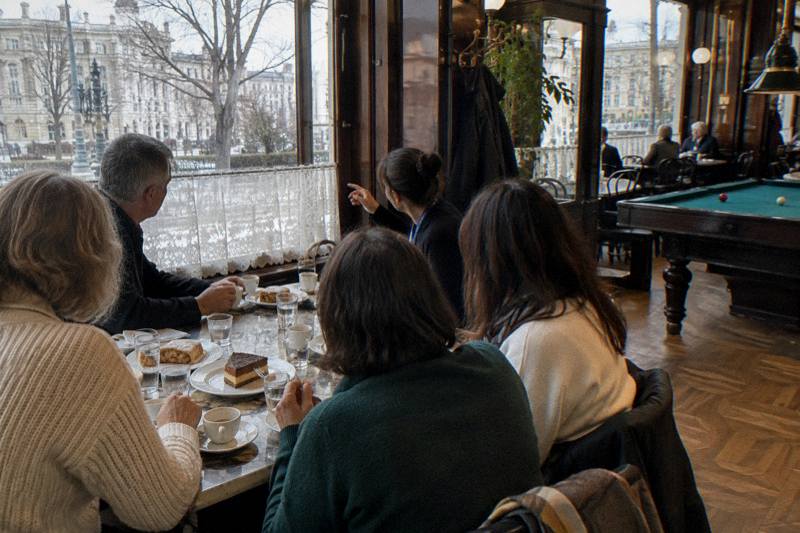
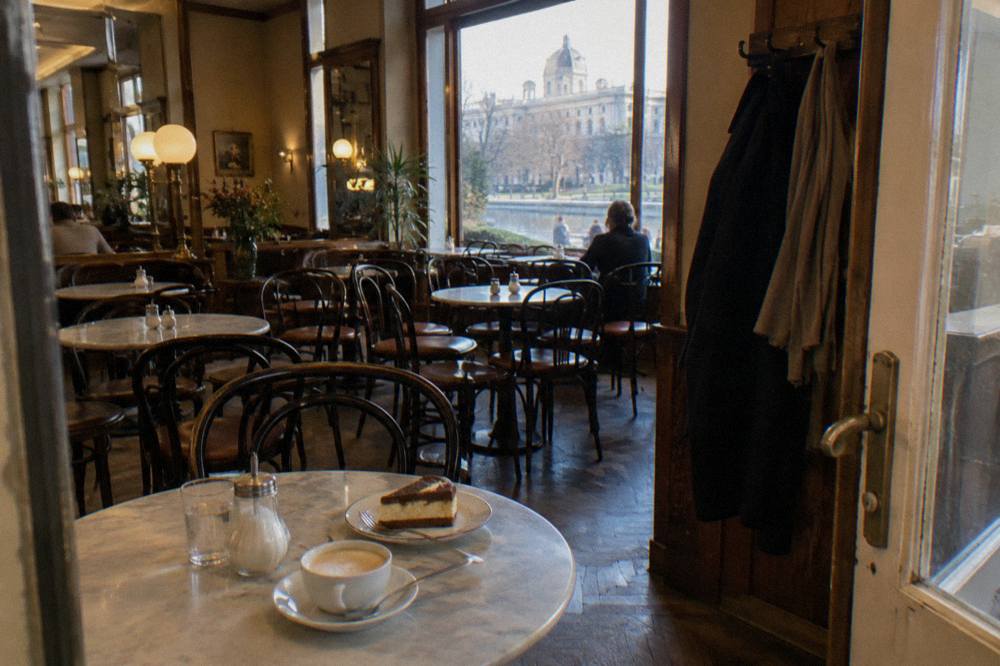
The classic houses are grand, high-ceilinged rooms, and the coffee house has long served as the city's second living room. The furniture follows a pattern visitors start recognising quickly: bentwood chairs, small marble tables, chandeliers, and card players in the corner. The point of the room is duration. A coffee house is designed so that time slows down inside it, with deep upholstery, dim light, and staff who consider it rude to bring the bill unasked.
The institution survives on a specific economic bargain. A Melange costs a few euros, and in exchange the house does not meter your stay. Writers, chess players, and students taking up a table for four hours with one small coffee are not abusing the system; they are the system. The Vienna Food Tours site exists partly because this culture is the single thing visitors most want decoded before their first visit.
What separates a real coffee house from a café that merely serves coffee? Locals point to a few markers: table service rather than counter ordering, a wide coffee menu with Austrian specialities, newspapers available, and interior space that predates the espresso-bar era. The tourist board maintains its own guide to the classic houses, and our best coffee houses in Vienna guide profiles the ones worth planning a trip around.
One historical footnote worth knowing: the Melange, the house coffee of Vienna, has been around long enough that its origins are argued about the way only old institutions are. What is not argued is that the coffee house was where Viennese newspapers were read, business was done, and famously, Trotsky and Freud held court in different rooms of the grand old houses. Café Central alone hosted enough political exiles to fill a history syllabus.
How Does Coffee House Etiquette Work In Vienna?
Coffee house etiquette in Vienna is built on three rules: you seat yourself, you order from the waiter who comes to the table, and you pay only when you ask for the bill. Tipping means rounding up or adding 0.50 to 1 euro at coffee houses, well below the 5 to 10 percent expected at restaurants, and table time is effectively unlimited with an order.
The first stumbling block is the door. There is no host station. Walk in, choose a free table, and sit down; the waiter has seen you and will come over. If the room is busy and tables are marked as reserved, respect the little signs, but otherwise the room is open seating. Water and a small welcome, if any come, arrive without charge in most houses, though Vienna venues may legally charge for tap water if the price is listed on the menu, so check the small print rather than assuming.
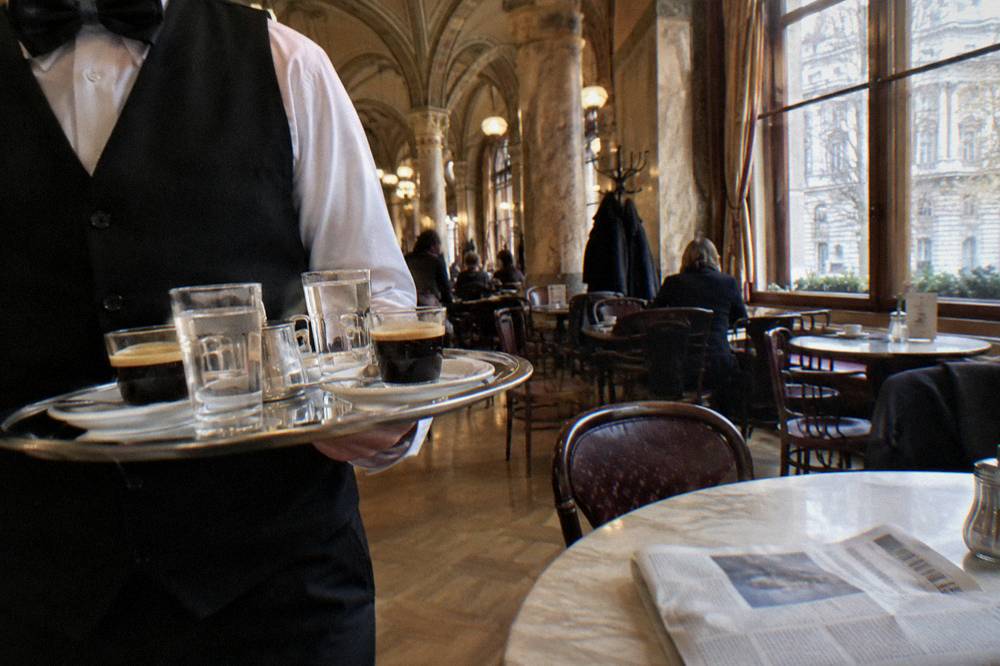
The waiter relationship is the heart of the ritual. Head waiters in the grand houses are professionals in the old sense, often in bow tie, sometimes famously brusque, and almost always faster than they first appear. Do not go to the counter to order, do not flag them down with a raised voice, and do not expect them to introduce themselves by name. A nod and "bitte" when you are ready is the whole protocol. If service feels curt by Anglo standards, that is style rather than hostility; the same waiter will remember your order on a second visit.
Paying is the part visitors get wrong most. The bill comes only on request: "zahlen, bitte" is the phrase, and it works in any house in the city. Say the total you want to pay including the tip, or say "stimmt so" (that is correct as it stands) to let the waiter keep the change. The Gedeck, a cover charge of 2 to 5 euros per person in traditional venues, is legal only if printed on the menu; if it appears, it covers bread and the table setting and is charged whether or not you touch them. Our tipping in Vienna guide covers the full arithmetic, and the restaurant etiquette rules on Gedeck and tap water overlap heavily with coffee house practice.
One more rule surprises smokers and vapers: Austrian gastronomy has been smoke-free indoors since 1 November 2019, under the federal smoking ban, and that applies to every guest area of a coffee house. The cigar-and-coffee image from old Vienna is now strictly a terrace affair.
If you would rather have all of this translated live, a guided format does exactly that. The Vienna coffee house walk below pairs a local guide with several stops, and it is the format we would point a first-time visitor toward.
Each of these walks covers the etiquette in the first stop, so the remaining stops feel like practice rather than a test. They differ mostly in length and emphasis: the guided Viennese coffee house tour is a three-hour deep dive on the institution itself, while the shorter coffee, cake and chocolate format compresses the same highlights into about two and a half hours for tighter schedules.
What Should You Order In A Vienna Coffee House?
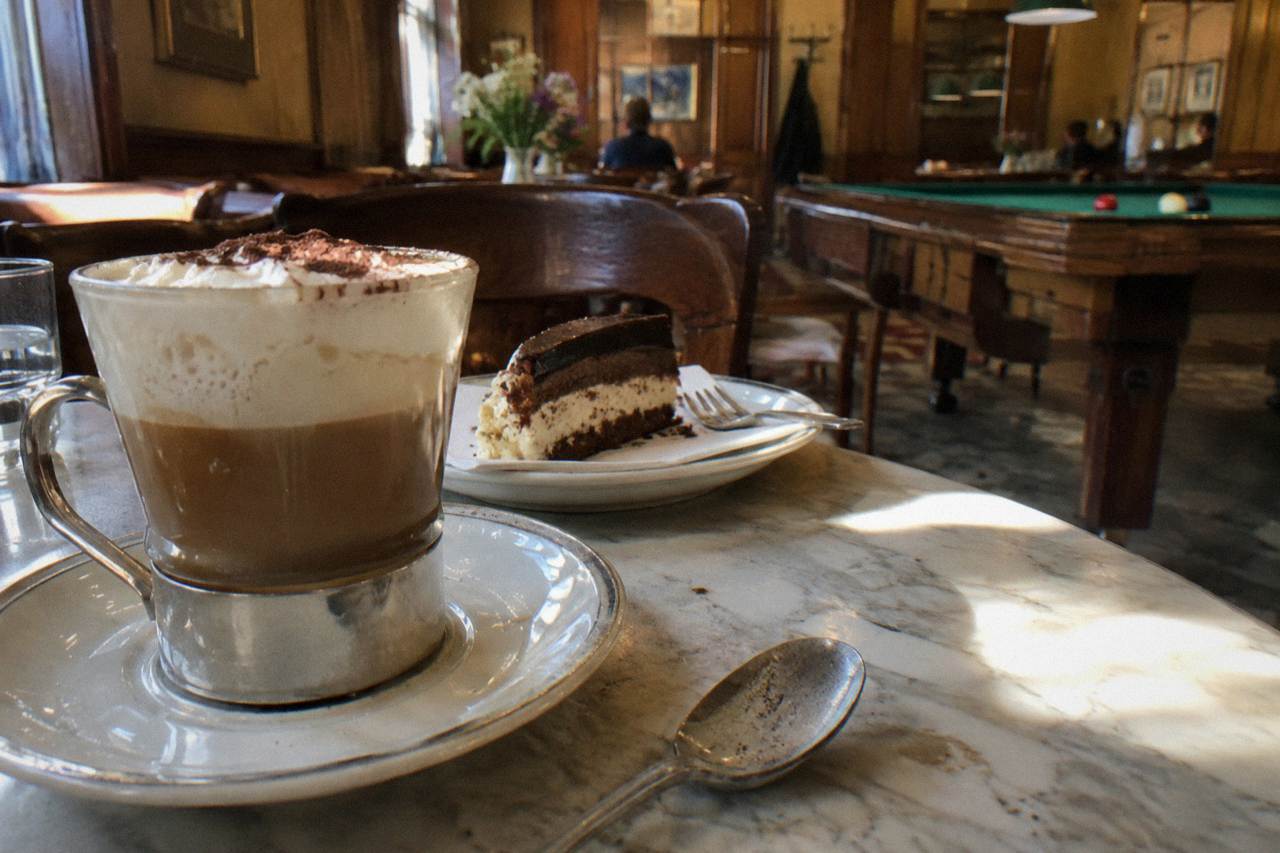
Order a Melange first: equal parts coffee and steamed milk, the house standard. The Einspaenner is the second classic, black coffee topped with whipped cream in a tall glass, traditionally drunk through the cream. Beyond those, the menu offers dozens of variations, and cake is not optional in practice: Sachertorte, Apfelstrudel and Kaiserschmarrn are the three to know. If you want to see how these coffee house staples fit into a full morning routine, the guide to a typical Viennese breakfast covers everything from Melange and cake to sausage stands.
The Melange is the reference point. Around 6.90 euros at classic houses like Landtmann, Museum and Schwarzenberg in recent menu data, it is the coffee Viennese locals order by default, and the one against which every house is judged. If you want it stronger, the kleiner Brauner is a small coffee with a splash of milk; the grosser Brauner is the same at double size. The Verlaengerter is an Americano in all but name.
The Einspaenner carries the best story: named for the one-horse carriages whose drivers supposedly needed a coffee they could carry, the cream cap keeps the coffee hot and the drink bitter-free until the last sip. Do not stir it. That is not a rule anyone will enforce, but the drink is built to be drunk through the cream, and stirring it marks you as someone who reads about coffee houses rather than sits in them.
| Coffee | What it is | When to order it |
|---|---|---|
| Melange | Coffee with steamed milk, the Viennese house standard | Your first coffee in any classic house |
| Einspaenner | Black coffee under a cap of whipped cream, served in a tall glass | When you want the full ritual, drink it through the cream |
| Kleiner Brauner | Small black coffee with a splash of milk | When the Melange is too milky for you |
| Grosser Brauner | The Brauner at double size | A longer, stronger sit |
| Verlaengerter | An extended black coffee, Vienna's Americano | When you just want a big cup of black coffee |
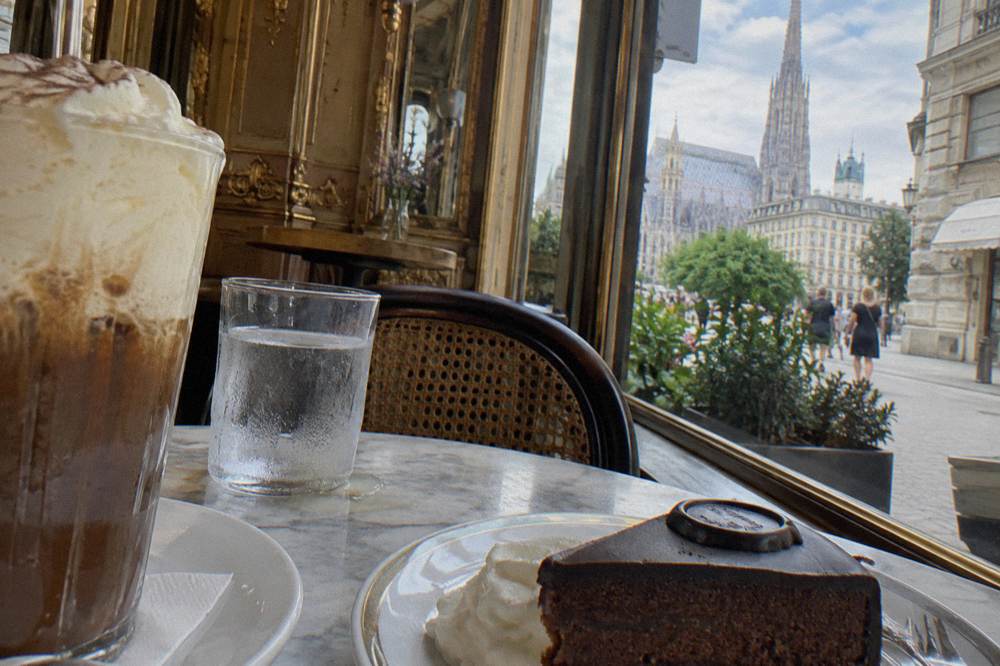
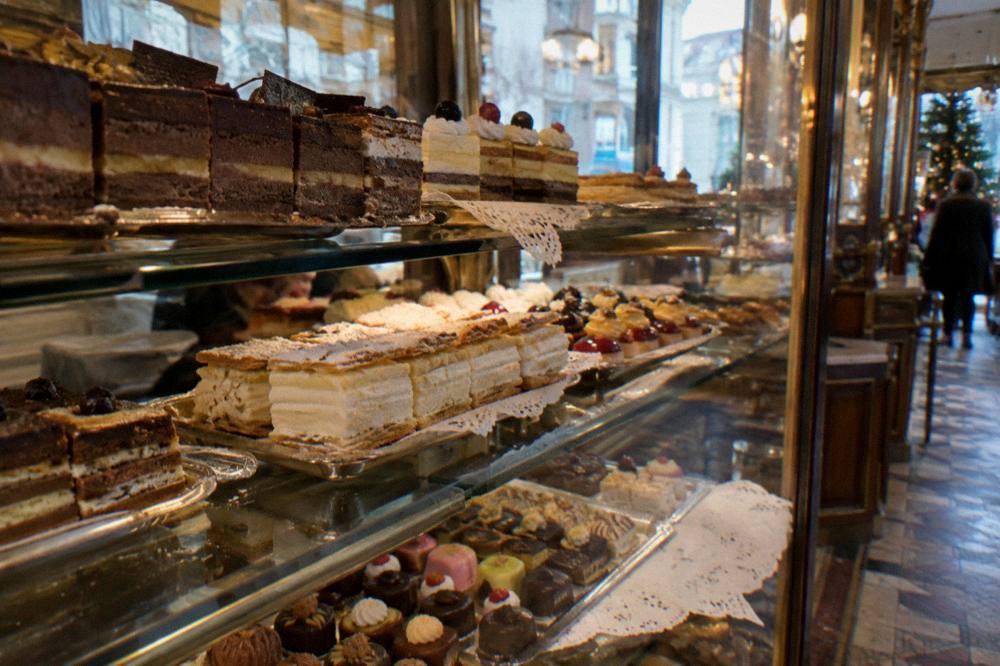
The cake order deserves its own paragraph of planning. Sachertorte, the dense chocolate cake with apricot jam, is the famous one, and the Hotel Sacher versus Demel rivalry over the "original" is a genuine legal distinction: Hotel Sacher holds the "Original" title with a seal and two apricot layers, Demel serves its rival version with a triangular seal and one layer. Apfelstrudel is the lighter choice, Kaiserschmarrn the shredded pancake you order when you have skipped lunch. Our Vienna cake and pastry guide sorts the whole counter, and the Sachertorte question gets a dedicated answer in Sachertorte or Demel: where to eat the cake.
Coffee house tours exist largely because the menu and the ritual are a lot to decode alone, and the coffee formats are where a guide pays for themselves fastest. The coffeehouse tour with pastries, bites and local stories runs about three and a half hours and builds the cake stops into the walk.
How Much Does Coffee And Cake Cost In Vienna?
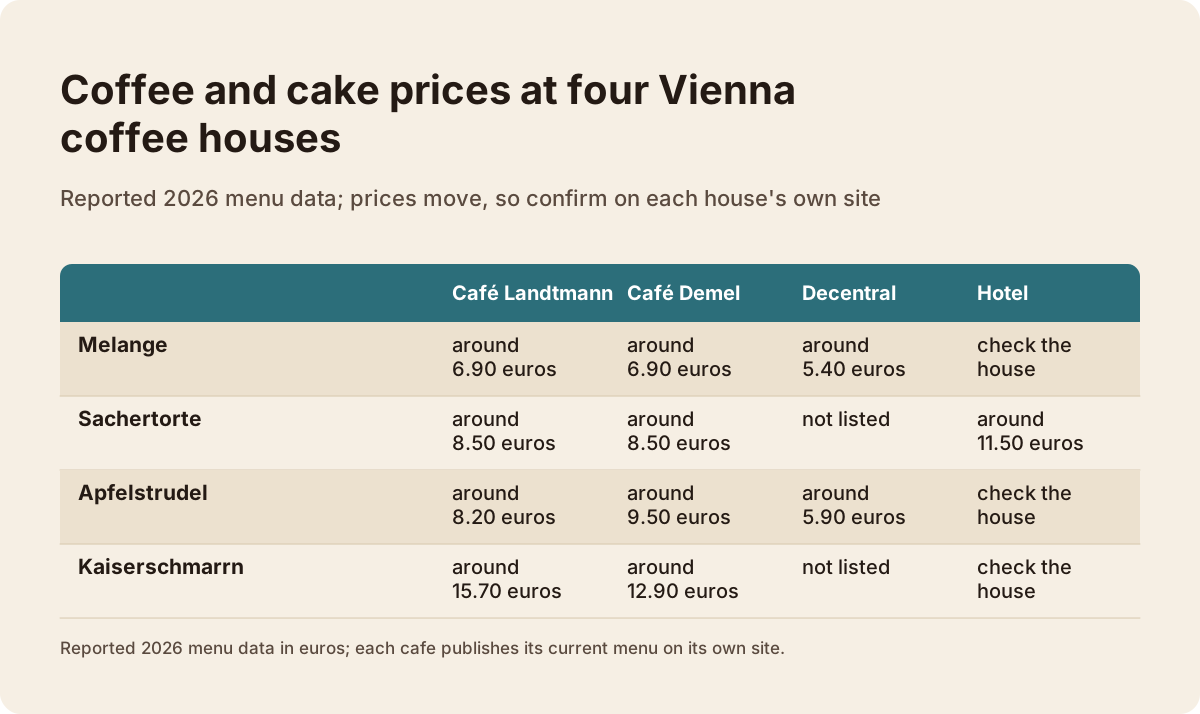
A Melange runs around 6.90 euros at the classic houses, with Sachertorte around 8.50 euros at Demel and Landtmann and up to about 11.50 euros for the Original at Hotel Sacher. Apfelstrudel runs around 8 to 9.50 euros and Kaiserschmarrn around 12.90 to 15.70 euros. All figures are reported menu data in euros, so treat them as planning ranges and check the menu.
The classic houses cluster tightly on coffee. Café Landtmann lists a Melange at 6.90 euros, Café Demel likewise, and the cluster around Landtmann, Museum and Schwarzenberg sits at the same level. The pop-up Decentral, operating while Café Central renovates, undercuts them slightly with a Melange at 5.40 euros and an Apfelstrudel at 5.90 euros, though pop-ups change fast.
| Item | Café Landtmann | Café Demel | Decentral pop-up | Hotel Sacher Café |
|---|---|---|---|---|
| Melange | around 6.90 euros | around 6.90 euros | around 5.40 euros | on the menu, check the house |
| Sachertorte | around 8.50 euros | around 8.50 euros | Not listed | around 11.50 euros, reported |
| Apfelstrudel | around 8.20 euros | around 9.50 euros | around 5.90 euros | on the menu, check the house |
| Kaiserschmarrn | around 15.70 euros | around 12.90 euros | Not listed | on the menu, check the house |
Two cautions on that table. First, every figure is reported menu data rather than a promise: prices move, and the named houses each publish current menus on their own sites. Second, the queue economics differ by venue: the Sacher café queue runs longest in afternoons, Demel typically shorter, and arriving early or after 16:00 is the standard advice for both. Landtmann accepts reservations; Demel generally does not, which makes Demel a walk-in gamble at peak cake hour.
A guided tour restructures this cost question. The coffee, cake and chocolate walk includes its tastings in the ticket price, which turns four separate café bills into one known number; the current price is on the operator's live listing. For a visitor planning three or four coffee house stops anyway, that arithmetic is worth doing before booking anything.
Is Café Central Open Right Now?
Café Central has been closed for major renovation since 16 March 2026, with reopening planned for winter 2026. Meanwhile it operates a pop-up called Decentral at Freyung 3, reported open daily from around 08:30 to 20:00, with a Melange at around 5.40 euros and Apfelstrudel at around 5.90 euros. Confirm current status on the café's own site before going.
This matters because Café Central is the one coffee house most visitors have heard of, the former home of chess-playing intellectuals and the poster venue for the whole heritage tradition. Planning a visit around its Herrengasse address right now means finding scaffolding. The reopening window is reported as November to December 2026, which is close enough to be tempting but not firm enough to book travel against; the café's own site is the only source that will tell you the day it reopens.
The Decentral pop-up is a genuine substitute rather than a stall in a lobby. It serves the classic menu in proper seating, and its reported prices actually undercut the grand houses. Freyung 3 sits a few minutes' walk from Herrengasse, so the detour costs almost no time if you were already in the inner city. Expect the pop-up to carry Central's queue profile too: it is the famous name in a smaller room.
The rest of the classic houses are unaffected. No verified closures have been reported for Demel, Hotel Sacher, Landtmann or Sperl, and their 2026 operations continue as normal, with the usual caveat that individual holiday hours should be checked. If your heart was set on the Central experience specifically, the advice is simple: go to Decentral now, and save the reopened main house for a return trip.
Can You Really Sit For Hours In A Vienna Coffee House?
Yes: unlimited table time with a single order is the defining feature of the institution, and the wait staff will not bring the bill until you ask for it. Newspapers on wooden sticks exist precisely for long stays. The social contract is that you order something, keep the table civil, and leave the seat eventually, but nobody meters the clock.
Visitors from café cultures where laptops have a ninety-minute limit sometimes struggle to believe this part. The coffee house evolved as a place where people without heated apartments spent the day, where journalists filed copy, and where a game of cards could outlast three coffees. That economics has not changed. The house makes its margin on the food and the tourists passing through, and the regulars reading Die Presse at 10:30 on a Tuesday are part of what the room is selling.
Practical limits still exist, mostly unwritten. If the house is packed and a queue is forming, ordering only one small coffee while occupying a six-top for three hours crosses from tradition into rudeness. Weekend afternoons at the famous houses are the wrong time to test the system. And if you want to work rather than lounge, the culture splits: grand houses tolerate laptops coolly, while modern third-wave cafés welcome them, a distinction our coffee house guides draw in more detail.
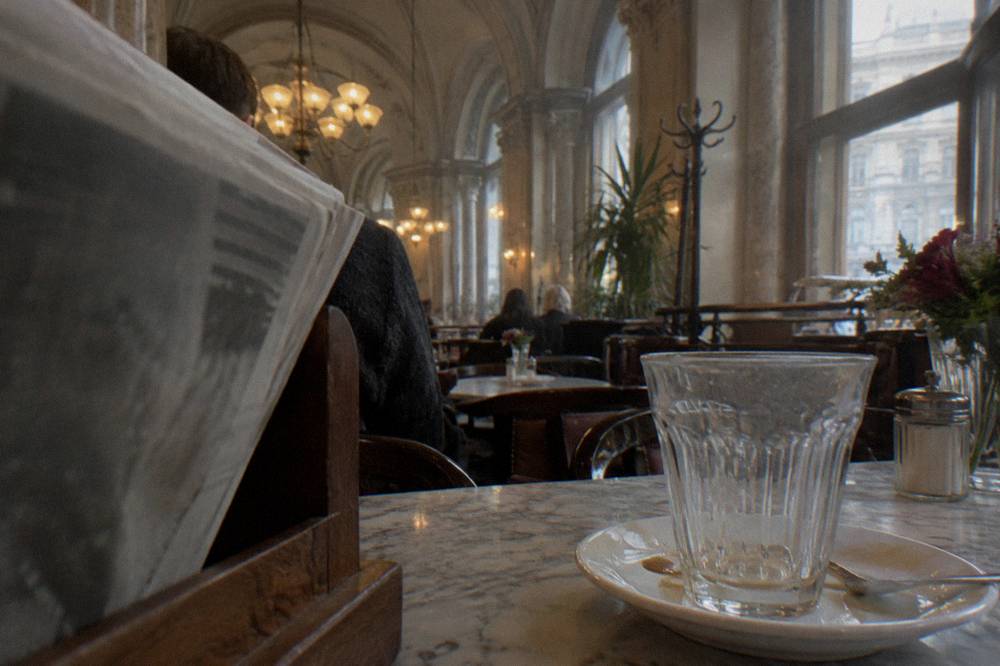
The long-stay tradition is also why the coffee house list on a Viennese menu runs to dozens of entries: the house assumes you are settling in and may want a second or third different drink. Working through that list is a legitimate afternoon plan, and one some visitors build a whole day around, pairing a morning Melange with an afternoon Einspaenner and a cake between.
Do You Need A Reservation For A Vienna Coffee House?
Mostly no: coffee houses operate open seating and you simply take a free table, which is why queues form at the famous names at peak times. Landtmann accepts reservations, and Demel generally does not, so walk-in timing is your tool there. Book ahead only for groups, weekend afternoons, or a specific famous house at cake hour.
The reservation question splits the houses into three groups. The first is reservation-friendly: Landtmann takes bookings, as do several of the larger grand houses, and a reservation makes sense for a group of four or more. The second is walk-in only, Demel being the notable case, where early arrival or a post-16:00 slot is the practical strategy. The third is the famous-café queue, Hotel Sacher's café chief among them, where the line itself is part of the experience nobody enjoys.
| House | Reservations | Queue profile | Best strategy |
|---|---|---|---|
| Café Landtmann | Accepts reservations | Moderate at peak | Book for groups, walk in off-peak |
| Café Demel | Generally does not | Typically shorter than Sacher | Arrive early or after 16:00 |
| Hotel Sacher Café | Check with the house | Longest in afternoons | Arrive early or after 16:00 |
| Decentral pop-up (Central) | Walk-in | Famous name in a smaller room | Expect a wait at peak times |
Weekend afternoons are the pinch point everywhere. Saturday between 15:00 and 17:00 at any house on the tourist circuit means waiting, and Sunday compounds it because Austrian retail closes on Sundays, pushing more locals into coffee houses too. A weekday morning at 09:00, by contrast, gets you the room nearly to yourself, newspapers untouched, waiters unhurried.
This is another spot where a guided format quietly solves the problem. Organised coffee walks time their stops off-peak and walk past queues, and the guides handle the table politics. Whether that is worth a ticket price depends on how many houses you plan to visit; one leisurely Landtmann afternoon needs no help, while a mission to hit four houses in a day benefits from someone who knows the door times.
Should You Book A Guided Coffee House Tour In Vienna?
A guided coffee house tour makes sense if you want the etiquette, history and menu decoded at the table rather than researched in advance; the guided walks run roughly two and a half to three and a half hours and include tastings in the ticket. Independent visitors who plan one long coffee house afternoon can skip a tour and still have an excellent time.
The case for a guide is informational, not logistical. Anyone can walk into Landtmann and order a Melange. What a guide adds is the layer a menu cannot: which house invented which coffee, why the bill comes only on request, what the Gedeck on the menu means, and which of the cakes in the vitrine is worth the calories. That is the difference between visiting a coffee house and understanding one, and it is the specific gap the coffee house formats on this site fill.
The counter-case is honest too. Vienna's coffee houses are not gatekept. A visitor who reads this guide, picks one house, and commits to a slow afternoon with a newspaper will experience the core of the tradition for the price of a Melange and a slice. The tour is for visitors who want multiple houses, multiple stories, and someone to answer questions in between, or whose time budget is too short for trial and error.
For travellers combining the coffee house ritual with the wider food scene, note that the longer city food walks also include coffee house stops among their market and street food visits; the flagship five-and-a-half-hour walk we cover in which Vienna food walk you should book folds coffee houses, markets and lunch into one ticket.
Dietary needs deserve one flag: tour listings that state a vegetarian lunch option exist for some food walks, but none of the coffee formats states a vegan or gluten-free option, so message the operator before booking if that matters to you, and check the booking page for current meeting points and inclusions.
If you are still weighing formats, the three walks below cover the same core tradition at different depths and durations, and each carries the same tasting-led approach to the ritual.
Common Questions About Vienna Coffee House Culture
What Is A Vienna Coffee House?
A full-service institution with waiter service, marble tables and newspapers, designed for long stays rather than quick coffee. The tradition is recognised on Austria's national inventory of intangible cultural heritage (2011) and cited by the Vienna Tourist Board as UNESCO heritage.
How Does Coffee House Etiquette Work In Vienna?
You seat yourself, order from the waiter at the table, and pay only when you ask for the bill with "zahlen, bitte". Tip by rounding up or adding 0.50 to 1 euro, and never go to the counter to order.
What Should You Order In A Vienna Coffee House?
A Melange, the house coffee of equal parts coffee and steamed milk, or an Einspaenner, black coffee under a cap of whipped cream served in a tall glass. Add a slice of Sachertorte, Apfelstrudel or Kaiserschmarrn.
How Much Does Coffee And Cake Cost In Vienna?
Around 6.90 euros for a Melange at the classic houses, with Sachertorte around 8.50 euros at Demel and Landtmann and about 11.50 euros for the Original at Hotel Sacher, all reported menu data; check the menu at each house.
Is Café Central Open Right Now?
No. It has been closed for major renovation since 16 March 2026, with reopening planned for winter 2026, and a pop-up called Decentral operates at Freyung 3 meanwhile. Confirm on the café's own site before visiting.
Can You Really Sit For Hours In A Vienna Coffee House?
Yes. Unlimited table time with an order is the core social contract, and the bill arrives only on request. Avoid testing the system at peak weekend times or with a large table and a single small coffee.