Heuriger In Vienna: A Visitor's Guide To The Wine Taverns
A Heuriger is a Vienna wine tavern serving its own wine with simple food, and finding a good one means reading pine bushes, buffet counters and tram timetables.
Short answer
A Heuriger is a wine tavern licensed to pour only wine from its own vineyards, marked by a pine bush and an Ausg'steckt sign. Around 100 still operate across Vienna, from Grinzing to Stammersdorf, most opening irregularly and many closing or cutting hours from November to March.
The pine bush over the door is the whole system. When a Vienna wine tavern hangs out its branch of greenery and its "Ausg'steckt" sign, it is open, and the wine inside comes from the tavern's own vineyards, poured beside cold buffets, bread baskets and long wooden tables full of locals. Roughly 100 of these Buschenschanken, the formal name for licensed Heuriger establishments, were still operating, down from past decades but far from extinct. This guide explains how they work, which district suits which kind of evening, how to get there and what the seasons change, in plain terms, with the numbers that can actually be verified.
What Is A Heuriger In Vienna?
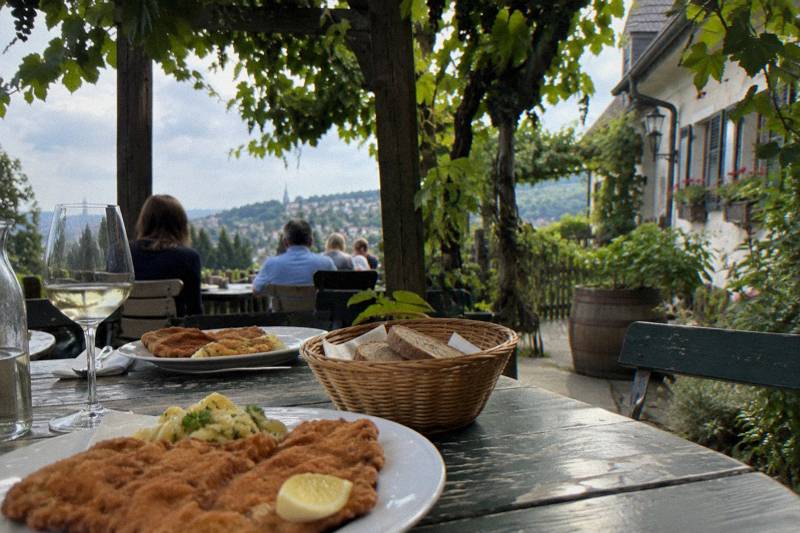
A Heuriger is a wine tavern in Vienna where, by the official definition, only wine grown and pressed from the establishment's own vineyards may be served. Alongside this house wine, guests are offered simple cold food and, in some cases, hot dishes as well, making the Heuriger a distinctly local way to drink and dine. The Vienna Tourist Board's own page on Viennese Heurige sets that rule out plainly: own-vineyard wine only, no bought-in bottles, recognisable by the pine or fir bush and the "Ausg'steckt" sign that doubles as an open signal. It is a working winery's tasting room with tables, not a restaurant with a wine list. If you're wondering where to find one and what a visit actually costs, the complete visitor's guide to Vienna's wine taverns walks through the practical side, from season to setting.
The word carries a second meaning that trips up visitors. "Heurige" also names the current vintage: the young wine of this year's harvest, which may legally be called Heuriger only until 11 November, St Martin's Day. After that date it becomes "Alter", last year's wine, and a fresh Heuriger takes over the title. So a tavern can be a Heuriger (the place) serving Heuriger (the young wine) or, from mid-November, the same place serving Alter.
The culture around it runs deep. The Vienna Tourist Board lists Heuriger culture as UNESCO intangible heritage alongside the Viennese sausage stand and coffee house culture, in the page's own wording. Whether you come for the sociology or the Achtel, the format is the same: you arrive, you take a plate at the buffet, you pay by what you took, and you drink the house wine by the eighth of a litre. Heuriger culture is one of the few working-class dining traditions Vienna has kept continuously, and the districts where it lives are still on working tram and bus lines, not museumified into a heritage zone. For the wider wine picture in the city, from cellars to tastings, the Vienna Food Tours site covers the bookable side of Vienna wine in depth.
How Do You Know A Heuriger Is Open In Vienna?
You check the bush first, then the sign, then the calendar, always in that order: a Heuriger hangs out a bush or branch to announce it is open and pouring, so if nothing is displayed over the door you can assume it is closed, and only then do you fall back on reading the posted sign and checking the calendar for its current serving dates. The pine or fir "Buschen" over the entrance plus an "Ausg'steckt is'" sign means the tavern is serving that day; no bush, no service. The catch is that genuine Heurigen open irregularly and seasonally, a few days a week or a few weeks a season, and there is no single city-wide opening board, which is why locals rely on the Ausgsteckt calendars published by the Vienna Woods region and by the taverns themselves.
The pattern matters for planning. Many traditional Buschenschank reduce hours or close entirely between November and March, while the larger, more tourist-oriented spots in Grinzing and Nussdorf stay open year-round. A September report counted about 100 still operating across Vienna, a decline the Austrian press calls "Heurigensterben", though taverns in Mauer and Oberlaa were reported as bucking the trend with strong demand. The 40th-anniversary celebrations at Heuriger Zur Christl on the Stammersdorfer Kellergasse in May 2026, and a Kirtag festival in Neustift am Walde that drew roughly 100,000 visitors over six days in August, show the tradition still draws crowds when it opens.
Two practical rules follow. First, never promise yourself a specific tavern on a specific evening without checking its own opening days for that week; the bush goes up and comes down with the family's schedule, not a fixed rota. Second, in the city's wine-hiking season the calculus changes: the Vienna Wine Hiking Day of 26 and 27 September 2026 sent walkers past open wineries on four routes with tastings from 10:00 to 18:00, and that event is now past, so it helps nothing for a November trip. If your dates fall in the deep winter window, aim your evening at the bigger Grinzing and Nussdorf names rather than a one-family Kellergasse tavern that may be shuttered until spring.
How Does The Buffet System At A Vienna Heuriger Work?
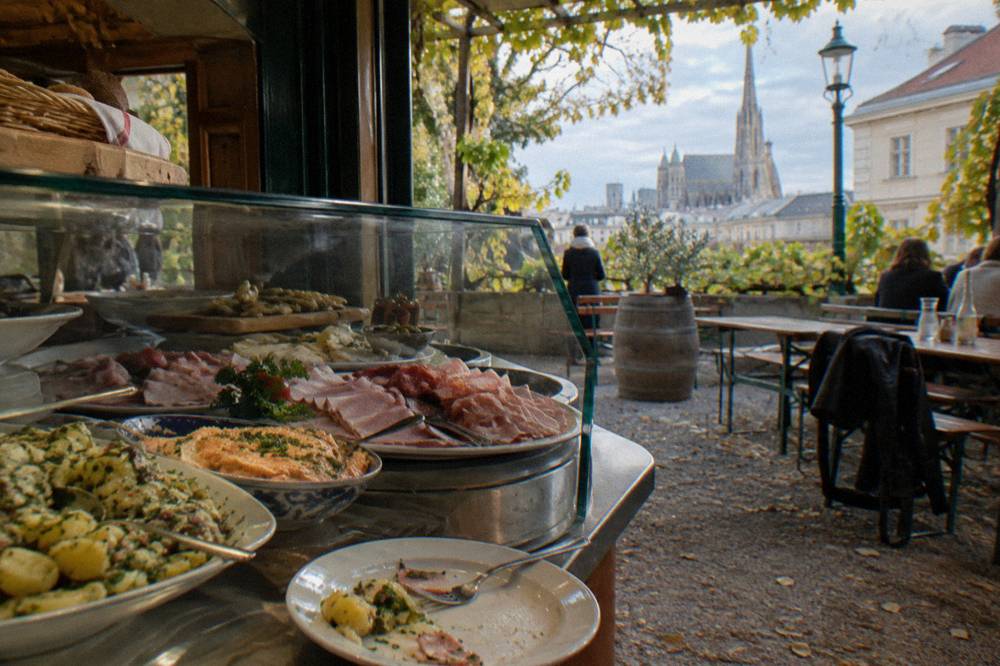
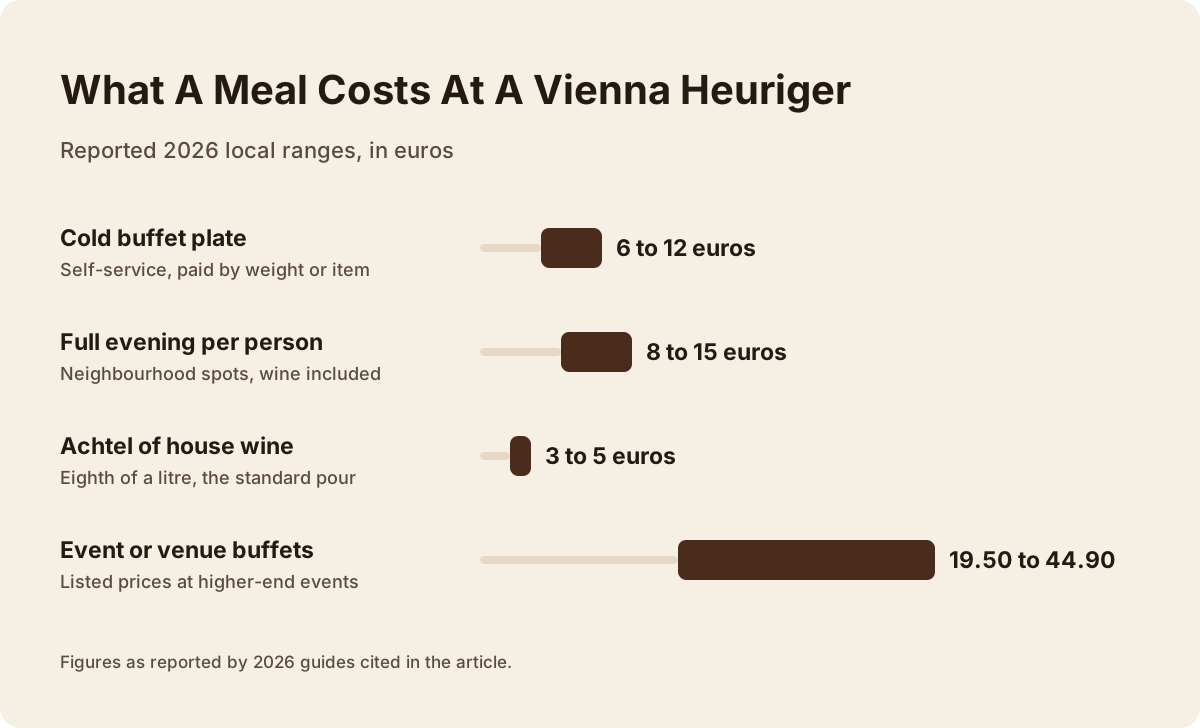
You take a plate, load it at a self-service cold buffet of spreads, salads, bread and cold meats, and pay by weight or by item, with a typical local plate running around 6 to 12 euros and an eighth of wine around 3 to 5 euros, all as reported by 2026 guides. There is no waiter bringing a menu of dishes. Some taverns add hot specials, schnitzel or a roast, but the core is the buffet, and the etiquette is to clear your own table in many places, dropping plates at the rack by the kitchen on your way out.
The 2026 price norms are worth knowing before you load the plate, because first-time visitors routinely over-order. Reported local patterns: a self-service cold plate at a neighbourhood spot lands around 6 to 12 euros, an evening's total around 8 to 15 euros per person, an Achtel (an eighth of a litre) of wine around 3 to 5 euros, and larger, tourist-oriented or event buffets climbing to listed prices of 19.50 to 44.90 euros per person at some venues. These are planning ranges from reported 2026 guides, not promises: the actual price is whatever the scale and the menu in front of you say.
| What you order | Reported local range | Notes |
|---|---|---|
| Cold buffet plate | around 6 to 12 euros | Self-service, paid by weight or item |
| Full evening per person | around 8 to 15 euros | Neighbourhood spots, wine included |
| Achtel of house wine | around 3 to 5 euros | Eighth of a litre, the standard pour |
| Event or venue buffets | 19.50 to 44.90 euros listed | Higher-end or organised events |
The wine you should be drinking alongside it is Wiener Gemischter Satz, Vienna's signature field blend, and it now has legal teeth. A consolidated EU-protected ordinance for "Wiener Gemischter Satz" confirms the rules: the wine must come from registered Vienna vineyards, blend at least three grape varieties with no single variety above 50 percent and a third variety at least 10 percent, cap label alcohol at 12.5 percent, and not be sold to consumers before 1 December of the harvest year. In plain terms, the fresh Gemischter Satz you drink in autumn is last year's harvest, and the tavern pouring it is pouring a wine that could not legally exist as a blend from anywhere else. For what to actually eat with it, the traditional Viennese dishes guide covers the classics that show up on Heuriger tables.
The one thing a Heuriger evening cannot give you is a guide. Reading the buffet, choosing between a Riesling and a Gemischter Satz, and knowing which Kellergasse is worth the tram ride are exactly the gaps a guided wine tasting fills, and the three experiences above are the nearest bookable options to a Heuriger evening: a half-day countryside wine tour with a meal and pickup, a Vienna Forest tour with an underground lake and wine tasting, and a city wine tasting walk. None of them is described as a visit to a Heuriger, and none should be booked as one; they are wine experiences with transport, guidance and tastings handled for you, with full details, prices and inclusions on each booking page.
Grinzing Or Stammersdorf: Which Heuriger Area Should You Visit?
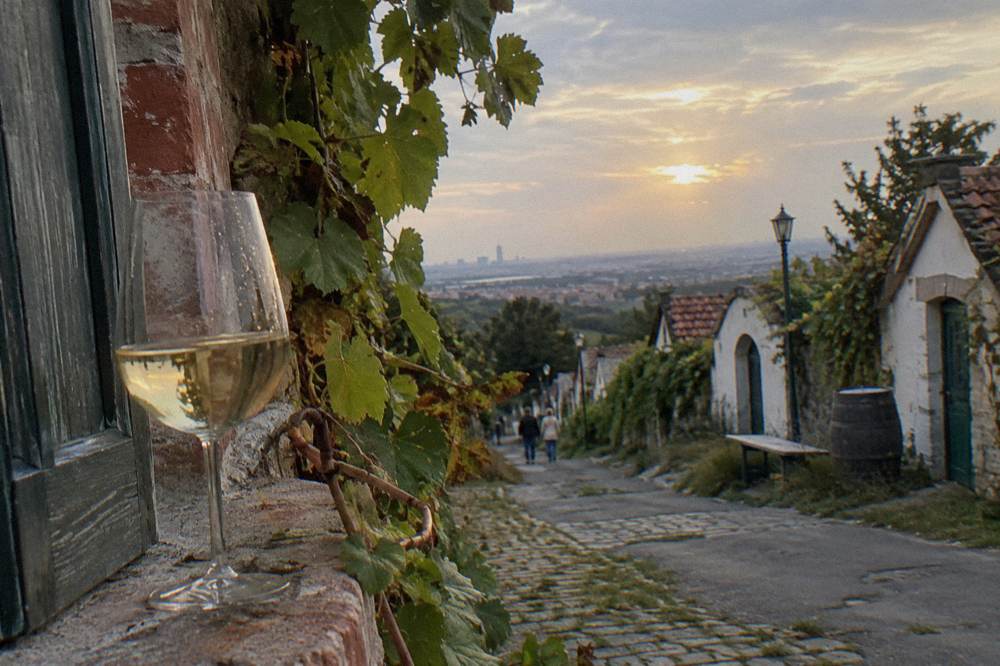
Grinzing is the famous, tourist-heavy, year-round option, sitting on tram and bus lines close to the centre, which makes it the practical pick for most visitors. Stammersdorf, further out in the 21st district, offers the quieter, more local Kellergasse scene instead, so choose it if you would rather trade convenience for a slower, more neighbourhood feel. The Vienna Tourist Board names the wine districts plainly: Grinzing, Nussdorf, Neustift am Walde, Heiligenstadt and Sievering in the north; Ottakring, Hernals and Oberlaa elsewhere; and Stammersdorf and Strebersdorf, with Mauer, completing the map. Vienna's vineyard area stands at 588 hectares across 172 wineries, with 33 percent farmed organically, clustered in Döbling (48 percent) and Floridsdorf (38 percent).
| District | Character | Best for | Watch out for |
|---|---|---|---|
| Grinzing (19th) | Famous, busy, many large year-round taverns | First visit, evening without planning | Most tourist-oriented, priciest |
| Nussdorf and Heiligenstadt (19th) | Village lanes, the Danube canal walk in | A shorter evening close to the centre | Smaller opening rosters |
| Neustift am Walde (19th) | Wine village with a strong festival calendar | Weekend Kirtag season | Quiet on weekdays off-season |
| Stammersdorf and Strebersdorf (21st) | Kellergasse cellar lanes, local crowd | A local-feeling afternoon | Further out, many winter closures |
| Mauer and Oberlaa (23rd) | Reported strong demand, fewer visitors | Escaping the crowds | Least publicised in English |
The honest framing: Grinzing is where Vienna takes its visitors and where the buses go, and it is genuinely good, just busy. Stammersdorf is where Viennese families spend a Sunday afternoon walking the Kellergasse, the lane of wine cellars, and eating at taverns that may open only weekends. The 2026 harvest report gives the year's flavour either way: heat and dryness cut Vienna's yield by 30 to 40 percent, but the quality of the 2026 vintage, including the Gemischter Satz, was described as very good to exceptionally good, so what is in your glass this season is scarce but strong.
A question worth asking yourself before you commit an evening: do you want to work out the tram, the buffet and the opening calendar yourself, or would you rather someone drove you out, fed you and poured the wine? The half-day countryside wine tour from Vienna pairs a meal, pickup and tastings in one outing, and for many visitors it answers the question in a way a self-planned Kellergasse afternoon cannot. Its price, meeting point and exact inclusions are on the booking page, and the operator's cancellation terms are listed there too, so check them before you book rather than after.
How Do You Get To Vienna's Heuriger Districts?
Getting to Vienna's Heuriger districts is easy because public transport reaches every wine district: tram D takes you to Nussdorf, bus 35A serves Neustift am Walde, bus 38A or tram 38 connects to Grinzing, and tram 31 runs to Stammersdorf, as reported by 2026 guides. No Heuriger village requires a car, and after an evening of Achtel you should not be driving one anyway. The rides from the centre run roughly 30 to 50 minutes depending on the district, with the northern Döbling villages closest and Stammersdorf the longest haul.
| Destination | Line | Notes |
|---|---|---|
| Nussdorf | Tram D | Ends in the wine village itself |
| Grinzing | Bus 38A or tram 38 | Most frequent, most visitors |
| Neustift am Walde | Bus 35A | Terminus by the wine village |
| Stammersdorf | Tram 31 | For the Kellergasse cellar lanes |
Two planning notes from the 2026 transport picture. Construction on Vienna's rail and tram network is causing ongoing diversions and replacement services into 2027, so a line that ran last month may be partly replaced this month; the transport operator's live journey planner is the only reliable check on the night. And if you are building a wider food itinerary around the wine villages, the getting around Vienna transport guide explains the ticket types, and the where to stay for food lovers guide helps you pick a base that shortens the ride home from the Kellergasse.
If the tram map already feels like homework, the Vienna Forest tour is the middle path: a 4 hour 30 minute outing that pairs the Vienna Woods with an underground lake and a wine tasting, described only as the listing describes it. It is not a Heuriger visit, no tour listed here is, but it reaches wine country without you reading a single timetable. Price, departure point and inclusions are on the booking page.
What Is Sturm Season In Vienna?
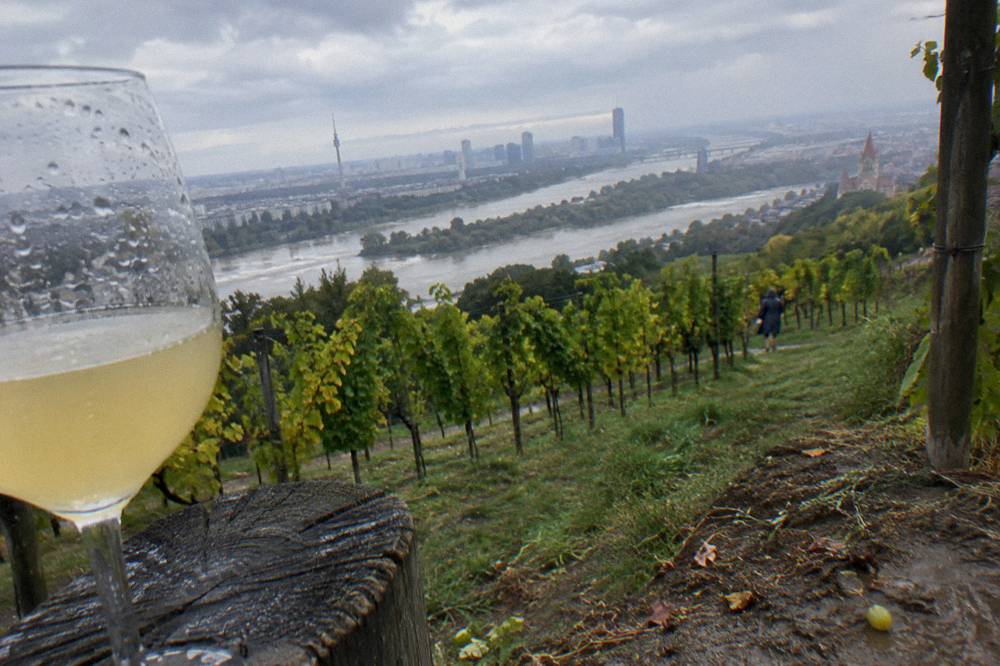
Sturm season is the brief stretch, typically September and October, when the cloudy, sweet, fizzy partially fermented grape must is sold in Vienna. Because it appears only for a short time and is traditionally drunk fresh, enjoying a glass of Sturm is a quick seasonal ritual rather than a year-round drink. It sits between juice and wine: still fermenting, lightly alcoholic, and shipped to taverns within days of the press. By the time the stable young wine is ready, the Sturm is gone, and asking for it in November marks you as a visitor instantly.
The 2026 season fit the classic window. Stammersdorf's Kellergasse held weekend Sturm events through September and October, and the harvest itself came early this year, with picking already underway at the Schwarzenbergplatz demonstration vineyard in the first days of September thanks to the hot, dry summer. That same weather cut the citywide yield by up to 40 percent while pushing quality up, so the 2026 Sturm was scarcer and reportedly better than usual. If you are chasing it in a future year, plan for late September and the first half of October, aim at the northern wine villages, and treat any Sturm you find after that window with suspicion.
When Is The Best Time Of Year For A Heuriger Visit In Vienna?
May through early October is the best window for a Heuriger visit in Vienna, and September is the true peak, when new wine and Sturm arrive, evenings stay warm, and opening rosters are at their fullest. From November to March, many taverns partially close, so check each one ahead of your visit. The deep winter is not a total loss, the bigger Grinzing and Nussdorf taverns keep the lights on and some family places open specific winter blocks, but the odds of walking up to a closed pine bush rise sharply once the clocks change.
| Season | What to expect |
|---|---|
| May to June | Vines green, taverns on summer hours, festivals begin |
| July to August | Beer festivals and Kirtag season in the wine villages |
| September | Peak: harvest, Sturm, Wine Hiking Day, fullest rosters |
| October | Late Sturm, autumn walks, Gemischter Satz releases approach |
| November to March | Many closures; the 11 November Heuriger-to-Alter shift |
The calendar has its fixed markers. The young wine legally stops being "Heuriger" on 11 November and becomes Alter, which is also roughly when the winter closures bite. Vienna's 2026 Wine Hiking Day, four routes through the vineyards with free entry and paid tastings, ran 26 and 27 September and is now past. For planning a trip around the whole food calendar, not just the wine villages, the best time to visit Vienna for food guide breaks the year down month by month.
Can You Book A Guided Wine Experience Near Vienna?
Yes, but none of the bookable experiences is a Heuriger visit: the nearest options are a half-day countryside wine tour with meal and pickup, a Vienna Forest tour with an underground lake and tasting, a city wine tasting walk, and longer Vienna Woods and Wachau Valley day trips. That is the honest limit of the market, and it matters. The pine-bush evening is a do-it-yourself tradition; what you can book is transport-plus-tasting in various shapes, all described on their own booking pages with exact prices, meeting points and inclusions.
| Experience | Length | What it is |
|---|---|---|
| Half-day countryside wine tour with meal and pickup | 4 hours | Countryside winery tasting with a meal, hotel pickup as listed |
| Vienna Forest tour with underground lake and wine tasting | 4 hours 30 minutes | Vienna Woods sights, lake visit, wine tasting |
| Vienna wine tasting walk | 2 hours 30 minutes | City tasting walk |
| Vienna Woods wine tour | 8 hours | Full-day wine country outing |
| Wachau Valley small-group tour with wine tasting | 8 hours 30 minutes | Danube valley day trip with tasting |
For context on the wider field, the Vienna wine tasting and wine tour options guide compares the formats in detail. A useful division of labour for a longer trip is one guided wine day plus one self-directed Heuriger evening: the tour teaches you what Gemischter Satz, Riesling and the Wachau's Grüner Veltliner taste like, and the pine-bush evening lets you use that knowledge on your own plate. Check dietary needs with the operator before booking any of them; a message before you pay saves a wasted evening.
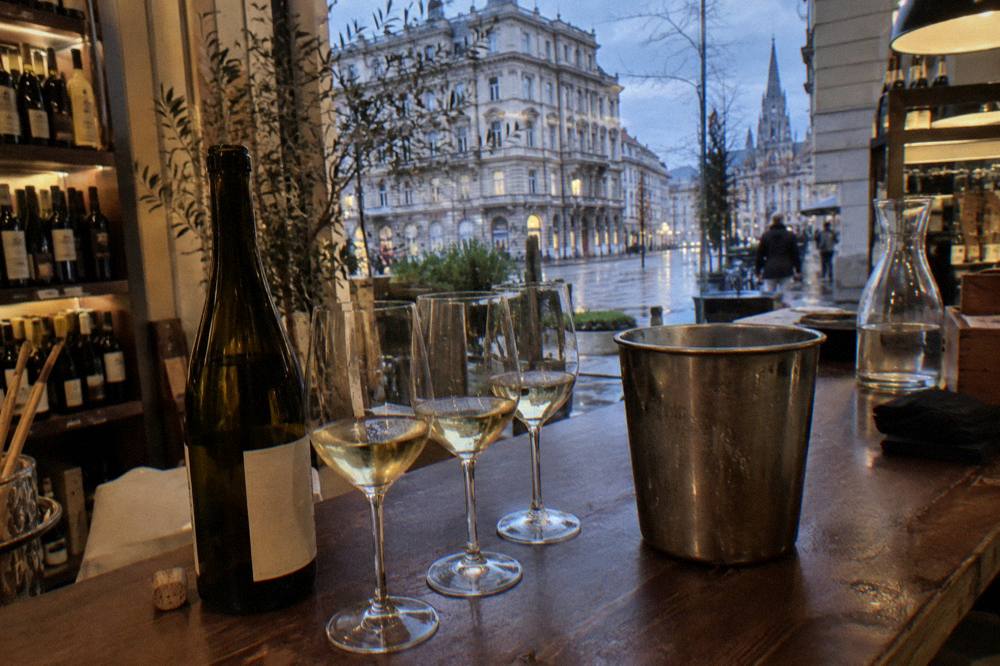
The 2 hour 30 minute city wine tasting walk is the low-commitment version, an evening-format tasting without a vineyard in sight. It suits a trip where the wine villages are a maybe rather than a plan. Details are on the booking page.
For a sit-down introduction to Austrian wine in general, the 2 hour Austrian Wine Tasting covers the national picture beyond Vienna's own vines, which is useful before you choose what to order at a buffet. Again, price and venue are on the booking page, not guessed here.
Common Questions About Vienna Heuriger Evenings
What Does "Ausg'steckt" Mean At A Vienna Heuriger?
The "Ausg'steckt is'" sign, hung with a pine or fir bush over the door, signals that the tavern is open and serving. No bush and no sign means closed that day.
Can Any Wine Be Served At A Heuriger?
No. By the official tourist-board definition, a genuine Viennese Heuriger serves only wine from its own vineyards, which is what separates it from a restaurant with a wine list.
How Much Does An Evening At A Heuriger Cost?
Reported 2026 local norms run around 6 to 12 euros for a cold buffet plate, 3 to 5 euros for an Achtel of wine, and 8 to 15 euros per person for a full neighbourhood evening. Event and venue buffets list higher prices; check the menu on site.
Which Heuriger District Is Easiest To Reach?
The northern Döbling villages: tram D to Nussdorf, bus 38A or tram 38 to Grinzing, and bus 35A to Neustift am Walde. Stammersdorf, on tram 31, is further out.
Are Heurigen Open In Winter?
Many reduce hours or close from November to March. The larger Grinzing and Nussdorf taverns stay open year-round; smaller family places open specific winter blocks only, so check before you go.
Can You Book A Tour That Visits A Heuriger?
No bookable experience on this site is described as a Heuriger visit. The nearest options are guided wine tastings and countryside wine tours with meals and transport, as described on their booking pages.