Vienna Cake And Pastry Guide: Sachertorte, Strudel, Kaiserschmarrn
Vienna bakes three famous desserts that every visitor asks about, plus a whole cabinet of pastries most visitors never order. Here is what each one is, what it should cost, and where the bakers themselves say it is done best.
Short answer
Sachertorte is a dense chocolate cake with apricot jam, Apfelstrudel is a thin pastry roll of spiced apples, and Kaiserschmarrn is a torn pancake served with plum compote. Slices run around 8.50 to 11.50 euros at the classic houses, with a Melange at around 6.90 euros. A guided tasting walk bundles several stops.
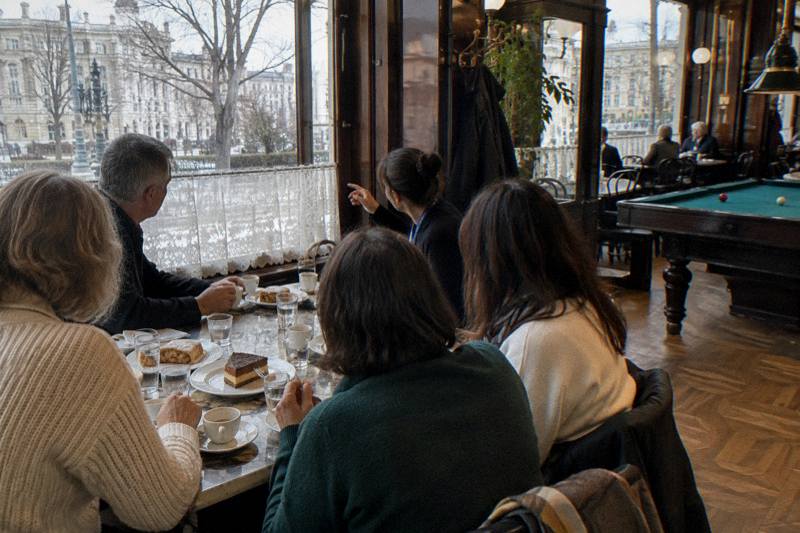
Vienna treats cake as a civic institution rather than a dessert course. The coffee house itself is recognised on Austria's national inventory of intangible cultural heritage, inscribed in 2011, and the ritual that surrounds the cake, the newspaper, the glass of water, the waiter who never hurries you, matters as much as the slice. That heritage framing is worth knowing because it explains the pricing and the etiquette that surprise first-time visitors. This Vienna Food Tours guide walks through the three cakes everyone asks about, the pastries locals actually queue for, and the honest costs of both.
Sachertorte, Apfelstrudel and Kaiserschmarrn. Each has a distinct history, a distinct serving style and a distinct price band. Around them sits a second tier, Topfengolatschen, Gugelhupf, Buchteln, that rarely makes an English-language menu translation but fills the display cases of every serious Konditorei. We cover both tiers, plus how a tasting tour can save you three days of trial and error.
| Cake | What It Is | How It Is Served | Typical Venue |
|---|---|---|---|
| Sachertorte | Dense chocolate sponge with apricot jam, dark chocolate glaze | Cold slice with unsweetened whipped cream | Coffee houses, the Hotel Sacher cafe |
| Apfelstrudel | Thin stretched pastry roll with spiced apples, raisins, cinnamon | Warm, sliced, with vanilla sauce or cream | Coffee houses and alpine-style kitchens |
| Kaiserschmarrn | Thick torn pancake, caramelised in butter | Hot from the pan, icing sugar, plum or apple compote | Beisl taverns and coffee houses |
What Is Sachertorte And Where Did It Come From?
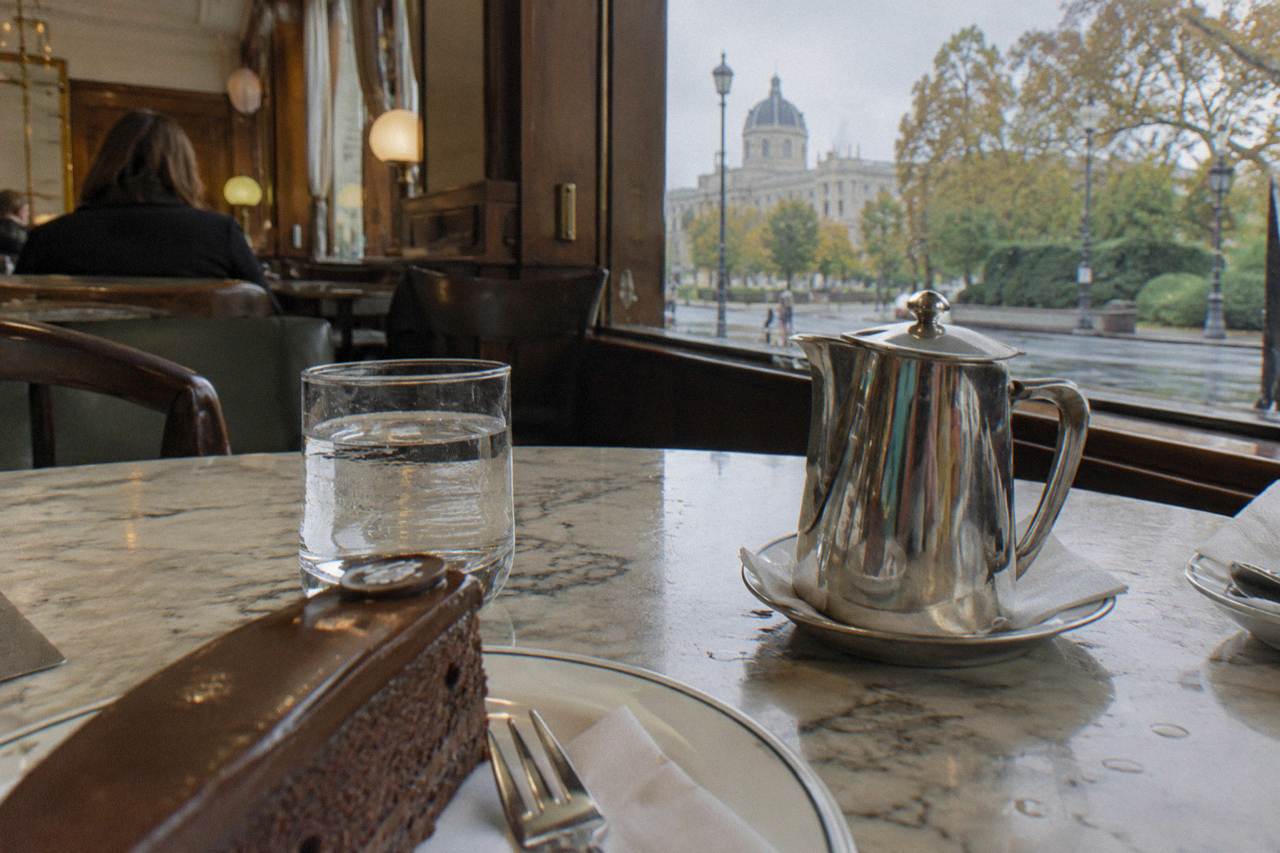
Sachertorte is a dense chocolate sponge cake, glazed in dark chocolate and layered with apricot jam, created in Vienna for Prince Metternich's household. It is heavier and less sweet than most visitors expect, and it is served with a dollop of unsweetened whipped cream on the side. Two rival houses still sell competing versions of it. The cake's origin story is the famous part: an apprentice named Franz Sacher is credited with inventing it when the head chef fell ill. His son Eduard later refined the recipe at the Hotel Sacher, and a legal fight over who could call theirs "original" ended with a compromise that still stands. Hotel Sacher holds the sealed "Original" version with two apricot layers; Demel serves its rival with a triangular seal and a single apricot layer. The cluster sources describe this split as ongoing, and neither house claims the other's version is wrong, only different.
The texture is the thing to understand before your first slice. A Sachertorte is closer to a firm, slightly dry pound cake than to a molten or mousse-style dessert, which is why the whipped cream is not optional garnish but part of the construction. Viennese regulars will tell you a day-old Sachertorte is better than a fresh one, because the jam and chocolate soften the crumb. If your slice tastes dry, that is partly the style; the cream and a sip of Melange exist to balance it.
Where to eat it is a genuine decision, and it has a dedicated comparison elsewhere on this site in Sachertorte Or Demel: Where To Eat The Cake. The short version: the Hotel Sacher cafe charges the most, around 11.50 euros per slice by 2026 reports, and draws the longest queues, especially in the afternoon. Demel, a former imperial confectioner on the Kohlmarkt, lists its Sachertorte around 8.50 euros with typically shorter waits. Both are worth the money once, and neither is the place to eat three slices in one afternoon.
For that, the city's second tier of coffee houses serves perfectly credible Sachertorte at gentler prices, and a guided walk that strings several of them together is the efficient way to sample. The coffee, cake and chocolate tasting walk covers exactly this ground across two and a half hours, with the stops and tastings arranged in advance; see the operator's listing for the current meeting point and inclusions. If you want the full lineup beyond Sachertorte, this guide to the cakes Vienna is famous for covers strudel, Kaiserschmarrn and the rest.
Where Should You Eat Cake In Vienna's Classic Coffee Houses?
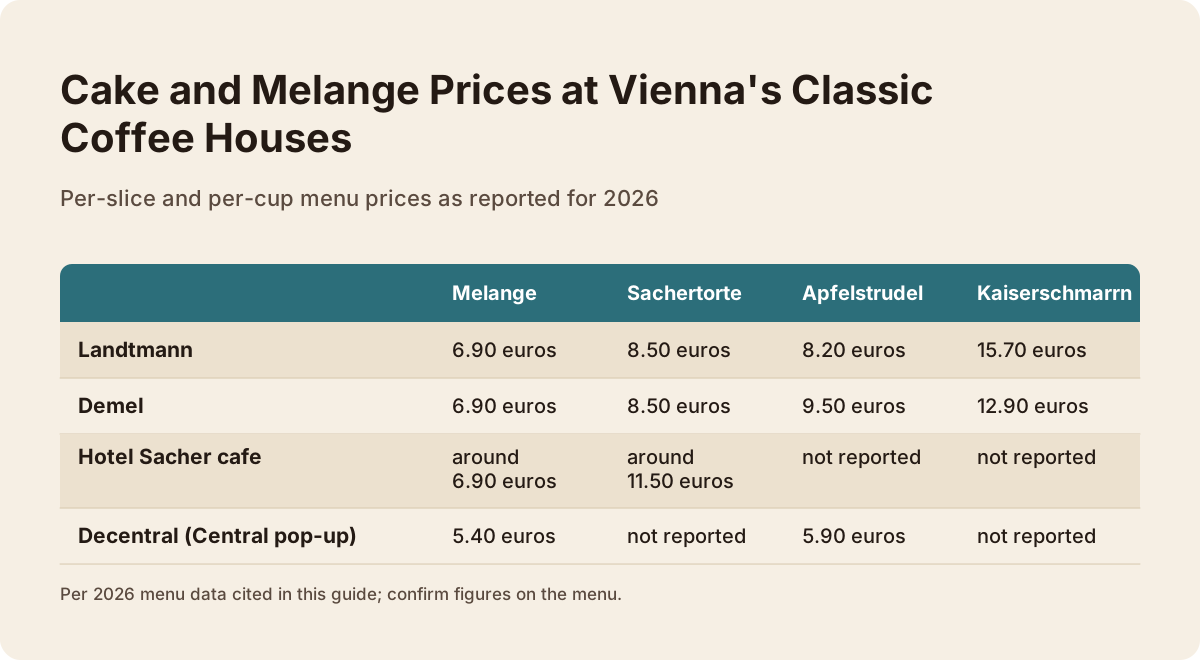
The classic houses, Landtmann, Demel, Sperl, Sacher and Central, each price a slice around 8.20 to 11.50 euros with a Melange around 6.90 euros. They differ more in setting and queue than in baking quality. Landtmann takes reservations; Demel generally does not. Cafe Central is closed for renovation until winter 2026. That last point matters more than any other in this section. Cafe Central, the vaulted hall at Herrengasse 14, has been closed for major renovation since 16 March 2026, with reopening planned for winter 2026. Until then it runs a pop-up, Decentral, at Freyung 3, open daily from around 08:30 to 20:00, where a Melange is 5.40 euros and an Apfelstrudel 5.90 euros, noticeably cheaper than the mother house. Confirm on the cafe's own site before planning a visit, since renovation timelines move.
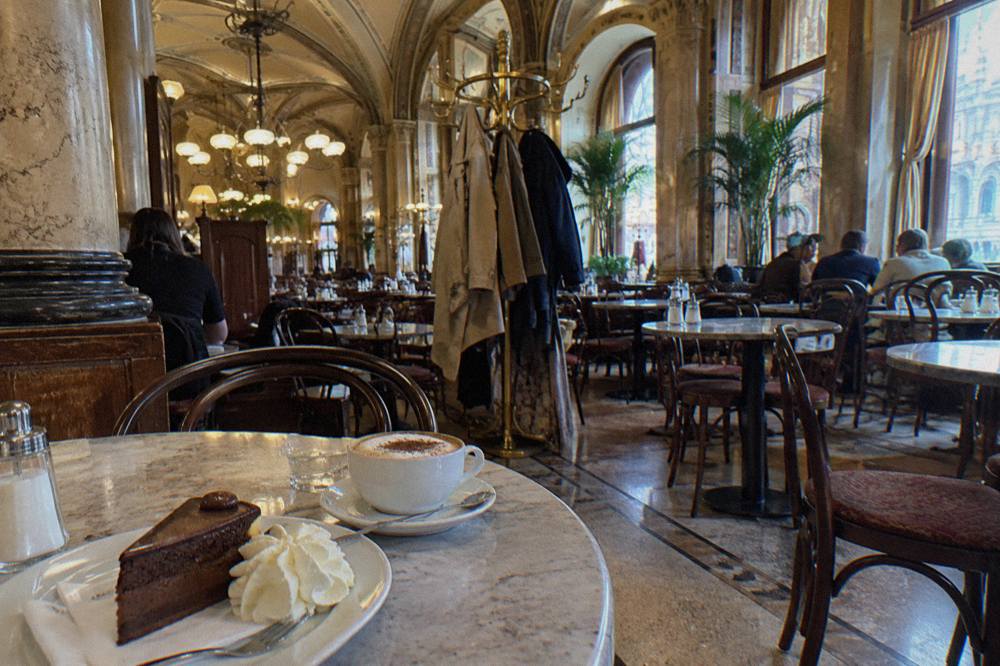
Landtmann, the Ringstrasse institution near the Burgtheater, lists a Melange at 6.90 euros, Sachertorte at 8.50 euros, Apfelstrudel at 8.20 euros and Kaiserschmarrn at 15.70 euros, and it accepts reservations, which makes it the pragmatic pick for a fixed-date visit. Demel's menu shows a Melange at 6.90 euros, Sachertorte at 8.50 euros, Kaiserschmarrn at 12.90 euros and Apfelstrudel at 9.50 euros. Melange prices at the classic houses like Landtmann, Museum and Schwarzenberg cluster around 6.90 euros, which makes the Melange a reliable benchmark: if a house charges far more than that, you are paying for the address.
| House | Melange | Sachertorte | Apfelstrudel | Kaiserschmarrn | Reservations |
|---|---|---|---|---|---|
| Landtmann | 6.90 euros | 8.50 euros | 8.20 euros | 15.70 euros | Accepted |
| Demel | 6.90 euros | 8.50 euros | 9.50 euros | 12.90 euros | Generally not |
| Hotel Sacher cafe | around 6.90 euros | around 11.50 euros | not reported | not reported | Recommended |
| Decentral (Central pop-up) | 5.40 euros | not reported | 5.90 euros | not reported | Not reported |
The practical case for a guided walk here is simple: the houses are scattered, the queues are unpredictable, and a guide who knows which counter to approach saves an hour per stop. If you would rather go alone, read Best Coffee Houses In Vienna first for the full shortlist, and treat the etiquette as part of the experience: a Gedeck cover charge of 2 to 5 euros per person appears in traditional venues, legal only if printed on the menu, and coffee house tips are a rounding-up gesture of 0.50 to 1 euro rather than a percentage.
What Is Apfelstrudel And How Is It Served?
Apfelstrudel is a roll of paper-thin stretched pastry filled with spiced apples, raisins, cinnamon and breadcrumbs, baked until the shell shatters. It is served warm, sliced crosswise, with vanilla sauce, whipped cream or a vanilla custard, and it is the one cake that deteriorates if it sits. Order it where it is baked on site. The pastry tradition arrived with the Habsburg empire's ties to the Balkans and beyond; strudel dough is kin to Turkish baklava filo, pulled by hand until you can read a newspaper through it. That hand-stretching is the craft mark. A machine-rolled strudel tastes fine but has a bready, croissant-like wall instead of the many-layered crackle, and the difference is audible before it is visible.
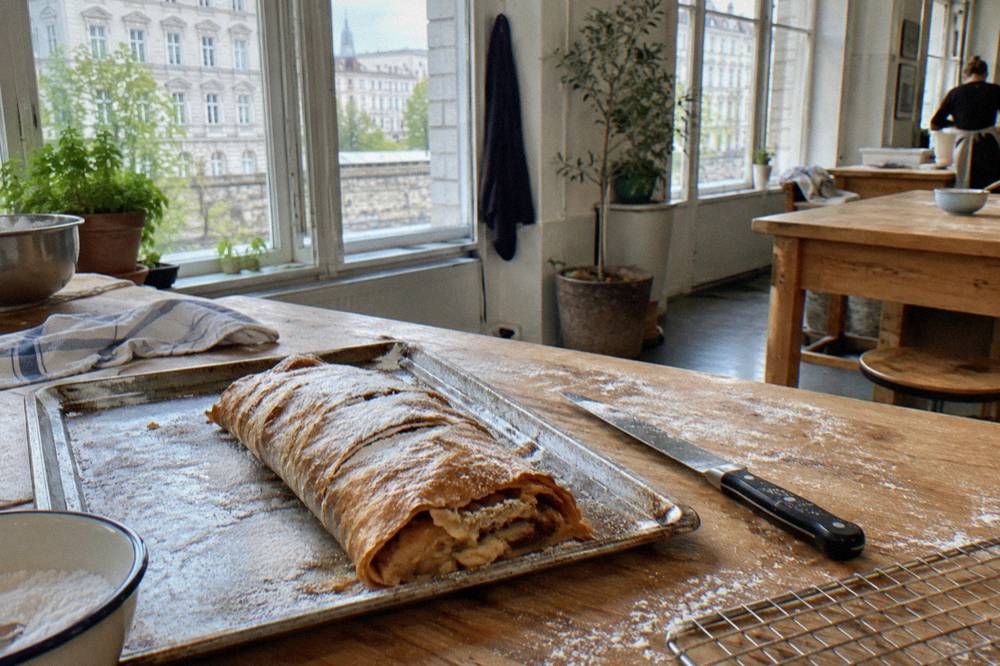
Serving style matters. The classic presentation cuts the strudel into coin slices, lays two or three on a plate with a warm vanilla sauce, and expects you to eat it within minutes. At the classic houses an Apfelstrudel runs around 5.90 euros at the Decentral pop-up to 9.50 euros at Demel per 2026 reports, with Landtmann between them at 8.20 euros. Cafe Central's pop-up price makes Decentral the current value option for strudel specifically, though the setting is a stand-in rather than the storied hall. The etiquette around coffee house seating applies wherever you go: lingering is expected, the newspaper racks are part of the furniture, and no waiter will bring a bill until you ask for it.
There is also a way to go deeper than ordering. A shared strudel and schnitzel cooking class walks you through the dough work and ends with eating what the group made, a three-hour format that suits travellers who want the technique rather than just the slice. Check availability on the class listing for dates, since shared classes run on fixed schedules.
What Is Kaiserschmarrn And Why Is It A Pancake?
Kaiserschmarrn is a thick, fluffy torn pancake, caramelised in butter, cut into ragged pieces in the pan and served dusted with icing sugar and plum or apple compote. It is named for Emperor Franz Joseph I, who reportedly preferred his pancakes scrambled. It is a sharing dish, a dessert and sometimes a main course all at once. The story, repeated in every menu footnote, is that the emperor's cook ruined a pancake, tore it up to hide the mistake, and the emperor liked it more than the original. Whatever the truth, the dish is now the centrepiece of alpine-style menus across Austria, and in Vienna it appears in two contexts: as a plated dessert in coffee houses and as a pan-sized portion in the Beisl taverns.
It is the most expensive item on the classic coffee house cake cards because it is cooked to order rather than sliced from a display case. Landtmann lists it at 15.70 euros and Demel at 12.90 euros, both reported figures worth confirming on the menu. A pan in a neighbourhood Beisl often lands lower. The pancake should be light, with caramelised edges and a custardy middle; if it arrives flat and uniform, the kitchen cut corners. The compote is not decoration. The tart plum side is what keeps the butter and sugar from becoming heavy, and asking for extra is normal.
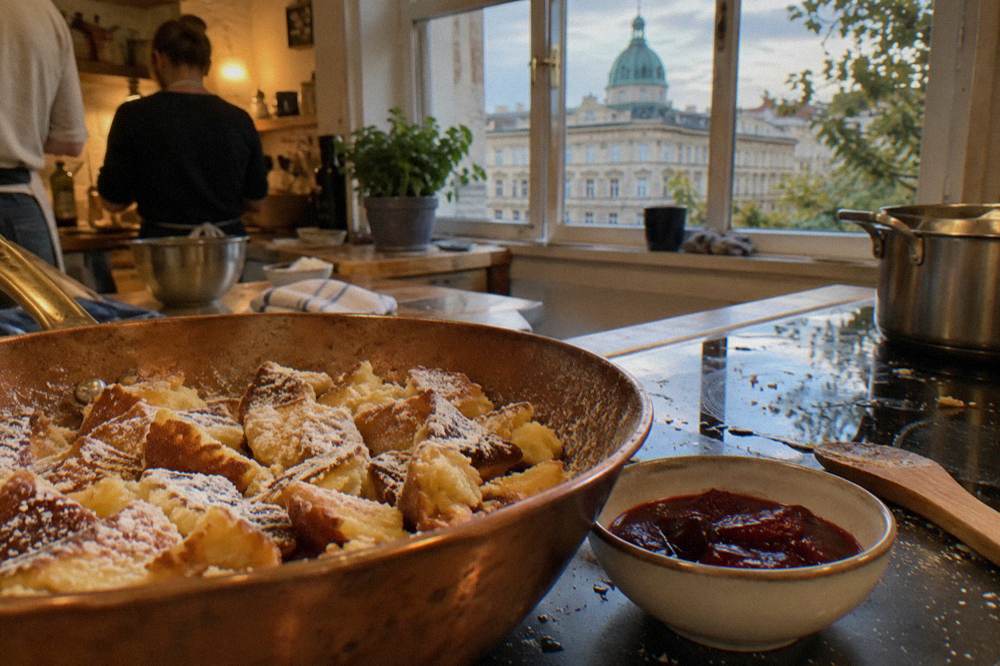
Kaiserschmarrn is also the one famous Vienna sweet that does not fit in a pastry case, which is why no walking tasting tour builds its route around it. It belongs to a sit-down meal, either a late lunch in a Beisl or a coffee house visit where you have 45 minutes. Plan it as the anchor of one afternoon rather than a stop on a crawl.
Which Pastries Do Locals Eat Beyond The Big Three?
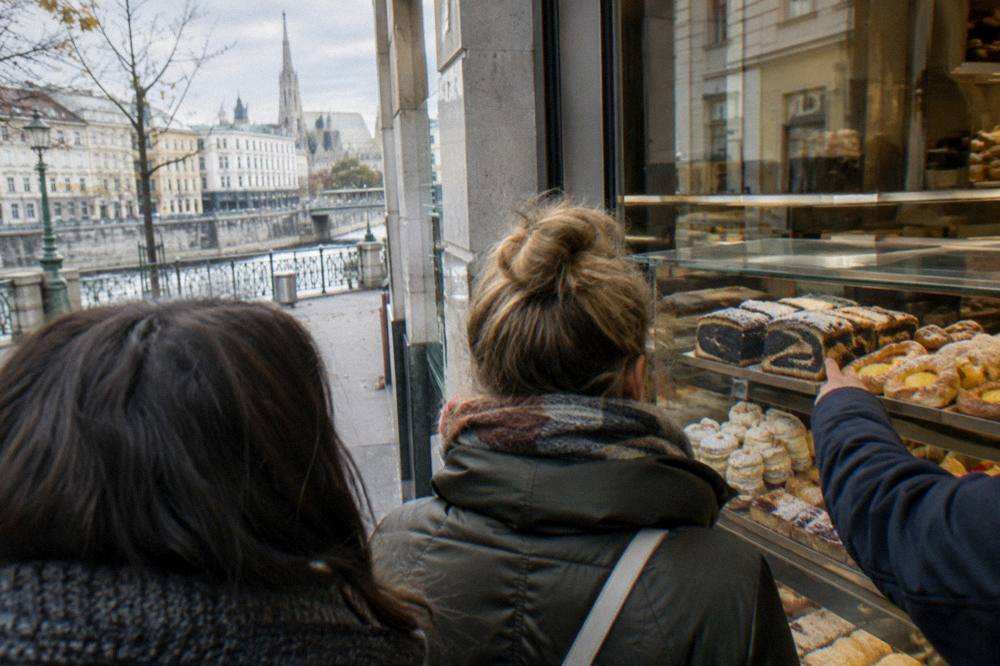
The local second tier is Topfengolatschen, a curd-cheese pastry pocket; Buchteln, warm jam-filled yeast buns; Gugelhupf, a marbled ring cake; and Mohnkuchen, poppy seed cake. These sell for a few euros each in Konditorei bakeries rather than coffee houses, and they are what Viennese actually buy for a Sunday afternoon at home. The distinction between a Konditorei and a coffee house is the useful one. A coffee house is a sitting room with waiter service, newspapers and a cake card. A Konditorei is a bakery-confectioner with a small counter and maybe a few seats, where a Topfengolatschen costs a fraction of a cafe slice and the turnover is higher because locals buy by the box. The display case is the menu, and pointing is the ordering system. Pastries are only the sweet half of Viennese eating, so for the savory side of the city's food culture, see our guide to Wiener Schnitzel, Vienna's signature dish.
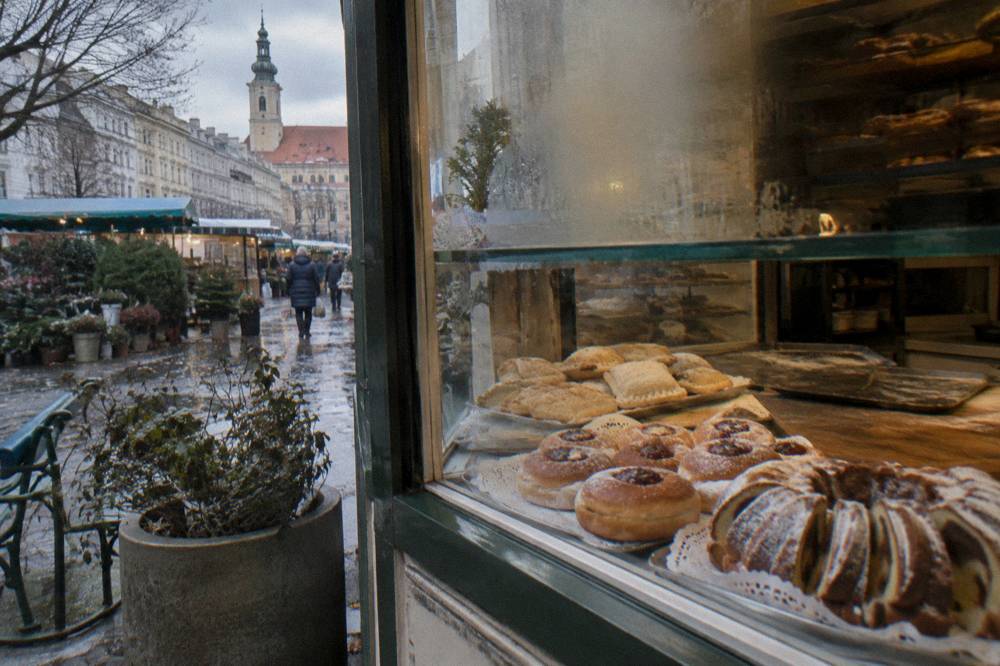
Topfengolatschen deserves the spotlight. The filling is Topfen, an Austrian quark-style curd cheese mixed with egg and sometimes raisins, enclosed in a leaf or puff pastry. It is the pastry that vanishes earliest in the day at good bakeries, and it is the item most often cited by locals as the thing they would miss abroad. Buchteln, best known from the Cafe Hawelka tradition, are yeast buns baked touching each other in a pan so they pull apart, filled with apricot or plum jam, and meant to be eaten warm. Order them when the tray is fresh and they need nothing else; order them cold and you will wonder what the fuss is about.
For a fuller treatment of the sitting side of this culture, including the Melange, the Kleiner Brauner and the water glass ritual, see Vienna Coffee House Culture Guide, and the official heritage framing is set out by the Austrian UNESCO commission's inventory entry, which records the 2011 inscription. The coffee house, the commission notes, is valued as a place where time and space cost nothing and only the coffee appears on the bill. That is a fair description of why a two-euro pastry difference between houses barely matters in practice.
How Much Does Vienna Cake Actually Cost?
A slice of cake in a classic Vienna coffee house runs around 8.20 to 11.50 euros, a Melange around 5.40 to 6.90 euros, and Kaiserschmarrn 12.90 to 15.70 euros, all reported 2026 figures. Add a Gedeck cover charge of 2 to 5 euros in traditional venues where it is printed on the menu, and a tip of 0.50 to 1 euro rounded up. The honest framing is that a cake stop at a famous house costs about the same as a main course at a mid-range restaurant, and roughly double what the same slice costs at a Konditorei counter. The premium buys the room, the waiter, the newspaper and the right to sit for two hours, and in December it buys a table near a Christmas market.
| Item | Classic house (reported) | Notes |
|---|---|---|
| Melange | 5.40 to 6.90 euros | Decentral pop-up low end, Landtmann, Demel and Museum cluster around 6.90 |
| Sachertorte slice | 8.50 to 11.50 euros | Demel 8.50, Hotel Sacher cafe around 11.50 |
| Apfelstrudel | 5.90 to 9.50 euros | Decentral 5.90, Landtmann 8.20, Demel 9.50 |
| Kaiserschmarrn | 12.90 to 15.70 euros | Cooked to order, largest cake-card item |
| Gedeck cover | 2 to 5 euros | Traditional venues, must appear on the menu |
Two budget levers work. First, the Konditorei route: the same baking tradition at counter prices, standing or perched on a stool, with no Gedeck. Second, the bundled route: a guided coffee and cake tasting walk folds several stops into one price, which typically lands below the sum of individual cafe bills once you count a drink at each stop. The guided Viennese coffee house tour, a three-hour format, sits in that category and covers the house histories as well as the slices; check its listing for what the current price includes.
Is A Cake And Coffee Tour In Vienna Worth Booking?
A cake and coffee tasting tour is worth it when you want multiple houses in one afternoon, want the histories explained, or are travelling solo and want the sitting ritual decoded. At around two and a half to three and a half hours, the formats bundle tastings and a drink at each stop, which usually beats the cost of doing four houses alone. It is less worth it for one specific cake. The economics deserve a sentence of honesty. If your entire goal is a single Sachertorte at Sacher, book nothing: queue once, pay, sit. A tour earns its fee when the goal is breadth, four or five stops with the selection made for you, or depth, the stories, the heritage framing and the etiquette, delivered at the counter instead of read the night before.
The tasting walk format also solves the ordering problem. First-time visitors reliably order wrong: the wrong portion size, the wrong drink pairing, a cold Buchteln, a Sachertorte without the cream. A guide who orders with the group removes that risk entirely, and on a short trip that is worth real money. For travellers weighing food walk formats generally, Which Vienna Food Walk Should You Book breaks the decision down by pace and appetite, and the private format, six or ten tastings on your own schedule, suits families and dietary needs; message the operator before booking about vegetarian or other options, since dietary provisions vary by listing.
The chocolate workshop format is the third option, one hour in the chocolate museum with a hands-on tasting element, and it suits families with children better than a three-hour walk does. Whatever the format, the standard advice applies: read the inclusions on the booking page, check the meeting point, and confirm the cancellation terms, which on most Vienna listings are free up to 24 hours before departure.
When Is The Best Time Of Year For Cake In Vienna?
Cake season peaks from mid-November through December, when 15 Christmas markets with 814 stalls open across the city and every coffee house fills, and again during the summer terrace months. Late autumn also brings MondoVino on 13 and 14 November 2026 and Sturm season tail-end, while Christmas Eve afternoon is the quietest classic-house window. The Christmas market detail comes from the City of Vienna's official 2026 market announcement: the Rathausplatz Christkindlmarkt runs 13 November to 26 December, Schonbrunn from 6 November to 24 December, and Spittelberg, Am Hof and Karlsplatz through 23 December. Cake and Punsch stops cluster around all of them, and the coffee houses nearest the markets get busy by mid-afternoon.
| Market | 2026 Dates | Nearest Cake Stop Character |
|---|---|---|
| Rathausplatz Christkindlmarkt | 13 Nov to 26 Dec | Ringstrasse houses, busiest of the season |
| Schonbrunn | 6 Nov to 24 Dec | Palace cafe, tourist-heavy afternoons |
| Spittelberg | 13 Nov to 23 Dec | Narrow lanes, smaller Konditorei nearby |
| Am Hof | 13 Nov to 23 Dec | Old town houses a short walk away |
| Belvedere | 20 Nov to 31 Dec | Quieter district, easier tables |
| Art Advent Karlsplatz | 13 Nov to 23 Dec | Near the Ringstrasse house cluster |
Timing inside the day matters as much as the calendar. The classic houses fill between 14:00 and 17:00, and the Sacher cafe queue is longest in that window, with arrival before noon or after 16:00 the standard advice. Weekday mornings are the calmest hours at nearly every house. One more planning note: most Vienna retail closes on Sundays, and while coffee houses stay open, their surrounding shopping streets do not, so a Sunday cake tour feels different from a Saturday one.
One indoor note that applies to every stop on this page: Austrian gastronomy has been smoke-free indoors since 1 November 2019 under the federal smoking law, so the cake cabinet and the dining room share clean air, a detail that still separates Vienna from several neighbouring capitals. The official business portal's summary of the law covers the rules, including the outdoor-terrace exceptions.
If you are building cake into a longer stay, pair this guide with What To Eat In Vienna: Traditional Dishes for the savoury side of the same cuisine, and treat the sweet half of the city as its own afternoon rather than an afterthought following dinner.
Common Questions About Vienna Cake
What Is The Most Famous Cake In Vienna?
Sachertorte, the chocolate and apricot jam cake credited to the Sacher family. Hotel Sacher sells the sealed "Original" version at a reported 11.50 euros per slice, while Demel serves its rival single-layer version at around 8.50 euros.
Why Is Sachertorte Dry?
It is meant to be dense and firm rather than moist, closer to a pound cake than a mousse cake, which is why it is served with unsweetened whipped cream and a Melange. A day-old Sachertorte is often preferred, since the jam softens the crumb.
What Is The Difference Between Sachertorte And Apfelstrudel?
Sachertorte is a chocolate sponge cake served in slices from a display; Apfelstrudel is a warm roll of thin stretched pastry filled with spiced apples, cooked to order and served with vanilla sauce. Strudel needs to be eaten fresh and hot, while Sachertorte keeps.
Is Kaiserschmarrn A Dessert Or A Meal?
Both. In coffee houses it appears as the most expensive item on the cake card, 12.90 to 15.70 euros reported, while in Beisl taverns a pan-sized portion works as a main course or a shared dish for two.
How Much Does Cake Cost In A Viennese Coffee House?
Around 8.20 to 11.50 euros for a slice at the classic houses, with a Melange around 5.40 to 6.90 euros, plus a Gedeck cover charge of 2 to 5 euros in traditional venues where it is printed on the menu. Konditorei bakeries sell equivalent pastries for a few euros at the counter.
Is Cafe Central Open In Vienna?
No. It has been closed for major renovation since 16 March 2026, with reopening planned for winter 2026. Its pop-up, Decentral, operates at Freyung 3 daily from around 08:30 to 20:00; confirm on the cafe's own site before visiting.