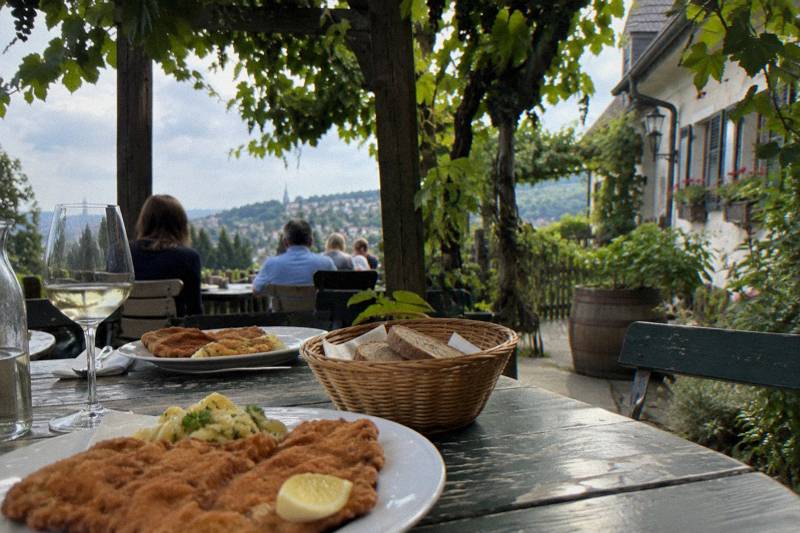
What Is A Heuriger In Vienna?
A Heuriger is a Vienna wine tavern serving its own vineyard wine under a pine bush sign. What it means, where to find one, costs, season and how it differs from a restaurant.
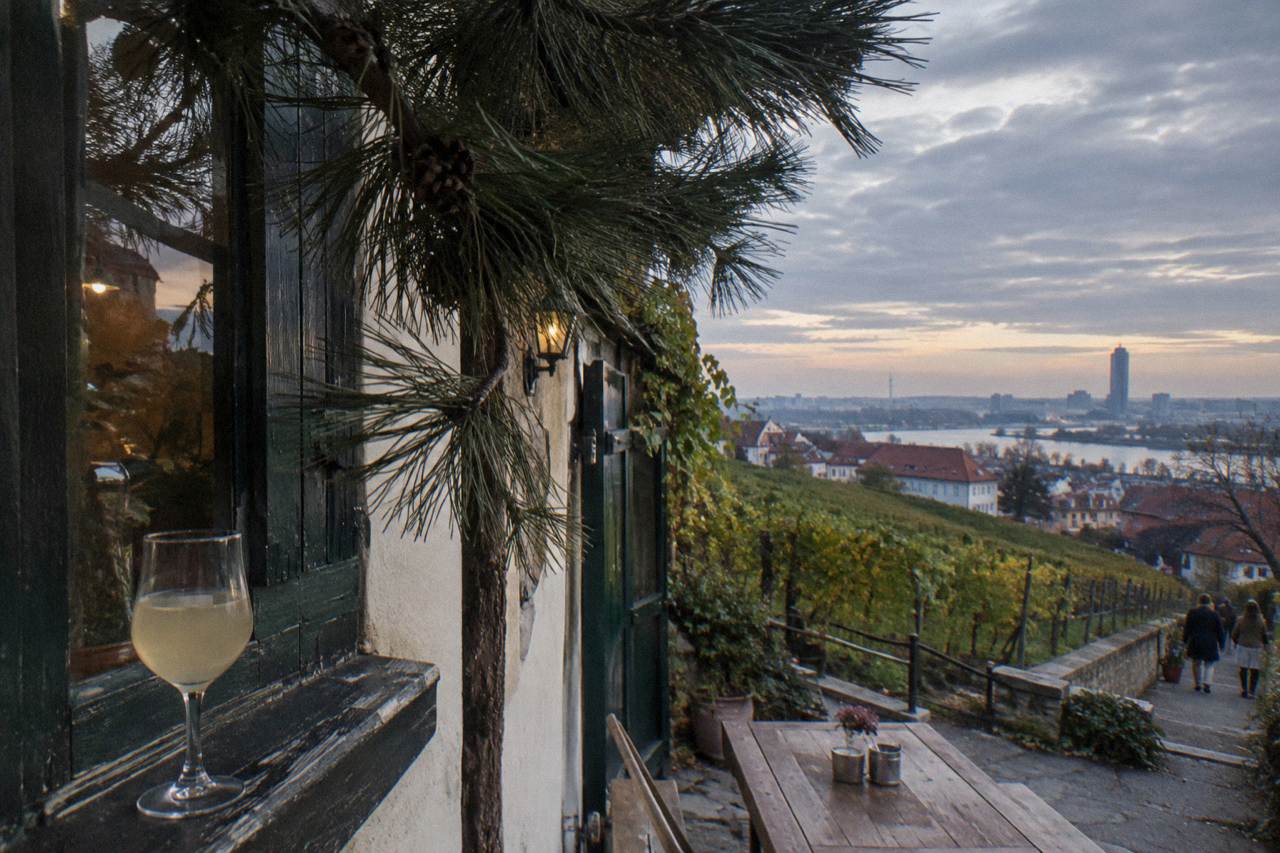
A Heuriger is a Viennese wine tavern that, by tradition and by license, serves only wine made from its own vineyards, alongside simple self-service food. The word has a second meaning: the "Heurige" is also the current vintage, the young wine that may legally carry that name until 11 November, St Martin's Day, after which it becomes "Alter". Both uses come from the same root, the German word for "this year".
That double meaning is the first thing that confuses visitors. A sign reading "Ausg'steckt is'" does not advertise a brand, it is a sentence: "the wine is tapped", meaning this house is pouring its new vintage and is open. The Vienna Tourist Board's own definition adds the visual clue that has governed the trade for centuries: a genuine Heuriger hangs a pine or fir bush, the "Buschen", over its door while it is open. No bush, no service.
The legal backbone matters too. The Buschenschank license under Austrian law restricts what such a house may sell: its own wine, and a limited cold and simple warm buffet rather than a full restaurant menu. That restriction is a feature, not a limitation. It is why a Heuriger evening feels nothing like a restaurant meal, and it is why the city counts only about 100 real Buschenschanken still operating, a number that reflects the trade's slow decline.
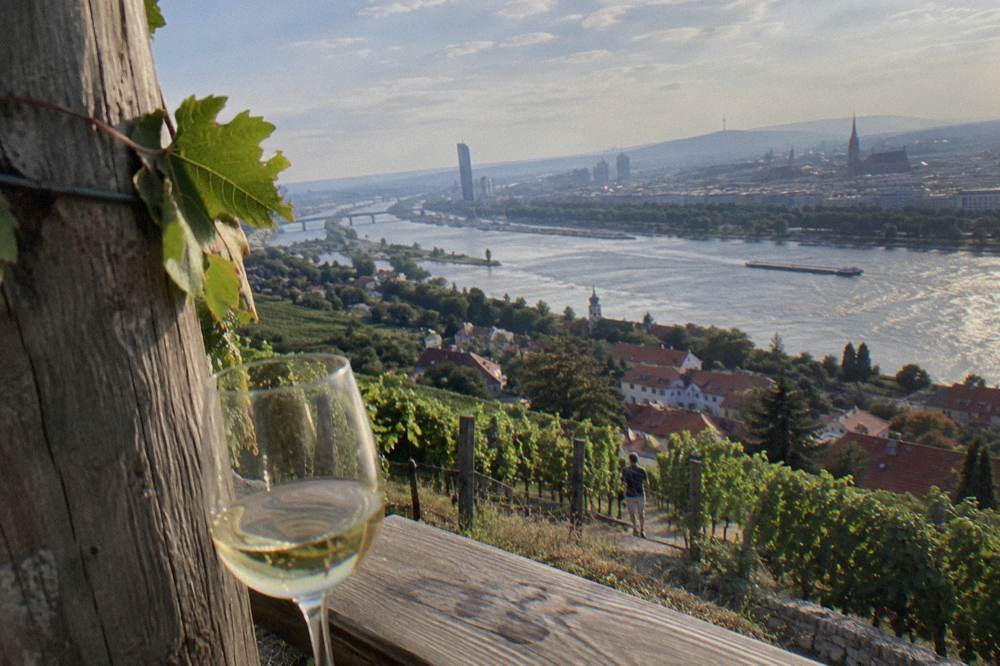
Vienna is the unusual part of this story. Very few capitals grow wine commercially within their boundaries; Vienna has 588 hectares of vineyard inside the city limits, spread across 172 wineries according to the 2026 Vienna wine catalog, with a third of that area farmed organically. The taverns exist because the vines do. For a fuller walkthrough of the districts, the buffets and the etiquette, the companion piece Heuriger visitors guide for Vienna goes deeper on each village.
None of that requires a guide, but a guided tasting is the easiest way to see wine country around the city if your time is short.
How Do You Know A Heuriger Is Genuine And Open?
Look for the pine bush over the door and the "Ausg'steckt is'" sign, because opening hours in this trade are irregular and seasonal rather than fixed. Many genuine houses open only a few weeks at a time, publishing their open periods in seasonal calendars, and a tourist-oriented restaurant calling itself a Heuriger without pouring its own estate wine is not the same thing. The bush is the honest signal, and it only hangs while wine is being served.
The distinction is worth spelling out because Grinzing in particular is full of places with "Heuriger" on the signboard that function as regular restaurants serving any wine they like. Nothing is wrong with a good dinner there. But if the specific tradition is what you came for, the test is simple: a licensed Buschenschank pours its own production, posts its open periods, and hangs the bush when it is serving. The city's wineries publish their "Ausgsteckt" open dates in seasonal calendars, so checking before you travel out to a village saves a wasted trip, especially between November and March when many traditional houses close or cut back sharply.
Roughly 100 real Buschenschanken were still operating in Vienna, and Austrian reporting has coined the word "Heurigensterben" for the slow shrinkage of the trade, even as some neighborhoods like Mauer and Oberlaa report strong demand. Practically, that means the surviving houses cluster in a handful of districts, covered below, and the quality ones are busy on weekends.
If the calendar-watching sounds like work, that is the gap a guided wine excursion fills: someone else tracks the openings, drives, and pairs the tasting with a meal.
Where Are Vienna's Heuriger Districts?
The genuine wine-tavern villages sit on the green edges of the city, mainly in Döbling in the north, Floridsdorf in the northeast, Ottakring and Hernals in the west, Oberlaa in the south and Mauer at the southern rim. The named Heuriger streets include Grinzing, Nussdorf, Neustift am Walde, Heiligenstadt and Sievering; Stammersdorf and Strebersdorf in the 21st district; and Mauer in the 23rd. Each has a different character, from polished to village-quiet.
Döbling holds nearly half of Vienna's vineyard area and most of the famous names. Grinzing is the tourist flagship, busy and easy to reach, which also means it carries the highest share of restaurants that are Heuriger in style only. Nussdorf and Heiligenstadt sit lower, at the foot of the hills, quieter and closer to the wine growers themselves. Neustift am Walde and Sievering sit higher up toward the Vienna Woods, and Neustift in particular keeps a real village feel; its annual Kirtag parish festival drew around 100,000 visitors over six days in August 2026, which tells you how local the culture still is.
Stammersdorf and Strebersdorf in Floridsdorf are the connoisseur's answer to Grinzing: a cellar-lane landscape, the Kellergasse, where weekend openings in September and October come with Sturm, the cloudy half-fermented new wine. Mauer in Liesing, and Oberlaa, round out the southern options, smaller in number but reported as thriving. The practical difference for a visitor is crowds and transport: Döbling absorbs tourists easily, Floridsdorf rewards those who make the trip.
For the wider picture of wine touring in and beyond the city, the guide to Vienna wine tasting and tour options maps what each kind of experience covers.
| District | Known For | Character |
|---|---|---|
| Grinzing (19th) | The famous name, easiest access | Busiest, most tourist-oriented |
| Nussdorf and Heiligenstadt (19th) | Lower-slope taverns near growers | Quieter, food-and-wine focused |
| Neustift am Walde and Sievering (19th) | Village atmosphere, Kirtag festival | Local, weekend-busy |
| Stammersdorf and Strebersdorf (21st) | Cellar lanes, Sturm season | Connoisseur, seasonal openings |
| Mauer and Oberlaa (23rd, 10th) | Southern vineyards, strong demand | Relaxed, fewer visitors |
What Does A Heuriger Meal And Wine Cost?
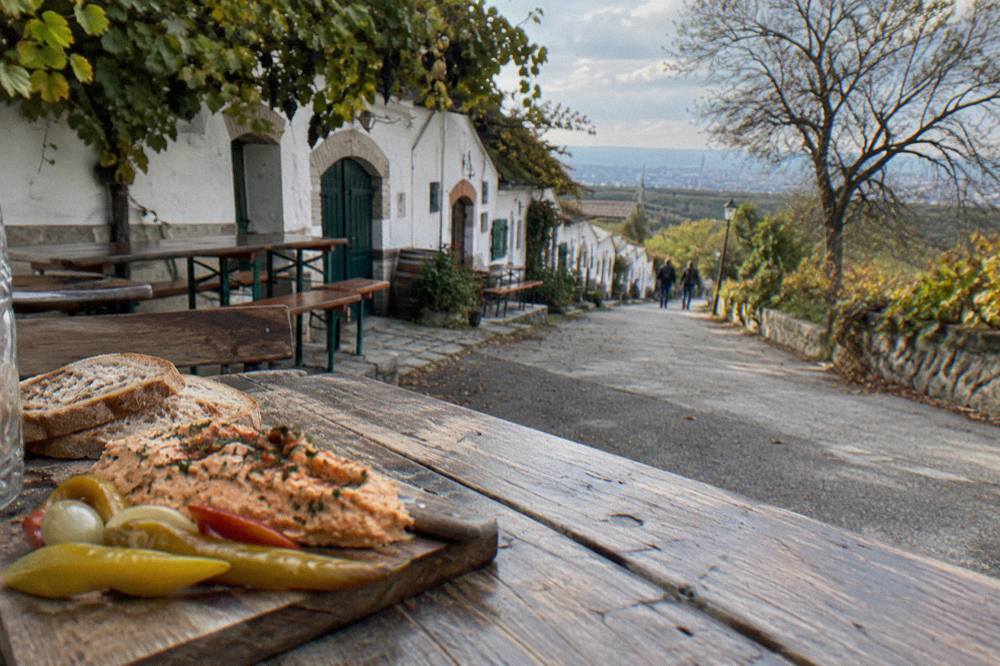
Expect a cold self-service buffet plate around 6 to 12 euros at neighborhood houses, evening totals commonly 8 to 15 euros per person, and an Achtel, an eighth of a liter of wine, around 3 to 5 euros, all reported 2026 figures from local guides. Tourist-oriented houses in Grinzing run higher. Buffet pricing is usually by the plate or by weight, so the final bill depends on how you load it.
The buffet is the ritual. You take a plate, load it from the cold spread, typically spreads, cheeses, cured meats, pickles, bread and lard, sometimes a soup or a warm dish, and pay at the counter. Nobody brings the menu to you because in a licensed Buschenschank the offering stays deliberately simple. The wine comes by the Achtel or Viertel glass or carafe, and the house style is Gemischter Satz, the field blend described below.
Two cautions keep the bill honest. First, the reported ranges come from neighborhood spots; large Grinzing venues and event buffets, which have been listed at 19.50 to 44.90 euros per person for organized occasions, sit far above them. Second, a table setting or cover charge may appear in more formal venues, and in restaurants generally a Gedeck of 2 to 5 euros is legal only if it is printed on the menu, a norm covered in detail in the guide to Vienna restaurant etiquette, Gedeck and tap water. Check the posted price list at the buffet before you pile the plate; it is the house's job to display one.
Quality-wise, 2026 gives the tradition a good story: heat and drought cut Vienna's harvest by 30 to 40 percent, yet growers described the vintage as very good, so the young wine poured this season is scarce but strong.
What Is Wiener Gemischter Satz?
Wiener Gemischter Satz is Vienna's protected field-blend wine: by the consolidated DAC regulation in force since September 2026, it must come from registered Vienna vineyards, mix at least three grape varieties in one vineyard, cap any single variety at 50 percent, keep a third variety at 10 percent or more, and show at most 12.5 percent alcohol on the label. It cannot be sold to consumers before 1 December of the harvest year.
The idea predates the paperwork by centuries. Rather than planting one grape per field, Vienna's growers historically mixed varieties in the same vineyard so that whatever the weather did, something would ripen. The DAC rules, consolidated in Austrian federal law, now protect that tradition: the wine must carry Vienna's vineyards, and finer designations, Ortsteil or Ried, hold back even longer, until 1 March or 1 May of the following year.
For a visitor, Gemischter Satz is simply the house pour at most genuine taverns, and it is the style most worth ordering precisely because it exists nowhere else at this scale. A tasting flight that walks you through it side by side with single-variety Austrian whites is the fastest way to understand what the blend does; Vienna: Wine Tasting Tour, a 2.5-hour guided tasting, covers exactly that ground, with the price on the operator's live listing.
When Is Heuriger Season In Vienna?
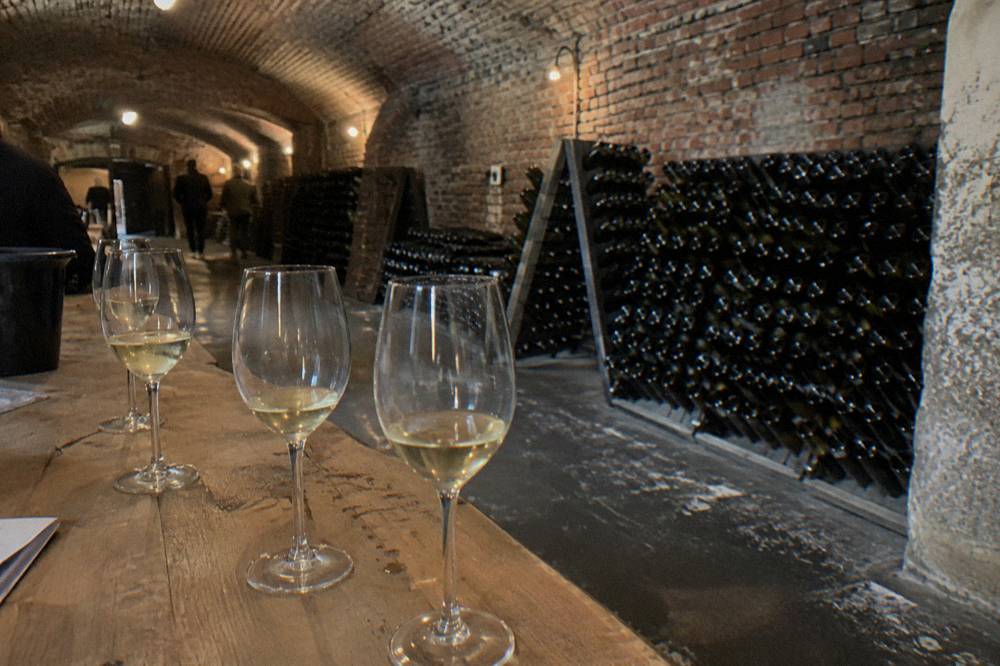
The high season runs roughly April through October, with September and October the peak, when Sturm, the sweet, cloudy partially fermented new must, appears briefly and the grape harvest fills the calendar. Many traditional houses reduce hours or close between November and March, though larger Grinzing and Nussdorf venues stay open year-round, and each house posts its own Ausgsteckt periods.
Sturm is the season's signature. Sold only for a short window while it is still fizzy, it arrives with the harvest, typically early to mid-October through mid-November depending on weather, and cellar-lane weekends in Stammersdorf build small festivals around it. Drink it fresh, expect it to be sweet and slightly wild, and treat it gently; locals will warn you it has a reputation.
The calendar's biggest single event, the Vienna Wine Hiking Day, has just passed: the 2026 edition ran 26 and 27 September, free to enter, with four routes of 10.8 km, 9.6 km, 4.5 km and 4.6 km through the northern and southern vineyards and tastings from 10:00 to 18:00. Entry cost nothing and tastings were paid at the stations. It is over for this year; watch for the 2027 dates if you want the whole vineyard landscape in one day.
After St Martin's Day on 11 November, the "Heurige" wine technically becomes last year's vintage and the new one is awaited. Winter openings shrink, which is exactly why checking the Ausgsteckt calendars matters in the cold months. For timing a whole trip around food events, the guide to the best time to visit Vienna for food places the wine season among the city's other calendars.
Can You Visit A Heuriger On A Guided Tour?
No guided tour in the city is described as a Heuriger visit, so any product promising one is stretching the word. What Vienna's operators genuinely offer are wine tastings, cellar visits and wine-country excursions into the Vienna Woods and surrounding regions, described from their own listings. Pairing those honestly is the right move: let a guide handle the wine education, and save the pine-bush taverns for a self-guided evening.
The nearest bookable experiences fall into three shapes. City tastings run 45 minutes to 2.5 hours and cover Austrian and Viennese wines in a cellar or bar setting; the Vienna: Wine Tasting Tour above is the representative example. Half-day and full-day countryside excursions add transport and often a meal: the From Vienna Half-day Countryside Wine Tour runs 4 hours and bundles a winery visit, a meal and hotel pickup, with the price and exact inclusions on the operator's live listing. And themed day trips, like the Vienna Forest Tour with Underground Lake and Wine Tasting at 4 hours 30 minutes, mix one tasting into a broader sightseeing loop, again with details and price on the listing.
Read the inclusions before booking rather than the title. Whether a tasting includes food, how many pours, and where pickup happens all vary by product, and the booking page is the only authoritative source. If a Heuriger-style evening with buffet food is specifically what you want, plan that separately: take the tram or bus out to Nussdorf or Stammersdorf and do it yourself, using the transport lines below. If guided wine country with the logistics solved is what you want, the half-day countryside wine tour covers it in one booking, and you can also check availability alongside it.
How Do You Get To The Heuriger Villages?
Public transport reaches every main district: tram D to Nussdorf, bus 35A to Neustift am Walde, bus 38A or tram 38 to Grinzing, and tram 31 to Stammersdorf, all per 2026 transport guides. The rides take under an hour from the center, the tavern clusters sit within a short walk of the stops, and a return after dark is easier if you note the last connections before your second carafe.
The direct lines are the good news; the detail is that the wine villages sit at the end of routes, so frequency thins in the evening. A table of the main pairs:
| Village | Line From The Center | Notes |
|---|---|---|
| Nussdorf | Tram D | Lower-slope taverns, quick ride |
| Grinzing | Bus 38A or tram 38 | Most frequent service, most visitors |
| Neustift am Walde | Bus 35A | Higher village, weekend Kirtag fairs |
| Stammersdorf | Tram 31 | Cellar lanes, Sturm season |
| Mauer | Bus 60A or regional | Southern rim, fewer houses |
Two practical notes finish the picture. Vienna's gastronomy has been entirely smoke-free indoors since 1 November 2019, so an evening in even the most rustic tavern room is comfortable, with smoking only on open terraces. And the vineyard districts sit inside the ordinary city fare zone, so no special ticket is needed; the transport basics are laid out in the guide to getting around Vienna and Wiener Linien tickets. On a fine evening, walking one leg of the route through the vines is half the pleasure.
Planning A Heuriger Evening Without Mistakes
To plan a Heuriger evening without mistakes, check the house's Ausgsteckt dates before you go, arrive early on weekends to claim a garden table, and carry modest cash for the buffet, where prices run roughly 8 to 15 euros a person plus 3 to 5 euros an Achtel of wine, reported 2026 figures. Do not expect a restaurant's menu or service style; genuine houses have you bus your own plate and pour from the carafe.
A few habits make the difference between a good evening and a confused one. Arrive before sunset in the warmer months, because the arbors and gardens are the point. Order the Gemischter Satz first; it is the house style and the cheapest education on offer. If Sturm is on, try one glass with the understanding that it is sweet, fizzy and short-lived. Tipping follows restaurant norms of 5 to 10 percent, or simply round up at the buffet counter.
Families are welcome in the garden setting, and the self-service format suits children better than a formal dining room. For the reverse question, whether the city center itself deserves your food time, the district-by-district food guide places the wine villages in the wider map of eating in Vienna, and the site's Vienna Food Tours homepage collects every tasting walk for comparison.
Whatever the season, the pine bush remains the only credential that matters: where it hangs, the estate's own wine is pouring, and the tradition, in roughly 100 houses across one capital, is still alive.
Common Questions About Heuriger In Vienna
What Is A Heuriger In Vienna?
A Heuriger is a Vienna wine tavern licensed to serve only wine from its own vineyards, alongside a simple buffet. The word also names the young current-vintage wine itself, which may carry that title until 11 November. A pine bush over the door and an "Ausg'steckt is'" sign show a genuine, open house.
How Is A Heuriger Different From A Restaurant?
A licensed Buschenschank pours its own estate wine and offers a limited cold, mostly self-service buffet rather than a cooked menu and table service. Many places with "Heuriger" signage in tourist areas are ordinary restaurants serving any wine, so the pine bush and posted Ausgsteckt dates mark the real thing.
What Does An Evening At A Heuriger Cost?
Reported 2026 figures put a neighborhood buffet plate around 6 to 12 euros, evening totals commonly 8 to 15 euros per person, and an Achtel of wine around 3 to 5 euros. Tourist-oriented Grinzing venues run higher. Check the posted price list at the buffet before loading your plate.
When Is The Best Time To Go To A Heuriger?
Roughly April to October, with September and October the peak, when Sturm, the cloudy half-fermented new wine, appears briefly and harvest events fill the calendar. Many traditional houses close or reduce hours from November to March, though larger Grinzing and Nussdorf venues stay open year-round.
Can You Reach The Heuriger Villages By Public Transport?
Yes. Tram D serves Nussdorf, bus 35A reaches Neustift am Walde, bus 38A or tram 38 reaches Grinzing, and tram 31 runs to Stammersdorf. Rides take under an hour from the center and the villages sit inside the ordinary city fare zone.
Do Guided Tours Visit A Heuriger?
No city tour is described as a Heuriger visit. What operators offer are wine tastings, cellar visits and wine-country excursions, from a 45-minute cellar tasting to half-day countryside tours with a meal and pickup. Details and prices are on each operator's live listing, so check inclusions before booking.