Getting Around Vienna: Wiener Linien Tickets And Passes
Vienna runs on one of Europe's densest transit networks, and almost every food stop worth visiting sits within a short walk of a U-Bahn or tram stop. Here is how the ticket system works, what changed at the start of 2026, and how to fold transport planning around a day of eating.
Short answer
Vienna's transit operator sells single, 24-hour and 7-day tickets in digital and paper form, and the 48-hour and 72-hour tickets were discontinued from 1 January 2026, as reported. Fares are published on wienerlinien.at, so check there before buying. One ticket covers U-Bahn, trams, buses and S-Bahn, including night buses on weekends.
Vienna's transit network carries people through the city on five U-Bahn lines, dozens of tram routes, a dense bus grid and the S-Bahn suburban rail. For a visitor whose real agenda is food, that network is the difference between a frustrated day of taxi hunts and an efficient loop from a morning coffee house to a market lunch and an evening wine tasting. The system is zone-free within the city, which means one ticket, whatever its length, covers every mode inside Vienna's boundaries, including the airport-adjacent stops at the edge of the fare zone.
The ticket side changed at the start of 2026 in ways that still catch travellers out. The short version: the old 48-hour and 72-hour tickets no longer exist, digital versions of the remaining tickets cost less than paper ones, and every fare is published on the operator's own site. This guide walks through the options, the disruption picture, and how to sequence a food-focused day without wasting a ticket. For the wider question of which walking routes connect the eating, the Vienna Food Tours site covers each neighbourhood in depth.
What Ticket Options Does Wiener Linien Offer?
Vienna's operator sells three core ticket lengths, single journey, 24 hours and 7 days, each available as a cheaper digital version or a paper one, and the 48-hour and 72-hour tickets were discontinued from 1 January 2026 as reported. Every ticket is valid on U-Bahn, trams, buses, the S-Bahn within Vienna and night buses. Exact fares live on wienerlinien.at, and that page is the only reliable source for the current numbers. With a valid pass covering the whole network, you can ride anywhere in the city for a meal, and our guide to the story behind Vienna's signature dish explains exactly what to order once you sit down.
The single, 24-hour and 7-day structure replaced a wider menu that used to include two-day and three-day passes. Reports on the change note that the operator standardised the range from the beginning of 2026, pushing most occasional visitors toward either a 24-hour ticket or, for longer stays, the weekly option. Digital tickets bought in the operator's app or validated on a phone consistently cost less than their paper equivalents bought at machines, which matters if you are buying for a family.
The 7-day ticket deserves a note: unlike some cities, it is not tied to a calendar week. That flexibility suits a five or six day food-focused trip that might include a Naschmarkt Saturday, a vineyard afternoon on the city edge and a Christmas market evening in late November. For shorter visits, stacking 24-hour tickets day by day sometimes beats guessing your itinerary in advance.
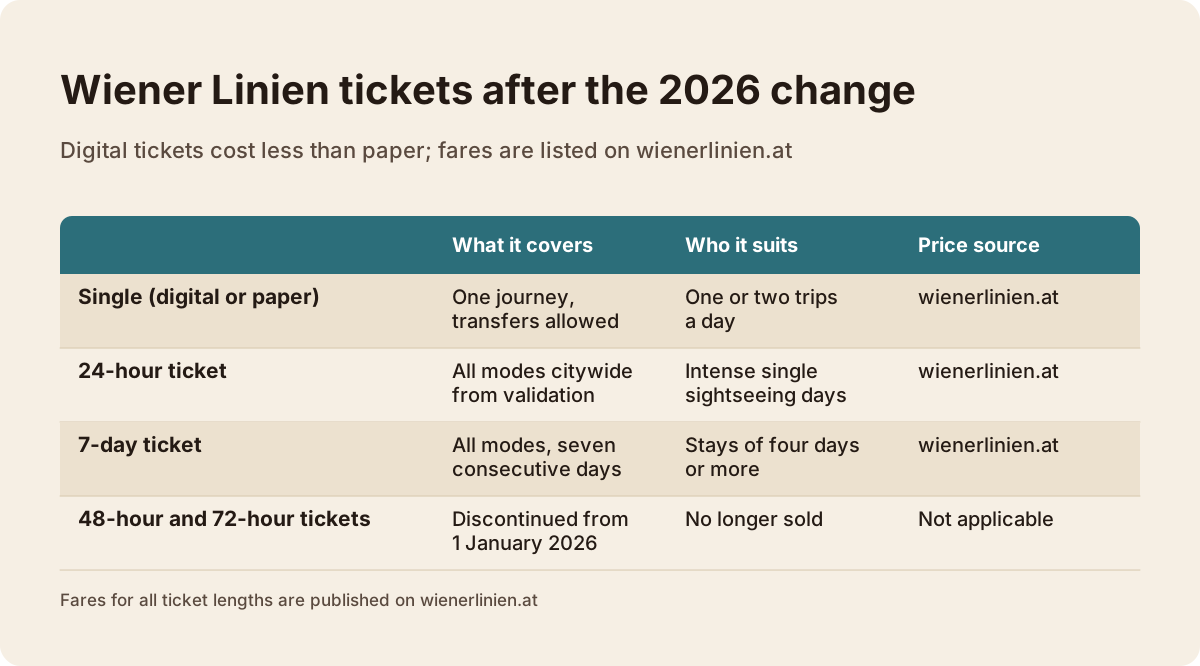
| Ticket | What it covers | Who it suits | Where the price lives |
|---|---|---|---|
| Single (digital or paper) | One journey, transfers allowed | One or two trips a day | wienerlinien.at |
| 24-hour ticket | All modes citywide from validation | Intense single sightseeing days | wienerlinien.at |
| 7-day ticket | All modes for seven consecutive days | Stays of four days or more | wienerlinien.at |
| 48-hour and 72-hour tickets | Discontinued from 1 January 2026, as reported | No longer sold | Not applicable |
Two practical rules shape every purchase. First, paper tickets need validation before boarding, in the blue or grey machines at station entrances or on trams, and an unvalidated ticket reads as no ticket to an inspector. Second, children and certain age groups travel on reduced or free terms, but the age thresholds and conditions are set by the operator, so confirm them on the same fares page rather than relying on forum posts. If a detail about your specific situation is not on the operator's page, ask at a service centre, for example the one at Stephansplatz.
Which Ticket Should You Buy For A Food Day In Vienna?
For most food-focused visitors, a 24-hour ticket is the sweet spot: a realistic eating day rarely stretches past twelve hours of transit use, and it covers the U-Bahn, trams and buses between a morning coffee house, a midday market and an evening tasting. For stays of four days or more, the 7-day ticket wins on arithmetic. Singles only make sense if your whole day is walkable, which in the first district it often is.
The decision is really about how far your stomach wants to travel. Central Vienna is compact: the first district's coffee houses, sausage stands and cake institutions sit within a twenty minute walk of each other, and a visitor happy to stay central could buy two singles a day and nothing more. The moment you add the Naschmarkt on the U4, a Heuriger area like Nussdorf or Stammersdorf, or the markets deeper in the outer districts, a day pass starts paying for itself. If you eat gluten-free, our guide to gluten-free food in Vienna explains how to check that market stalls, coffee houses and even Heurigen can adapt before you set your route.
Weekend nights add a wrinkle worth knowing. Night buses run in the small hours on Fridays, Saturdays and the nights before holidays, and they are included in the same tickets, which matters if an evening food walk or wine tasting runs late. During the week the U-Bahn closes around half past midnight and restarts early, so a late Thursday dinner far from your hotel may end in a taxi regardless of what ticket you hold.
A guided day removes most of this calculation. The Vienna Food Tour: Coffeehouses, Markets, Lunch & Street Food runs five and a half hours across the central food landscape, and its meeting point is transit-reachable by design, so a single ride in and a single ride out frames the whole experience. Check availability on the operator's live listing, and see the tour page for duration, inclusions and meeting details.
How Do You Reach Vienna's Food Neighbourhoods By Transit?
Every major eating area in Vienna sits on a rapid transit line or a direct tram: the Naschmarkt has its own U4 stations, the central coffee house district clusters around U1 and U3 stops, and the wine villages on the city edge are served by tram or bus with a short walk. None of the classic food destinations requires a car, and most involve under twenty minutes of transit from the centre.
The food geography of Vienna maps almost perfectly onto the transit map. The U4 stops Kettenbrückengasse and Karlsplatz put you at either end of the Naschmarkt. Trams 1 and 2 ring the first district where most historic coffee houses live. For the wine edge of the city, local guides report tram D toward Nussdorf, bus 35A to Neustift am Walde and tram 31 to Stammersdorf as the standard routes into the Heuriger villages. Our guide to meeting points and food stops across Vienna lists the specific stops.
| Food destination | Nearest transit | Notes for food visitors |
|---|---|---|
| Naschmarkt | U4 Kettenbrückengasse or Karlsplatz | Market stands and restaurants both walkable from either stop |
| First district coffee houses | U1/U3 Stephansplatz, trams 1 and 2 | Almost entirely walkable once you arrive |
| Nussdorf and Grinzing wine edge | Tram D, bus 38A | Vineyard lanes start within a short walk |
| Stammersdorf wine village | Tram 31 | Cellar lane area compact on foot |
| Brunnenmarkt, Ottakring | U6 Thaliastraße | Street market along a car-free stretch |
Market days matter more than distance here. The Saturday flea market beside the Naschmarkt and the market's own stand hours shape when a transit pass earns its keep; the Naschmarkt opening hours and flea market guide has the detail. Because Vienna's official stand hours let sellers trade as early as 6:00 and restaurants run later into the evening, the same neighbourhood can demand two visits, one for browsing and one for dinner, which a 24-hour ticket absorbs without a thought.
If a market-first morning appeals, the Vienna: Naschmarkt Food Tasting Tour concentrates two and a half hours on the market itself, so a single U4 ride in and out covers the transport side completely.
The touring logic also works in reverse. A visitor staying near the Westbahnhof can ride the U6 and U3 to a morning cake stop, walk to lunch, and still be back near the hotel by mid afternoon, all on one validated day ticket. That is the quiet argument for transit over taxis in Vienna: the network's density means the food map and the transit map are essentially the same document.
Is The S-Bahn Disrupted In Vienna Right Now?
Yes, in a targeted way: the core S-Bahn trunk stretch through the main station is closed for construction, with reports indicating the works run until around October 2027, and various tram and bus diversions come and go alongside it. For food visitors this mostly affects cross-city trips that would otherwise use the S-Bahn spine, while U-Bahn lines, trams and buses keep running.
The trunk line closure is the big one. Reports describe sealing and construction works on the central S-Bahn section that links the Hauptbahnhof area with the western approaches, stretching into late 2027. Replacement services and diversions exist, but a journey that was one direct S-Bahn hop may now involve a transfer. If your food day includes a stop that the S-Bahn served, the operator's live journey planner is the source of truth, since diversions change with the construction phases.
Tram and bus diversions are the second layer. These tend to be shorter, weeks rather than years, and are posted on the operator's site and at stops. A street market day can be affected if a tram detour adds a walk, but Vienna's grid usually offers a parallel route within a block or two. No widespread strikes were reported in the late 2026 picture, so the main planning risk is construction, not industrial action.
| Disruption | Reported status | Effect on food visitors |
|---|---|---|
| S-Bahn core stretch closure | Until around October 2027, as reported | Cross-city trips need transfers or U-Bahn alternatives |
| Tram and bus diversions | Rolling, phase dependent | Occasional short walks to market stops |
| Strikes | None widespread reported | Minimal planning impact |
| Night bus network | Runs weekend small hours | Included in standard tickets |
The practical takeaway is simple: build your eating day on the U-Bahn and trams, which are largely untouched, and treat the S-Bahn as a bonus rather than a backbone. The operator's real-time tools flag closures on the day, which is when you want them. For questions beyond transport, our best time to visit Vienna for food guide covers the seasonal layer.
Do You Need A Car In Vienna For Food Trips?
Almost never inside the city, and rarely beyond it: Vienna's transit covers every central food destination, and the wine villages on the edge are tram and bus reachable, while organised tours handle the farther wine country such as the Wachau with pickup included. A car mainly earns its keep for multi-stop rural wine routes on your own schedule, and even then parking and one-driver-no-wine limits apply.
The car question usually comes from wine travellers. Within Vienna, the answer is firmly no: the vineyard districts of Nussdorf, Neustift, Stammersdorf and Mauer all have transit links, and the cellar lanes themselves are pedestrian. Beyond the city, the Wachau valley and the wider wine country are the one case where driving or a guided tour genuinely competes with trains, because the wineries scatter along the Danube rather than clustering around stations.
For wine country specifically, guided options remove the driver problem entirely. The tours listed here include a Wachau Valley small-group tour with wine tasting that runs a full day from Vienna, and a half-day countryside wine tour with meal and pickup, both of which handle the transport so nobody has to spit. Our day trips from Vienna into wine country guide compares the routes.
Parking is the hidden cost downtown. Central Vienna's parking is managed and priced to discourage cars, coffee house districts included, and a day of driving between the Naschmarkt and the first district would cost more in parking than a week of transit tickets. Sunday closures of most shops add nothing for drivers either, since the food venues visitors want, the markets on their trading days, coffee houses and restaurants, keep their own hours regardless of retail rules.
How Does Transit Planning Support A Food Walk Day?
Transit planning and a food walk fit together at exactly two points, the ride to the meeting point and the ride home, because the walk itself covers its ground on foot. That means the ticket decision should be made for the rest of your day, not for the tour: a morning walk plus an afternoon of markets and an evening of wine usually justifies a 24-hour ticket on its own.
Think of a guided walk as a transit-free block in the middle of a transit day. The meeting points for central Vienna food walks sit near major stations by design, so you arrive by U-Bahn or tram, walk for the duration, and rejoin the network where the walk ends. The listing for each tour states its meeting point and inclusions, and where a detail such as the exact corner is unclear, the booking page is the place to confirm before you go. If a shared walk feels too fixed for your pace or dietary needs, the guide to booking a private food tour in Vienna explains what a private day covers and how it compares to a small group.
The format choice shapes the rest of the day. A coffee house tour of three and a half hours ends mid afternoon, leaving the evening free for a market dinner and making the 24-hour ticket the obvious pick. A shorter Naschmarkt walk of two hours leaves even more of the day open. Some visitors book the guided walk for one day and save the self-guided coffee house hopping for another, which spreads the transit spend across two day tickets instead of forcing one overloaded day. If that split appeals, the Vienna Coffeehouse Tour: Pastries, Bites & Local Stories covers the coffee half while your ticket covers the getting there.
One habit saves most visitors a mistake: validate the day ticket on the first ride of the morning, not the night before on the way to dinner. A 24-hour ticket runs from validation, so stamping it at 8:00 covers a late dinner return, while stamping it at 21:00 wastes the next morning. It sounds obvious, and it is the single most common ticket error visitors report in reviews of their Vienna trips.
What Should You Know About Validation And Ticket Checks?
Paper tickets must be validated in a machine before your first boarding, digital tickets are checked on your phone's screen, and plain-clothes inspectors ride the network regularly, with an on-the-spot penalty fare for travelling without a valid ticket. Children, dogs and bikes each have their own rules, and the operator's site sets the current terms.
The inspection system is quiet and effective. Inspectors board in groups, identify themselves, and check every passenger, and the penalty fare for an invalid or unvalidated ticket is many times the price of a single. Visitors are not exempted by confusion, though a genuine, freshly bought but unvalidated ticket is sometimes treated more gently than no ticket at all, entirely at the inspector's discretion. The safe habit is mechanical: buy, validate, board.
A few edge cases trip people up. A ticket bought in the app needs a charged phone and the actual ticket screen, not a screenshot of a confirmation email. Transfers are unlimited within a ticket's validity, so a wrong tram costs time, not money. And the night buses on weekend small hours accept the same tickets, which closes the loop for late food evenings. Where any doubt exists, the operator's own pages at wienerlinien.at carry the binding terms, and the city's official market pages at wien.gv.at set the stand hours that shape when you would ride there at all.
Dietary and mobility needs fold in here too. Stations on the U-Bahn are step-free to varying degrees, and the operator documents accessibility station by station, which matters for visitors planning a market day with a stroller or wheels. For everything about the food side once you step off, the Naschmarkt food guide picks up where the transit map ends.
Common Questions About Vienna Public Transport
What Ticket Options Does Wiener Linien Offer?
Single, 24-hour and 7-day tickets, each in a cheaper digital form or a paper one, valid on U-Bahn, trams, buses, the S-Bahn within Vienna and night buses. The 48-hour and 72-hour tickets were discontinued from 1 January 2026, as reported, and current fares are on wienerlinien.at.
Which Ticket Should You Buy For One Day In Vienna?
A 24-hour ticket for a full eating day that leaves the centre, singles if your day is walkable within one district, and the 7-day ticket for stays of four days or more. The choice depends on how far your food itinerary stretches, not on the length of any guided walk you book.
Is The S-Bahn Disrupted In Vienna Right Now?
Yes. The core S-Bahn stretch is closed for construction, reported to last until around October 2027, with replacement services and rolling tram and bus diversions alongside. U-Bahn, trams and buses are the reliable backbone for food itineraries.
Do You Need A Car In Vienna For Food Trips?
No inside the city: every major food district is transit reachable, including the wine villages on the edge. A car or a guided tour only competes for farther wine country such as the Wachau, and guided options there include pickup so nobody has to drive after tasting.
How Does Transit Planning Support A Food Walk Day?
A guided walk covers its own ground on foot, so transit matters only for the ride to the meeting point and the ride home. Match the ticket to the rest of your day: a walk plus a market afternoon plus an evening out is a clear 24-hour ticket case.
What Should You Know About Validation And Ticket Checks?
Validate paper tickets before boarding, keep digital tickets on a charged phone, and expect plain-clothes inspectors with an on-the-spot penalty fare for invalid travel. The operator's site sets the current terms for children, dogs and bikes.