Getting To Vienna Food Walk Meeting Points By U-Bahn And Tram
Your booking is confirmed, the confirmation names a street corner, and the only thing between you and the first tasting is Vienna's tram and U-Bahn network. Here is how meeting points work, how to reach the two the city's food walks cluster around, and how much time to give yourself.
Short answer
Every Vienna food walk states its exact meeting point on the operator's booking page, usually a named station exit or market entrance. The two hubs walkers meet around most are Karlsplatz in the city centre and the Kettenbrueckengasse area beside the Naschmarkt. Buy a ticket before boarding, and plan to arrive ten minutes early.
Your booking is confirmed, the confirmation names a street corner, and the only thing between you and the first tasting is Vienna's tram and U-Bahn network. Getting that last kilometre right is the difference between starting a walk relaxed and starting it apologising. This page covers how Vienna food walk meeting points are communicated, how to reach the two areas they cluster around, what to know about tickets before you ride, and what to do when construction diverts your line.
One thing to settle first: this site, Vienna Food Tours, publishes research on the city's food walks and tastings, and everything below reflects how operators actually describe their meeting arrangements. Where a detail is specific to one walk, the source is the operator's own booking description, and where something can change, the advice is to confirm it on the booking page before you set out.
How Do You Find Your Vienna Food Walk Meeting Point?
The exact meeting point for every Vienna food walk is stated on the operator's booking page and repeated in the confirmation you receive after paying. It is normally given as a named station exit, a market entrance, or a specific address with a landmark, and almost all operators also list an emergency contact number there. Read it before the morning of the walk, not on the tram.
Treat the booking page as the single source of truth. If a friend booked for you, ask them to forward the confirmation rather than guessing the corner from a review photo. Operators change meeting points occasionally, for construction, weather, or market reconfiguration, and a confirmation from months ago may not reflect the current arrangement. The most common format is a station name plus exit, or a gate number at the Naschmarkt, which is easy to follow once you know what to look for.
A few habits make the morning painless. Save the meeting point in your phone map the night before, with walking time from the nearest station. Screenshot the confirmation, since data coverage in U-Bahn stations is patchy in places. Note the guide's contact policy: most operators send a number or a messaging contact with the confirmation, and calling it is faster than emailing the support address if you are running late. Arriving ten minutes early gives you a buffer for a missed tram, a wrong exit, or the classic Vienna moment of emerging from the station facing the wrong direction.
One gap worth naming: the free city-centre walking tours that run on a pay-what-you-want basis are not food walks, and if you are relying on one of those for orientation, their meeting details are on their own pages. For tastings, market stops, and a sit-down lunch or coffee house visit, a guided food walk is the format that includes those, and the details below assume you have one booked.
How Do You Get To Karlsplatz For A City-Centre Walk Start?
Karlsplatz is one of Vienna's busiest interchange stations, sitting on the edge of the first district within a short walk of the Opera, and city-centre food walks and coffee house walks commonly start at or near it because every major line of the network converges there. Check your booking page first, since the station has several exits and the named exit is part of the meeting instruction.
The station area is also a landmark in itself, facing the Karlskirche and the Resselpark in front of it, which makes orientation easy even if you exit on the wrong side. The square is a recognised gathering point for guides, and on any given morning you will see held signs, coloured umbrellas, and small clusters of people waiting with a purposeful air. If your walk starts elsewhere in the centre, it is likely still within a ten to fifteen minute walk of Karlsplatz, which is why so many confirmations name it as a reference point.
Walking from Karlsplatz into the first district is genuinely pleasant and often faster than transferring. The Opera is a two minute walk, the Naschmarkt area twenty to twenty-five minutes along the Linke Wienzeile, and the coffee house quarter of the first district spreads north and east from there. For a morning walk, building in the walk as part of the journey means one less transfer and a chance to see the city wake up, with sausage stands opening early and bakery windows filling before the guided tasting starts.
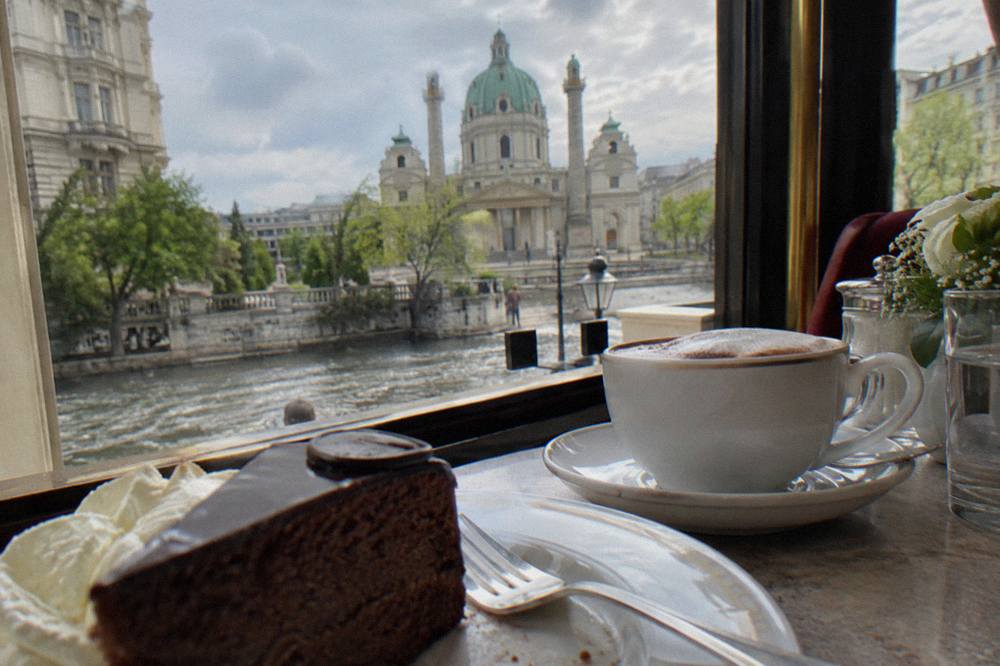
The five and a half hour coffeehouse, market and street food walk, which this site covers in detail, is the format that ties both hubs together: it moves between coffee house stops, market stalls, and street food stands with lunch and drinks included, so the start point is chosen to make that loop work. Its exact meeting point and start time are on the booking page, and if you would rather see the full picture before deciding, the Lunch and Markets, Small Group link shows current dates, times, and the meeting description in one place.
How Do You Reach The Naschmarkt Area At Kettenbrueckengasse?
The Naschmarkt sits along the Wienzeile between the Kettenbrueckengasse and Karlsplatz stations, and market-focused food walks meet at a named gate or stand row rather than at a loose "Naschmarkt" pointer. The market's own rules cap stand hours, with all stands required to be open Tuesday to Friday between 15:00 and 18:00, and sales stands permitted up to 21:00 on weekdays, which shapes when walks start.
Kettenbrueckengasse is the station most confirmations reference for the western end of the market, near the flea market side and the U-Bahn viaduct. The area around it has been reshaped by the market's redevelopment: the former car park is now a green space with dozens of newly planted trees, the new timber Marktraum hall has opened with thirteen regional food stands, and the full redevelopment is expected to complete in February 2027, so entrances and walkways have shifted during the works. All of this is worth knowing before you navigate to a stand number, because the shortest route from the station may not be the one your map remembers.
If your walk meets at the market, the confirmation usually names the gate or the first stand. Official city rules set the maximum hours for the market's stands and venues, and a tasting walk that includes a proper stop will be timed against them, which is one reason the two hour market walks start mid-morning or mid-afternoon rather than at the day's edges. The two hour Naschmarkt guided walk is the clearest example: it is built entirely around the market, and its meeting point and start time are on the booking page.
For the practical side of a market visit beyond the walk itself, the hours and the Saturday flea market are covered in the Naschmarkt opening hours guide, and the wider picture of what to eat there is in the Naschmarkt food guide. If your walk ends at the market and you want to keep browsing, the flea market runs Saturdays from early morning to mid-afternoon, though it is restricted on two December dates for the Christmas tree market.
What Should You Know About Vienna Public Transport Tickets?
Vienna's network runs on a proof-of-payment system: you buy or validate a ticket before boarding and carry it during the ride, with inspectors issuing fines on the spot. Digital tickets cost slightly less than paper ones, ticket machines in stations take cards, and current prices are published on the operator's official site, wienerlinien.at, which is the place to check before travel.
This site does not reprint fare tables, because they change and the operator's own site is the authoritative source, but the mechanics are stable and worth understanding. A single ticket covers one continuous journey including transfers, so a hotel-to-meeting-point trip is one ticket even if you change from tram to U-Bahn. Short-stay tickets covering 24 hours or a week exist and suit visitors making several trips a day, and the digital versions bought in the app are consistently a little cheaper than the paper equivalents from machines. Children, and in some cases dogs and bikes, have their own rules, all listed on the operator's site at wienerlinien.at.
Two local quirks catch visitors out. First, paper tickets from a machine must be validated in the blue or red validators at the platform entrance before your first ride, and an unvalidated ticket is treated as no ticket. Second, most shops cannot sell you a travel ticket on a Sunday, because Austrian retail closing rules shut supermarkets and stores on Sundays, with exceptions mainly at stations, the airport, and some bakeries, so buy any paper ticket you need the day before. Sunday walks are common, and the walk itself will feed you, but the ticket question is yours to solve on Saturday.
| Ticket Question | What To Do | Where To Confirm |
|---|---|---|
| Single journey to the meeting point | Buy before boarding, validate paper tickets at the platform | wienerlinien.at |
| Several rides in one day | Compare the 24-hour ticket against singles in the app | wienerlinien.at |
| Digital vs paper | Digital versions are consistently slightly cheaper | wienerlinien.at |
| Sunday purchase | Station and airport shops are the open exceptions | Station kiosks |
| Group or family options | Rules vary by age and number, listed with the fares | wienerlinien.at |
A practical note for the walk itself: you will not need a ticket during a guided walk, since walking tours move on foot between stops. Budget one ticket or one day pass for the journey in, and one for the journey out from wherever the walk ends, which the booking page also states. If the end point is the Naschmarkt, the chances are good you will want to stay anyway.
When Should You Leave Your Hotel For A Morning Or Evening Walk?
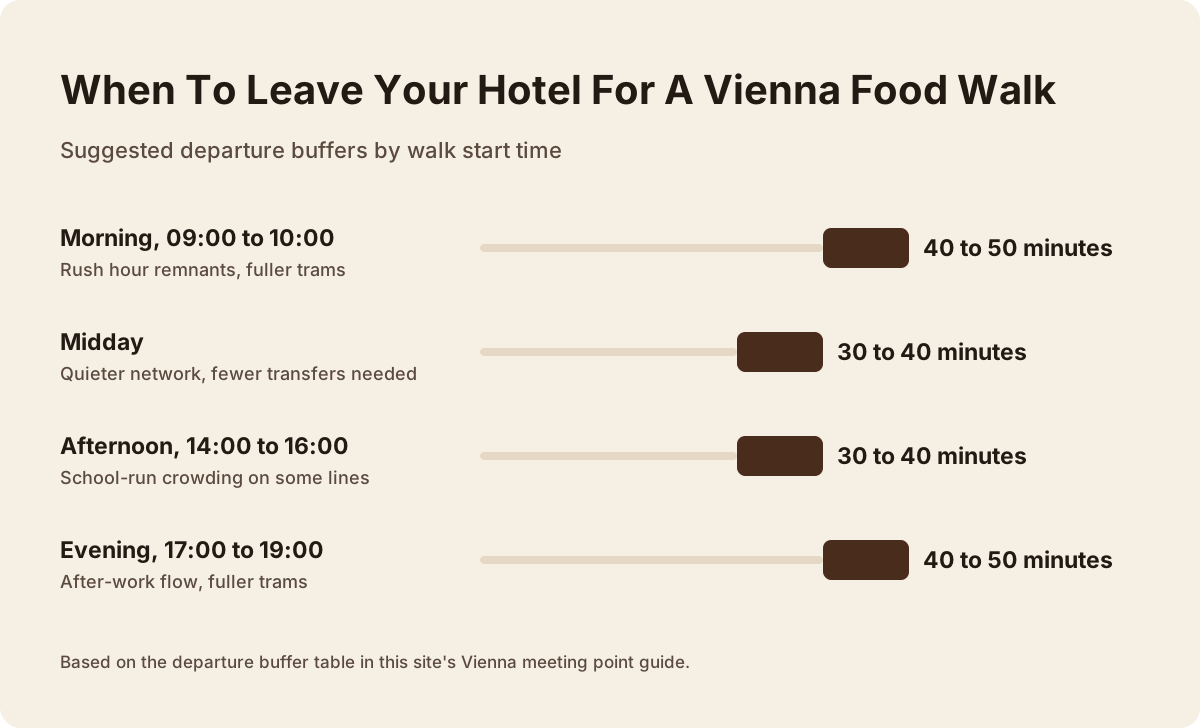
For a morning food walk, leave enough time to arrive at the meeting point ten minutes before the stated start, which in central Vienna usually means departing your hotel forty to fifty minutes early for a cross-city journey. Evening walks need the same buffer plus a little more, since trams run slightly less often and restaurant districts get busy around the pre-theatre hour.
The buffer is not pessimism, it is arithmetic. A cross-city U-Bahn ride in Vienna is quick, but the walk to the station, the wait, one transfer, and the walk from the exit to the meeting point each add minutes, and a single missed connection can eat the difference. Ten minutes at the meeting point costs you a coffee standing at a sausage stand window; ten minutes late costs you the first tasting, and most operators state their late policy plainly, which ranges from joining at the second stop to missing the walk without a refund.
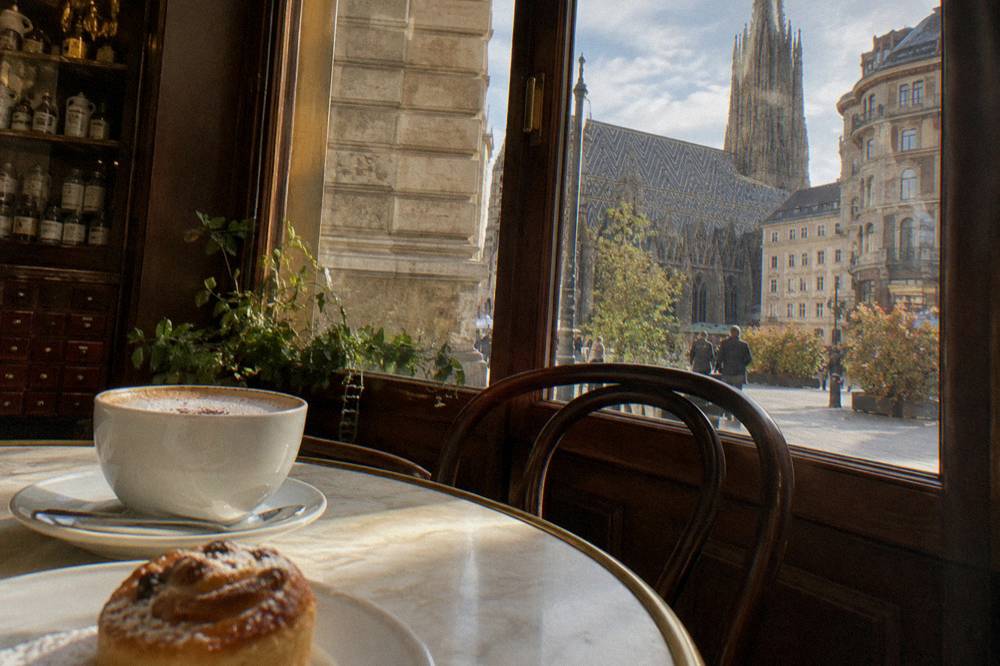
Morning walks have a specific advantage worth planning around: Vienna's coffee houses open early, and a walk that starts near one gives you a proper Melange before the guide arrives, which is very much in the spirit of the format. The three and a half hour coffee house walk, which pairs pastries and bites with the stories behind the institution, is a format built entirely around this rhythm, and its start point is chosen to make a mid-morning coffee house circuit work. Details and start times are on its booking page.
For evening walks, the same arithmetic applies with a twist: you are travelling against the pre-theatre and after-work flow, trams are fuller, and if the walk includes drinks, as the small-group dinner, wine and cocktail formats do, you will want to eat lightly beforehand only if the listing says so. The booking description states what food is included, and it is worth reading closely, since some evening formats are effectively a full dinner across stops. Planning around the walk's food content is covered from the buyer's side in the which Vienna food walk to book guide.
| Walk Start Time | Suggested Departure Buffer | Why |
|---|---|---|
| Morning, 09:00 to 10:00 | 40 to 50 minutes before departure | Rush hour remnants, fuller trams |
| Midday | 30 to 40 minutes | Quieter network, fewer transfers needed |
| Afternoon, 14:00 to 16:00 | 30 to 40 minutes | School-run crowding on some lines |
| Evening, 17:00 to 19:00 | 40 to 50 minutes | After-work flow, fuller trams |
These are planning ranges, not promises: the real number depends on your hotel's distance from a station, and a hotel two minutes from a U-Bahn stop needs less buffer than one deep in a side street. The where to stay for food lovers guide covers the trade-offs district by district if you are still choosing a base.
Is The Network Usable With A Stroller, Suitcase, Or Limited Mobility?
Most of Vienna's U-Bahn fleet and the newest trams are step-free by design, with level platforms on the U-Bahn and low-floor sections on modern trams, but individual station lifts and escalators can be out of service, and accessibility details for a specific route should be confirmed on wienerlinien.at before travel. Accessibility arrangements for a specific walk should be confirmed with the operator through the booking page's contact details.
Vienna's network is generally considered one of Europe's more manageable ones for wheels of any kind, and low-floor trams are the norm on central routes. The weak point is the last-minute one: a lift outage can turn a step-free journey into a staircase, and the operator's site and app carry current lift status. If your mobility needs are specific, checking the lift situation at your boarding station and your arrival station the night before, and again in the morning, is the habit that prevents surprises.
For the walk itself, the honest answer is that food walks vary. A market-and-coffee-house format moves along flat, paved routes and suits strollers well; a walk with cellar stops, which several wine and tasting formats include, may involve stairs without alternatives. The operator's booking description states the route character where it matters, and where it does not, message the operator before booking, which is also the advice for dietary needs, since a vegetarian lunch option is stated on some listings and nothing in the listings promises vegan or gluten-free arrangements.
Luggage deserves a sentence of its own. If your walk starts on departure day, stations and airport connections are built for suitcases, but a guided tasting walk is not: operators reasonably expect you to arrive hands-free, and a suitcase at a coffee house table is a nuisance for everyone. Most major stations have lockers, and leaving luggage there before a morning walk is the standard move.
What If A Line Is Diverted Or A Station Is Closed?
Vienna's network is in a period of sustained construction, including a major S-Bahn core closure running into late 2027 and a rolling programme of tram and bus diversions, so check the operator's site or app for your specific route on the morning of the walk. A diversion rarely cancels a journey, it just adds minutes, which is exactly what your ten minute arrival buffer exists to absorb.
The single most useful habit for a visitor with a booked walk is a sixty-second check of live disruption information while having breakfast. The official channels list current diversions, replacement services, and station closures, and they are updated in real time. If your route is affected, the app usually offers an alternative automatically, and in a city as dense as Vienna's network, an alternative almost always exists: a diverted tram is typically covered by a parallel U-Bahn line, and a closed station by a neighbouring one within walking distance.
The market area has its own version of this. The Naschmarkt redevelopment, running until early 2027, has already relocated the farmers' market stands during tunnel works and shifted entrances, and stand rows have moved during the build. If your walk meets at a specific stand or gate, a map that is even a year old may point you to the wrong corner, so the confirmation's landmark description beats your phone's memory. Give the operator's contact details the benefit of the doubt and call if you cannot find the group, since guides are used to shepherding stray guests in by phone.
One more seasonal wrinkle: from mid-November, the Christmas markets change traffic around the Rathausplatz and the inner ring, with fourteen sister markets joining it across the city and over eight hundred stalls in total, per the city's official announcement. Walks starting in the centre are not cancelled by this, but the streets between your station and the meeting point will be fuller and partly rerouted for pedestrians, so add a few minutes to any buffer and enjoy the detour past the stalls. The Vienna Christmas markets guide covers the markets themselves if the walk has whetted your appetite for the season.
| Disruption | Typical Effect | What To Do |
|---|---|---|
| Tram diversion | Route shifted a street over, stops moved | Follow the app's alternative, allow 10 extra minutes |
| Station closure | Entry closed, nearest station a short walk away | Check lift and closure status at breakfast |
| S-Bahn core works | Regional trains rerouted until late 2027 | Use U-Bahn lines for cross-city trips |
| Market construction | Stand rows and entrances shifted until early 2027 | Navigate by the confirmation's landmark, not an old map |
| Christmas market season | Fuller streets near the Ring from mid-November | Add a few minutes to the buffer |
For a different evening format that starts centrally, the two and a half hour hidden wine cellars tasting experience is worth a look: it keeps the transit question simple by starting in the centre, and the cellar setting means weather and street closures barely matter. Meeting details are on its booking page.
Whatever format you choose, the mechanics in this page hold: the booking page names the point, the confirmation carries the contact, the ticket is bought before boarding, and the buffer is ten minutes. Vienna rewards the early arriver with a sausage stand breakfast and a coffee house window seat, which is a better use of ten minutes than a sprint.
Common Questions About Meeting Points In Vienna
How Do You Find Your Vienna Food Walk Meeting Point?
The operator's booking page states the exact meeting point, usually a named station exit, market gate, or address with a landmark, and repeats it in the confirmation email with a contact number. Check it the night before rather than on the tram.
How Early Should You Arrive At A Food Walk Meeting Point?
Aim for ten minutes before the stated start time. That buffer absorbs a missed tram or a wrong station exit, and late policies vary by operator, from joining at the second stop to missing the walk without a refund.
Do You Need A Public Transport Ticket For The Walk Itself?
No, guided walks move on foot between stops. You need tickets only for the journey to the meeting point and away from the end point, and digital tickets from the operator's app cost slightly less than paper ones.
Where Do Naschmarkt Food Walks Meet?
Market walks meet at a named gate or stand row, most commonly referenced against the Kettenbrueckengasse station area. Because the market is being redeveloped into early 2027, navigate by the landmark in your confirmation rather than an older map.
What If A Tram Or U-Bahn Line Is Diverted On Walk Day?
Check the operator's site or app at breakfast for live diversions. A diversion rarely cancels a journey in a network as dense as Vienna's, and your arrival buffer plus the app's alternative route will usually absorb the difference.
Can You Join A Walk With A Stroller Or Limited Mobility?
Many central routes are step-free, but lift outages happen, so check lift status on wienerlinien.at and confirm the route character with the operator before booking, since formats with cellar stops can involve stairs without alternatives.