Naschmarkt Food Guide: What To Eat, Where And When
The Naschmarkt is Vienna's best known market and the standard first stop of a guided food walk. Here is what the official hours actually allow, what is worth tasting, what to skip, and how the ongoing redevelopment changes a visit.
Short answer
The Naschmarkt stretches along the Wienzeile between the Kettenbrückengasse and Karlsplatz U-Bahn stops. Official city rules let sales stands trade Monday to Friday until 21:00 and Saturday until 18:00, with every stand required to be open Tuesday to Friday 15:00 to 18:00. Browsing is free, tastings cost what the stalls charge, and a guided walk bundles them.
The Naschmarkt has been feeding Vienna for generations of shoppers, long enough that its history is usually traced back to the riverbank milk sellers who worked the site before the market took its modern form. Today it stretches along the Wienzeile between the Kettenbrückengasse and Karlsplatz U-Bahn stations, a long strip of produce stalls, cheese counters, fishmongers, spice vendors and sit-down restaurants that locals treat as a supermarket and visitors treat as an open air menu. Both groups are right, which is exactly why the market rewards a little planning.
It is also the standard first stop of most guided food walks in the city. Operators use it because it concentrates a whole range of Austrian and international flavours into one walkable lane, with no entry fee and no queue at a door. Whether you browse on your own or let a guide do the ordering, the same questions come up: when is it actually open, what is worth tasting, what is overpriced, and what is all that construction about. This guide answers each one, using the city's official rules and the current reporting on the market's rebuild.
What Is The Naschmarkt In Vienna?
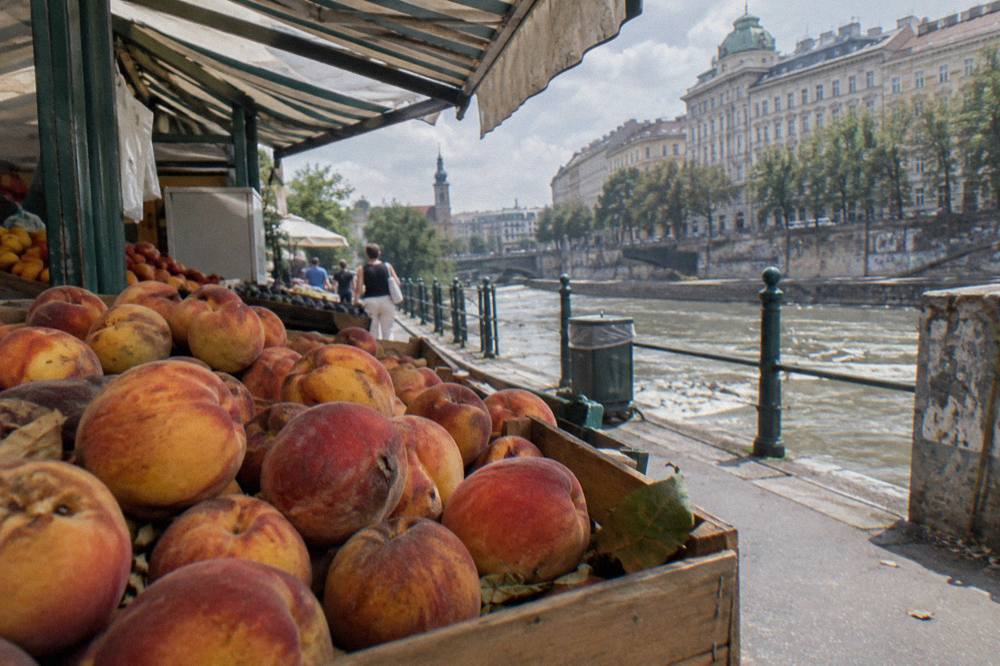
The Naschmarkt is Vienna's largest and best known public market, a long strip of stalls and restaurants along the Wienzeile between the Kettenbrückengasse and Karlsplatz U-Bahn stations. It combines produce stands, cheese and fish counters, spice sellers and dozens of sit-down restaurants, and browsing it costs nothing. The city regulates its hours, and a Saturday flea market runs alongside it.
The market's layout is simple once you see it. The eastern half, closer to Karlsplatz, leans traditional: fruit and vegetable stands, bakeries, butchers, and the cheese and olive counters where most of the tasting happens. The western half, toward Kettenbrückengasse, has drifted toward sit-down gastronomy, with restaurants spanning Austrian classics to Vietnamese, Turkish and Lebanese kitchens. The mix is the market's real character. This is not a museum of Viennese food, it is a working market where the city's immigrant kitchens and its sausage-and-schnitzel traditions sit twenty metres apart.
A useful framing for a first visit: the stalls are where you taste, the restaurants are where you sit. Stalls sell by weight and by piece, so an olive tasting, a wedge of cheese or a slice of bread costs whatever the counter charges that day, and nothing is verified or fixed enough to print a price list here. Restaurants operate like any other Vienna restaurant, with a Gedeck cover charge possible in the more traditional ones and a 5 to 10 percent tipping custom if service earns it. Our guide to Vienna Food Tours covers how a guided walk fits into a first day in the city, if you are weighing that option.
One thing the Naschmarkt is not: a farmers' market every day. The city's own pages describe a separate Bauernmarkt component that has been relocated during construction works, with regional producers selling on set days rather than continuously. Expect a market that is partly produce trade, partly street food, partly restaurant row, and plan for the parts you actually came for.
When Is The Naschmarkt Open In Vienna?
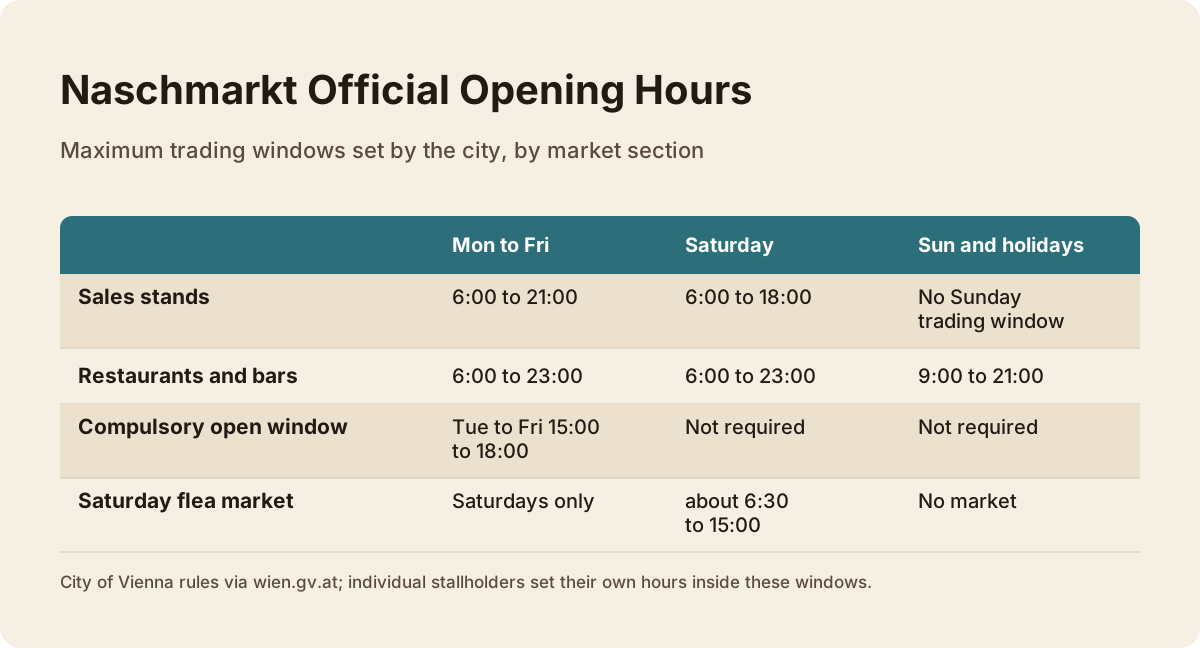
Official city rules allow sales stands at the Naschmarkt to trade Monday to Friday from 6:00 to 21:00 and Saturday from 6:00 to 18:00. Restaurants and bars may open Monday to Saturday 6:00 to 23:00 and on Sundays and holidays 9:00 to 21:00. In particular, every stand and venue must be open Tuesday to Friday between 15:00 and 18:00, which is the one window the city guarantees.
Those are maximum windows, not promises. Individual stallholders choose their own hours inside them, so a Saturday morning looks and feels very different from a Tuesday at 17:00, when the compulsory window forces nearly everything open. If you want the market at its fullest without the weekend crowd, Tuesday to Friday late afternoon is the officially backed sweet spot. If you want atmosphere and don't mind shoulder to shoulder lanes, Saturday morning is the classic experience, and it doubles as flea market day.
Sundays are the trap. The sales stands have no Sunday window at all, so a Sunday visit limits you to the restaurants, which may open from 9:00. Vienna's shops mostly close Sundays too, with exceptions mainly at stations and the airport, so a Sunday Naschmarkt trip should be planned as a meal, not a shop. The full official hours are published on the City of Vienna's Naschmarkt page.
| Part of the market | Official maximum hours | Notes |
|---|---|---|
| Sales stands | Mon to Fri 6:00 to 21:00, Sat 6:00 to 18:00 | No Sunday trading window |
| Restaurants and bars | Mon to Sat 6:00 to 23:00, Sun and holidays 9:00 to 21:00 | Sunday visits are restaurant only |
| Compulsory window | Tue to Fri 15:00 to 18:00 | Every stand and venue must be open |
| Saturday flea market | Sat about 6:30 to 15:00 | Not on 25 and 26 December, restricted 12 and 19 December 2026 |
What Should You Eat At The Naschmarkt?
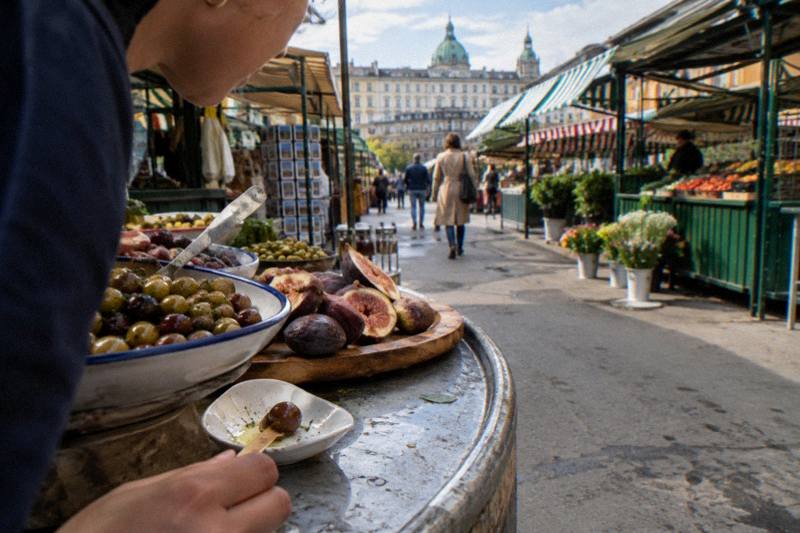
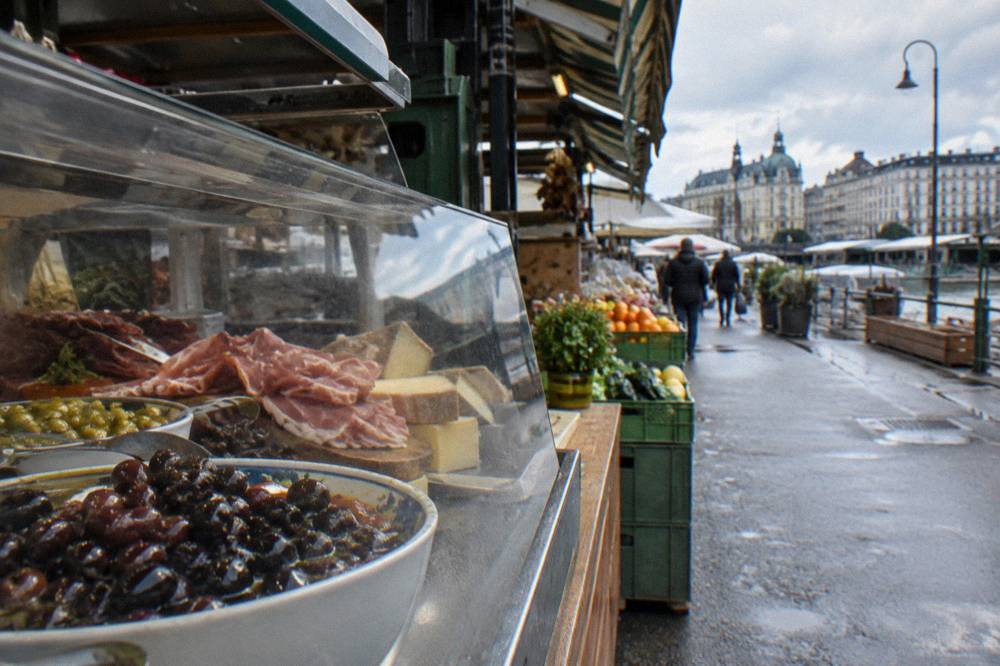
The strongest tasting ground is the market's eastern stalls: olives and antipasti by weight, regional cheeses, cured meats, fresh bread and the fruit and vegetable stands that give the market its colour. Skip nothing Austrian at the stall counters, and save seated meals for the restaurant row, where lunch menus, the Mittagsmenue custom, often undercut the dinner card. No individual stall names or dish prices are verified, so judge by the counter in front of you.
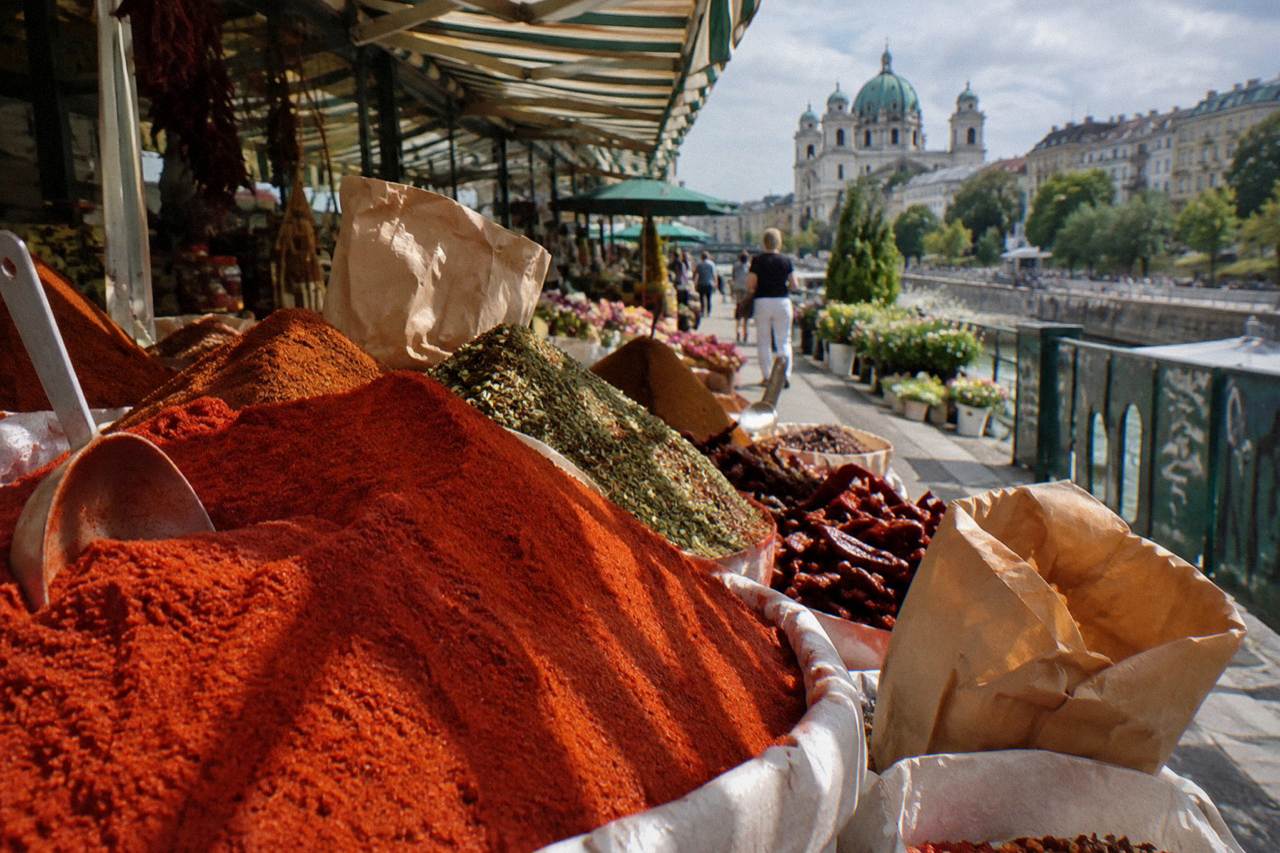
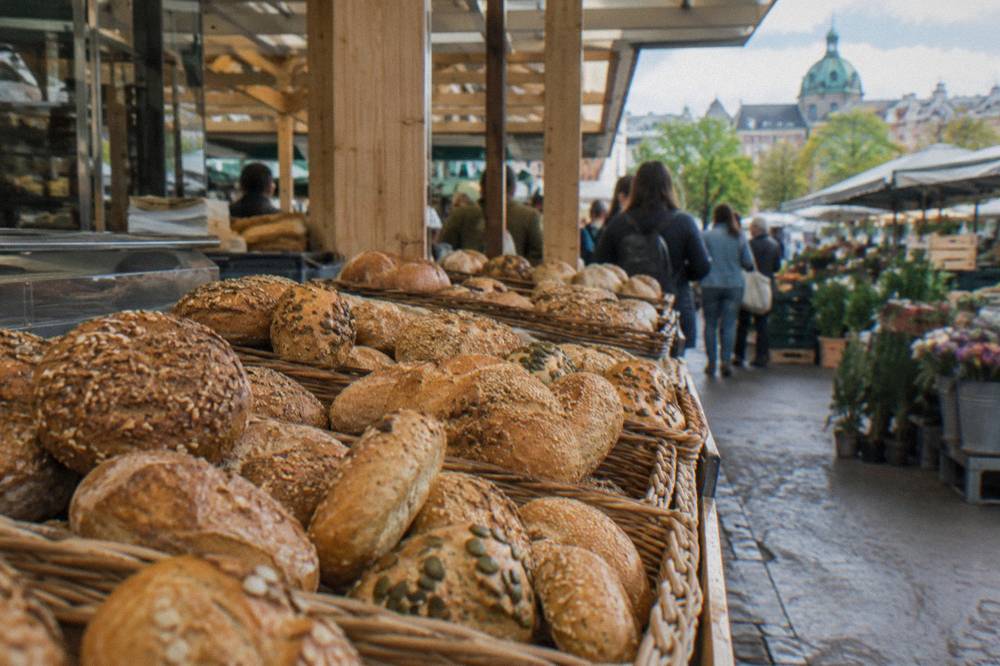
Work the stalls in the order a local would. Start at a bakery or bread stand for a slice of whatever is still warm, move to a cheese counter for a mixed wedge, add olives or antipasti by weight, and finish with fruit. This is the cheapest, most honest version of the market, and it costs whatever the scales say. Fish counters and spice stalls are the visual highlights worth browsing even if you buy nothing, the spice stands being the most photographed thing here after the flea market crowd.
The restaurant row is a different animal. Dozens of kitchens line the western half, and the practical advice is to eat where the menu is short and the room is full. Weekday lunch is the value moment: the Mittagsmenue, a set lunch menu, is a general Austrian custom rather than a Naschmarkt-specific price, so expect a cheaper midday card at many kitchens and confirm at the table. For the deeper context on Viennese dishes themselves, our traditional dishes of Vienna guide explains what schnitzel, Tafelspitz and Kaiserschmarrn should actually look like before you order them.
If you would rather not negotiate a dozen counters in German-tinged market English, this is precisely where a guided walk earns its fee. The Naschmarkt food tasting walk spends two and a half hours in the market with tastings built in, so the guide places the orders, translates the counters and walks you between the stands that earn their place. It is the most direct way to taste the market without doing the logistics yourself.
The alternatives in that band differ mainly in depth. The shorter guided option covers the market in two hours for visitors with limited time, while the longest of the three, Peters Naschmarkt Enjoyment walks at two hours, is built around an operator's curated route rather than open browsing. Details of stops and inclusions for each are on the operator's booking page, since individual stand visits vary with openings and season.
What Should You Skip At The Naschmarkt?
Skip the empty stretch, the stalls selling the same souvenirs you can find in the first district, and any restaurant whose greeter has to work for your table. Nothing about the market is a scam, but the value concentrates in the stall counters and the full rooms, and the difference between a great visit and an average one is mostly which half of the market you spend your time in.
The honest answer about tourist traps is nuanced. The market as a whole is not one, and locals genuinely shop here, but the western restaurant row has kitchens that live on passing foot traffic. The tell is always the same: a greeter actively recruiting, a vast multi-page menu covering three cuisines, and empty seats at prime Saturday lunch. A full room of German speakers is the opposite signal.
Shopping-wise, give the souvenir and gift stalls a pass if your goal is food. They are harmless, but they are not why the market exists, and the same magnets cost the same in the centre. Spend the attention instead on the counters where something is being cut, weighed or cooked in front of you, because that is the market's actual product. Our longer treatment of the question, is the Naschmarkt a tourist trap, works through the argument in detail.
One more skip worth naming: don't plan a full shop on Sunday, and don't arrive at 19:00 on a Saturday expecting anything but restaurants. The official windows in the table above are the hard edges of the visit, and no amount of enthusiasm extends them. A guide can't extend them either, which is why the tasting walks all start in the morning or early afternoon.
How Does The Saturday Flea Market Work?
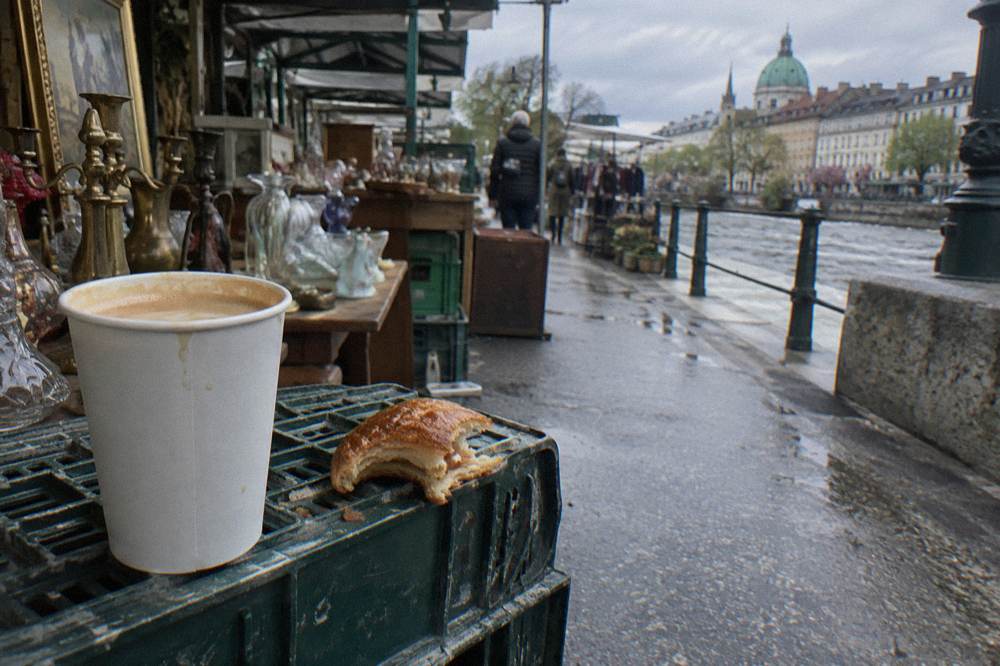
The flea market, Flohmarkt beim Naschmarkt, runs every Saturday from about 6:30 to 15:00 along the edge of the market site near Kettenbrückengasse U-Bahn. Entry is free, it is a genuine mixed junk and antiques market rather than a curated craft fair, and 2026 has two December restrictions: no market on 25 and 26 December and a reduced market on 12 and 19 December for a Christmas tree market.
Go early if you want the good stuff, and go late if you want the cheap stuff. Dealers set up in the dark and the serious browsing happens before 9:00; by early afternoon sellers are packing and prices soften. Cash remains the working currency of the aisles. The mix runs from actual antiques, silver, books, furniture, to boxes of unsorted household odds and ends, and the ratio shifts week to week. The official market information is summarised on the Naschmarkt's own visitor page.
Combining the two markets is the classic Vienna Saturday: flea market first, then walk east into the food stalls as the appetite builds, then lunch on the restaurant row. It is a lot of standing, so comfortable shoes matter more than any other planning detail. Arriving by U-Bahn, Kettenbrückengasse serves the flea end and Karlsplatz the food end, so you can structure the walk either direction and never backtrack.
A Saturday flea visit also pairs well with a food walk that extends beyond the market itself. A full meal walk of the kind above runs about three and a half hours and turns the tasting into lunch rather than a snack crawl, which suits a day when the morning has already been spent on your feet in the aisles.
Is The Naschmarkt Being Rebuilt?
Yes, partially, and the works are visible but not disruptive to a normal visit. The completed parts include the Naschpark, a new green space with 70 trees on the former car park, and the new timber Marktraum hall with 13 regional food stands. The full redevelopment, including the remaining market works, is now expected to finish in February 2027 rather than the end of 2026.
The reporting is specific about what happened and what slipped. The farmers' market component was temporarily relocated, with some stands made smaller during U4 tunnel sealing works, and traders described roughly 30 percent lower sales during that transition. The Marktraum hall, about 800 square metres of timber structure, opened with 13 stands offering regional and seasonal products, and one of those stands, an Italian cheese seller, vacated in spring 2026 with the city seeking a replacement. The overall completion date moved to February 2027, per Kurier's August 2026 report.
For a visitor, none of this closes the market. The main stall lane, the restaurant row and the flea market all run, and the new park is a genuine improvement to the western end, a place to sit with whatever you bought at the stalls. The practical effect is layout noise: some areas look like a building site because parts of them are, and the farmers' market stands may not be where a map or an older guide puts them.
| Redevelopment piece | Status | What it means for a visit |
|---|---|---|
| Naschpark green space | Completed | 70 new trees on the former car park, a place to sit and eat |
| Marktraum hall | Open, about 800 square metres | 13 stands of regional and seasonal food, closed at night |
| Farmers' market relocation | Ongoing during works | Producer stands may be in temporary spots |
| Full completion | Expected February 2027 | Expect visible works through late 2026 |
Should You Visit On Your Own Or With A Guide?
Visit on your own if you enjoy browsing and are happy ordering at counters in a foreign market, and book a guided walk if your time is short, you want tastings pre-arranged, or you want the market explained rather than just sampled. A two to two and a half hour guided option costs from the price on the listing, and the longer tasting walks fold the market into a bigger route with lunch included. If you enjoy the idea of a guide but want a drink-led version, the Vienna beer and craft brewery guide covers local lagers, the Ottakringer brewery, and how to book a beer tasting.
The case for going alone is real and shouldn't be undersold. Entry costs nothing, the market is one straight lane that is impossible to get lost in, and half the pleasure is wandering. If you speak a little German, or are comfortable pointing and smiling, the stall counters are straightforward. Budget whatever the tastings cost at the counter and a few euros for a sit-down coffee or lunch, and you have a genuinely cheap half day in an expensive city.
The case for a guide is efficiency and access. A guide knows which counters to stop at, places group orders so you are not queueing six times, and translates the market's texture into something you'd otherwise walk past. For travellers with one full day in Vienna, two and a half hours of pre-arranged tasting beats ninety minutes of hesitation. The comparison of formats in which Vienna food walk to book works through the choice by itinerary type, and our guide to food walk costs covers what typically sits inside the price.
| Factor | On your own | With a guided walk |
|---|---|---|
| Cost basis | Free entry, pay per tasting at the counter | From $62 per person, tastings arranged by the guide |
| Time needed | A relaxed half day of browsing | Two to two and a half hours for a market-focused walk |
| Language at counters | Yours plus gestures | The guide orders and translates |
| What you learn | What you notice | Market context and vendor knowledge from the guide |
| Best suited to | Slow travellers, repeat visitors | Short itineraries and first-time visitors |
Dietary needs are the one factor that should push you toward messaging an operator before booking anything. The listing descriptions state a vegetarian lunch option for some walking tours, but no listing states vegan or gluten-free coverage, so if that matters, write to the operator first and confirm. That advice holds for the market on your own too: stall counters are obliging but not labelled the way a restaurant menu is.
How Do You Get To The Naschmarkt?
Take the U4 to Kettenbrückengasse for the flea market and western restaurant end, or the U1, U2 or U4 to Karlsplatz for the eastern produce stalls, the two stations bracketing the market lane between them. Both are a short walk from the Ringstrasse trams, and the whole market is flat, paved and step-free along its length, which makes it one of Vienna's easier food walks for anyone with mobility limits.
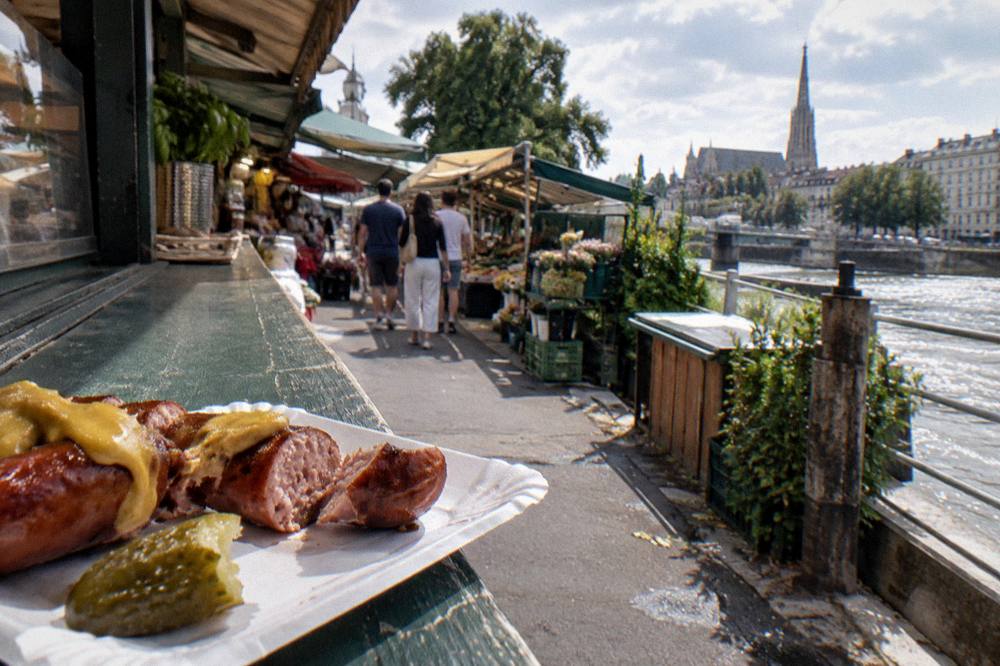
The orientation that matters: the market runs along the Wienzeile, the wide road carrying traffic on both sides of the canalised Wien river, with the stalls on the island between the two carriageways. Pick your end by your plan, flea market first means Kettenbrückengasse, food stalls first means Karlsplatz, and walking the full length between them takes about fifteen minutes without stops, which of course nobody manages. Our meeting points guide collects the practical arrival details for the guided walks, whose start points cluster around the market's eastern end.
Cycling is also viable, with city bike paths running nearby, and the flat layout makes the market itself walkable for prams and wheelchairs. The one arrival mistake to avoid is driving: parking around the market is scarce, and the redevelopment has chewed through what the car park used to handle, the former car park being the site of the new Naschpark. Public transport wins here without argument.
Timing the arrival against the official windows is the last piece. Morning suits photographers and serious shoppers, the Tuesday to Friday 15:00 to 18:00 compulsory window suits anyone who wants every shutter up, and Saturday before noon suits people who want both markets at full energy. Sunday, as ever, belongs to the restaurants alone.
Common Questions About The Naschmarkt
What Is The Naschmarkt In Vienna?
Vienna's largest and best known public market, a long strip of produce stalls, cheese and fish counters, spice sellers and restaurants along the Wienzeile between the Kettenbrückengasse and Karlsplatz U-Bahn stations. Browsing is free.
When Is The Naschmarkt Open In Vienna?
Official city rules allow sales stands Monday to Friday 6:00 to 21:00 and Saturday 6:00 to 18:00, with restaurants until 23:00 Monday to Saturday and from 9:00 on Sundays and holidays. Every stand must be open Tuesday to Friday 15:00 to 18:00.
What Should You Eat At The Naschmarkt?
Work the eastern stalls: olives and antipasti by weight, regional cheeses, cured meats and fresh bread, then fruit. Judge by the counter in front of you, since no individual stall prices are fixed or verified, and save a seated meal for the restaurant row.
When Does The Saturday Flea Market Run?
Every Saturday from about 6:30 to 15:00 along the Kettenbrückengasse edge of the market. In 2026 there is no market on 25 and 26 December and a reduced market on 12 and 19 December because of a Christmas tree market.
Is The Naschmarkt Being Rebuilt?
Partly. The Naschpark green space and the timber Marktraum hall are done, while the full redevelopment is expected to complete in February 2027. The main stall lane, restaurants and flea market all run as normal through the works.
Is The Naschmarkt Worth Visiting Without A Tour?
Yes, if you enjoy browsing and ordering at counters. A guided tasting walk suits short itineraries and anyone who wants tastings pre-arranged, with two to two and a half hour options covering the market with a local guide.