Vienna Cooking Classes: Strudel, Schnitzel And Beyond
Strudel and schnitzel classes are Vienna's most hands-on food experience: one to three hours, a small group, a meal you cooked yourself, and a recipe you take home. Here is what each class covers and how to pick between them.
Short answer
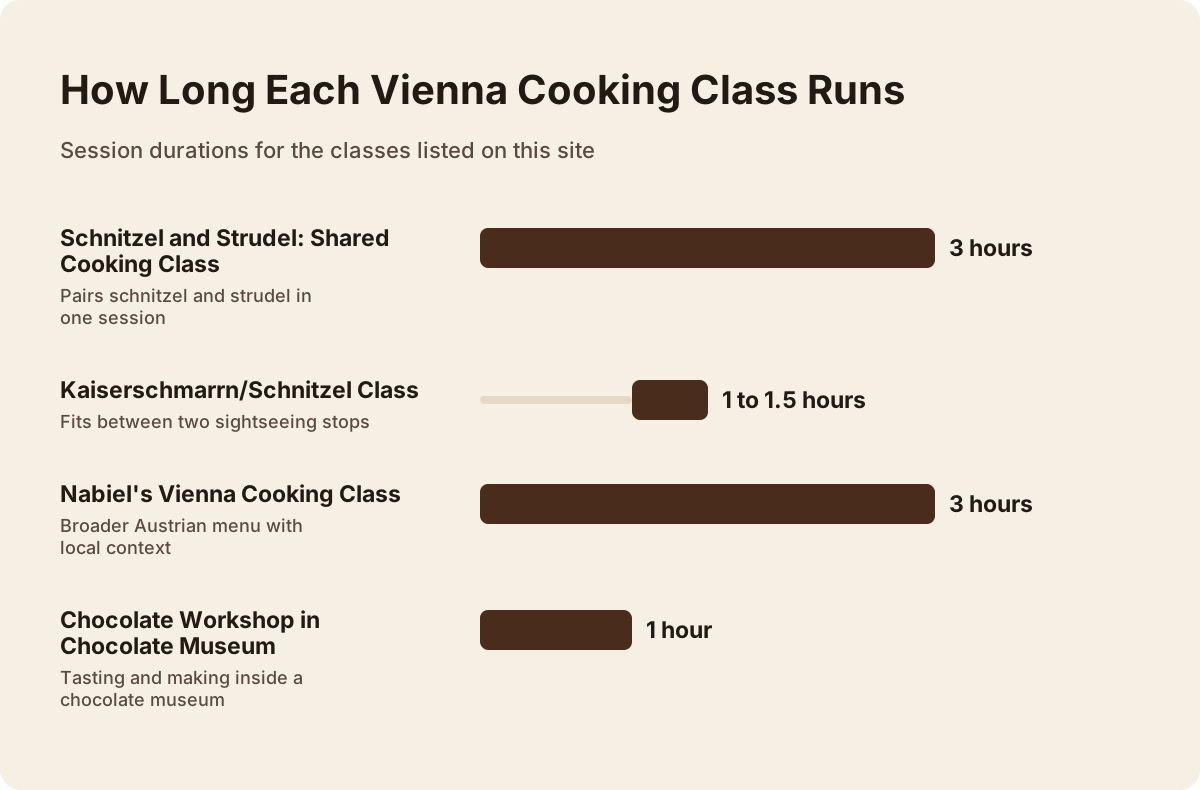
A Vienna cooking class runs 1 to 3 hours depending on the format. The shared strudel and schnitzel class lasts 3 hours, Nabiel's Vienna cooking class 3 hours, and the kaiserschmarrn and schnitzel class 1 to 1.5 hours. Prices are shown on each operator's booking page. All three end with eating what you cooked.
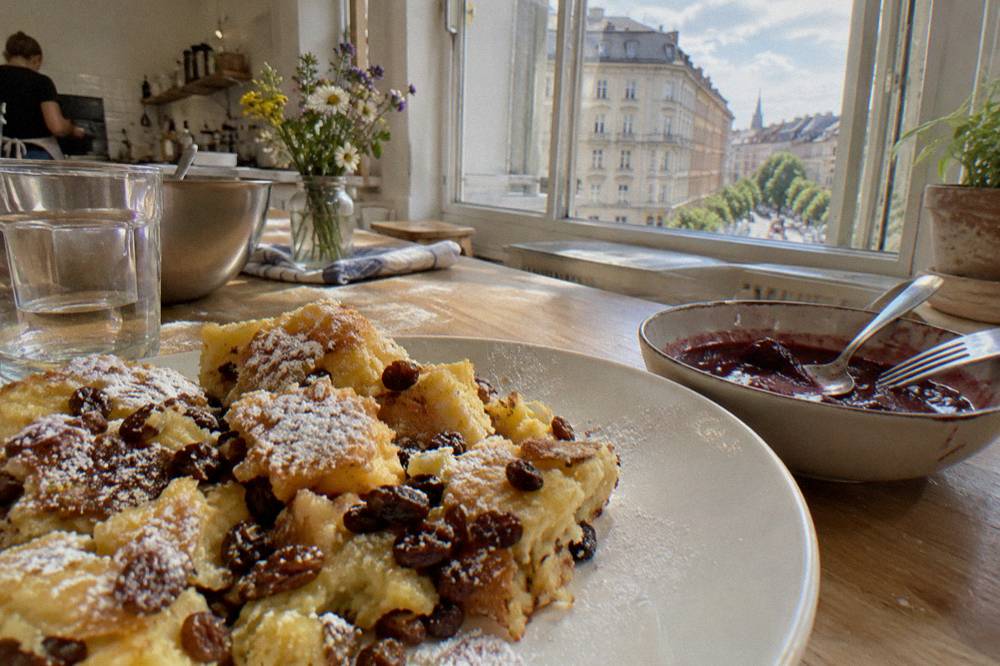
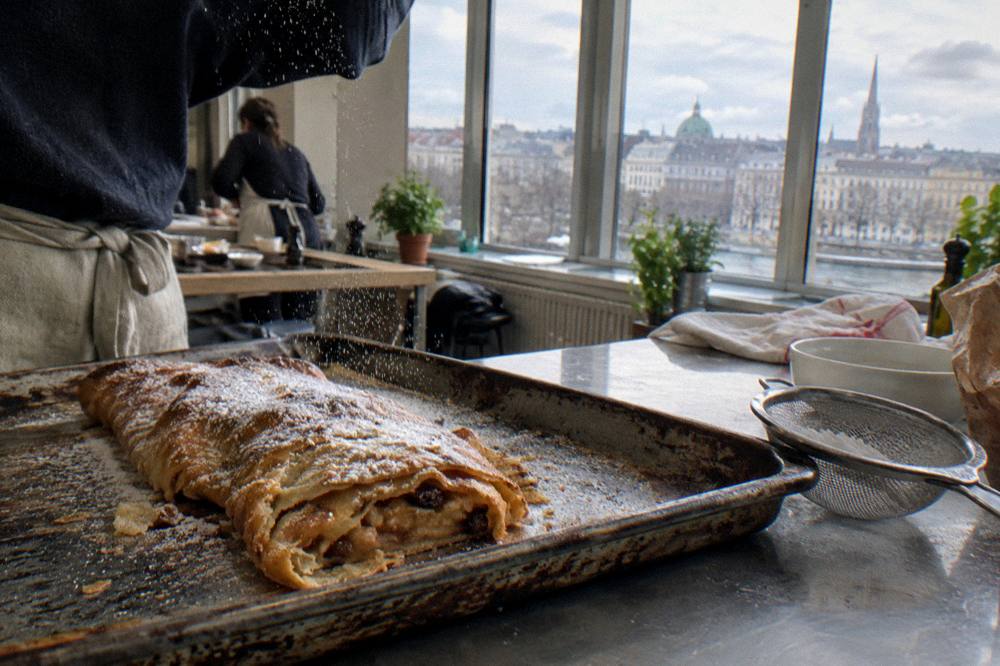
Strudel dough stretched so thin you can read a newspaper through it, a schnitzel bubbling in a pan, a plate of torn kaiserschmarrn dusted with icing sugar: a cooking class is the one Vienna food experience where you leave with the skill, not just the receipt. Three cooking classes and one chocolate workshop sit in the city's bookable line-up, ranging from a 45-minute tasting to a full 3-hour kitchen session, and they suit very different trips.
This guide covers what a Vienna cooking class actually includes, how the durations and formats differ, what the day looks like from meeting point to meal, and how a class compares with a guided food walk if you only have time for one. Every class detail here comes from the operators' own listings, durations, group formats, meal and drinks inclusions. Where a detail such as an exact price is only on the booking page, it says so plainly.
What Does A Vienna Cooking Class Actually Cover?
A Vienna cooking class covers hands-on preparation of one to three classic dishes, usually strudel, schnitzel or kaiserschmarrn, guided by an instructor, and it ends with you eating the result. Sessions run 1 to 3 hours, prices are listed on each booking page, and formats range from a shared group class to a chocolate workshop in a museum.
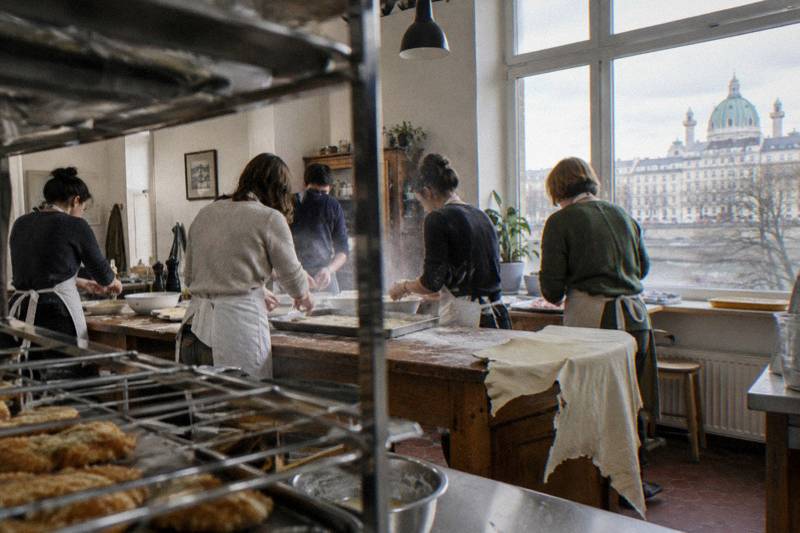
The core format is straightforward. You arrive, meet the instructor and the rest of the small group, and work through the dishes step by step: kneading and stretching strudel dough, breading and pan-frying schnitzel, or tearing and caramelising kaiserschmarrn. The listing for the shared Schnitzel and Strudel class describes a 3-hour session built around those two pillars of Viennese home cooking. The kaiserschmarrn and schnitzel class compresses a similar idea into 1 to 1.5 hours, which suits a morning slot between sightseeing stops. Nabiel's Vienna cooking class, also 3 hours, takes a broader approach to Austrian dishes rather than a single duo.
The chocolate workshop is the outlier in this group. It runs 1 hour inside a chocolate museum, so it is a tasting-and-making hybrid rather than a cooking class in the kitchen sense. Families with younger children often find it the easiest fit, while anyone who wants to leave able to cook a full Viennese plate should stay with the three-hour options.
What the classes have in common is the meal at the end. Unlike a demonstration or a show kitchen, every class here finishes with eating what the group produced, which makes the format genuinely different from a restaurant meal or a market walk: the plate arrives with a story attached, and the story is yours. For travellers deciding between this and eating out, the traditional dishes of Vienna guide explains what each of these plates is and where to find them made by professionals.
Which Strudel And Schnitzel Class Should You Book In Vienna?
Book the shared Schnitzel and Strudel class if you want the classic 3-hour version with both signature dishes and a shared meal; book the kaiserschmarrn and schnitzel class if you have only 1 to 1.5 hours; book Nabiel's class for a 3-hour session with a broader Austrian menu. Prices for all three are on the operators' booking pages.
The choice mostly comes down to time and appetite. The shared class pairs the two dishes most travellers come for, schnitzel and apple strudel, in a single three-hour block, and the listing presents it as a social, shared-kitchen format. That suits couples, small groups of friends and solo travellers who want company at the counter. The kaiserschmarrn and schnitzel class covers two dishes too, but the fluffy shredded pancake replaces the strudel, and the 1 to 1.5 hour length makes it the realistic pick for anyone with a packed itinerary, or for a family whose children will not sit through three hours of dough work.
Nabiel's class is the one to choose when the goal is a wider slice of Austrian cooking rather than the two famous plates. The 3-hour format gives the instructor room for additional dishes and local context, and the listing frames it around Vienna's food culture generally. It is also the natural fallback when the shared strudel class is fully booked on your dates, which happens in peak season because the small-group kitchen format limits numbers.
A quick way to test the decision: if you would be happy eating exactly one plate of schnitzel plus one dessert, either the strudel or the kaiserschmarrn version works. If you want technique you can repeat at home, the three-hour classes give more repetition and more instructor time per dish.
How Long Is A Vienna Cooking Class And What Does It Cost?
Vienna cooking classes run from 1 hour for the chocolate workshop to 3 hours for the shared strudel and schnitzel class and Nabiel's class, with the kaiserschmarrn and schnitzel class at 1 to 1.5 hours. Current prices are shown on each operator's booking page, since class pricing moves with season and group size.
Duration is the first planning number because it decides where a class fits in a day. A three-hour class, plus travel to the meeting point, eats most of a morning or an afternoon, so it works best as the anchor of that half-day rather than something squeezed between museums. The 1 to 1.5 hour kaiserschmarrn class slots between two sightseeing stops, and the 1-hour chocolate workshop behaves more like a themed break than a meal replacement.
| Class | Duration | Dishes or focus | Best fit |
|---|---|---|---|
| Schnitzel and Strudel: Shared Cooking Class | 3 hours | Schnitzel and strudel | First-time visitors wanting the classics |
| Traditional Kaiserschmarrn/Schnitzel Cooking Class & Tasting | 1 to 1.5 hours | Kaiserschmarrn and schnitzel | Tight schedules, families |
| Nabiel's Vienna Cooking Class | 3 hours | Broader Austrian menu | Repeat visitors, keen home cooks |
| Chocolate Workshop in Chocolate Museum with Tasting | 1 hour | Chocolate making and tasting | Children, sweet-toothed travellers |
On cost: class prices are not fixed public figures the way a museum ticket is, and this article does not print numbers the operators do not publish. The booking page for each class shows the current per-person price, and seasonal demand, weekend slots and private-versus-shared formats all move it. As a planning rule, a shared class in Vienna costs less per person than a private session, and a three-hour class costs more than a one-hour workshop, so set expectations by format rather than by a single number read anywhere.
One more planning note: Vienna's kitchens, like all Austrian gastronomy, have been smoke-free indoors since November 2019, so classes run in clean-air kitchens. That detail and the rules behind it are on the official Austrian business portal, which sets out the smoking ban in gastronomy.
What Does The Day Look Like At A Vienna Cooking Class?
A Vienna cooking class day looks like this: you travel to the stated meeting point, meet the instructor and group, cook or bake for most of the session, and finish by eating the dishes together. The shared strudel class and Nabiel's class each run 3 hours; the kaiserschmarrn class compresses the same arc into 1 to 1.5 hours.
The exact meeting point for each class is stated on its booking page, and it matters: Vienna's cooking venues sit in ordinary buildings rather than landmark kitchens, so check the address and the transport connection the evening before. The getting to Vienna food meeting points guide covers the practical side of reaching typical class and food walk locations by public transport.
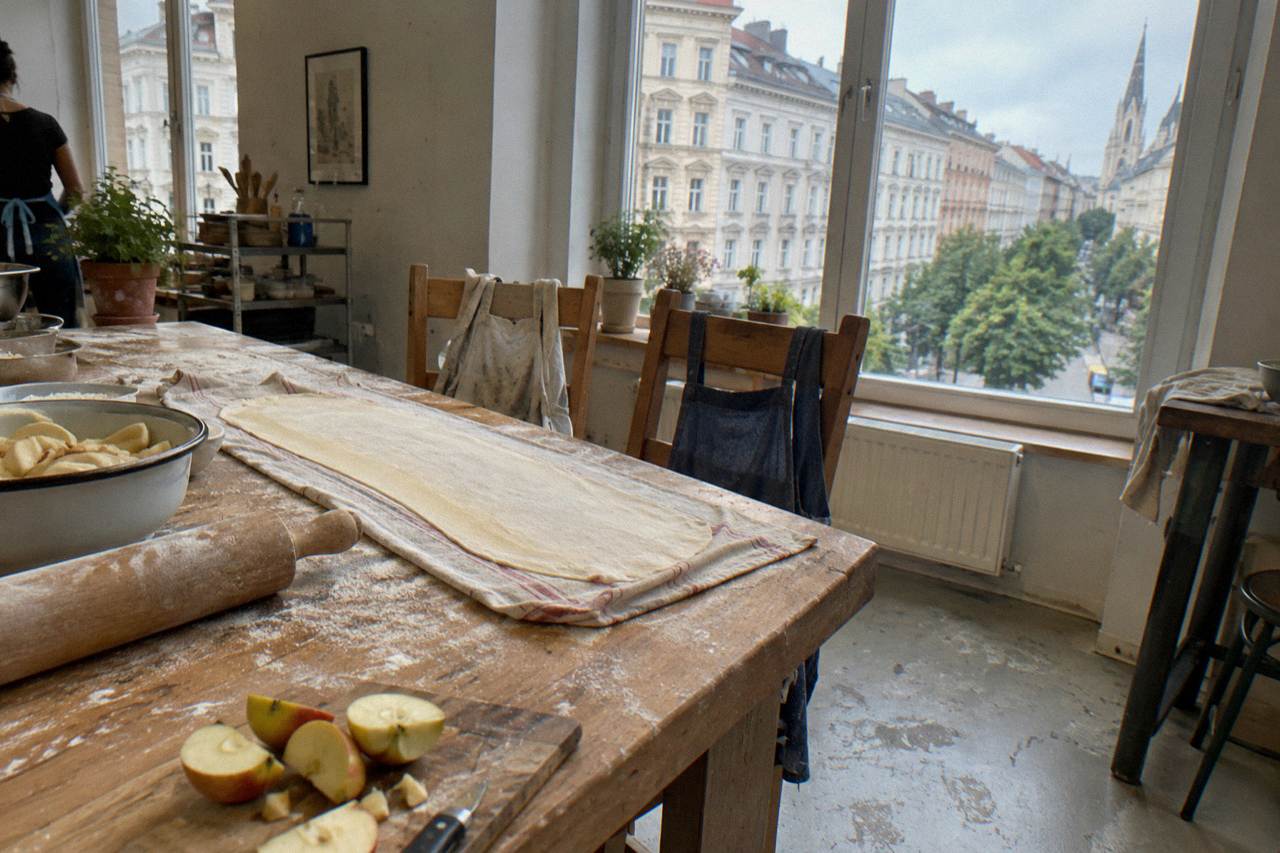
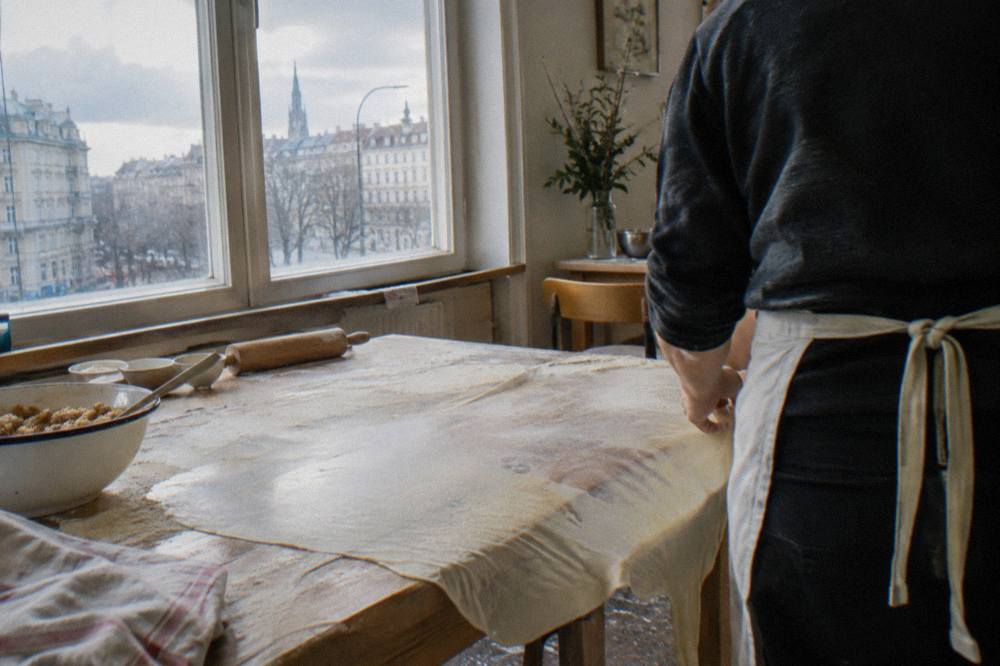
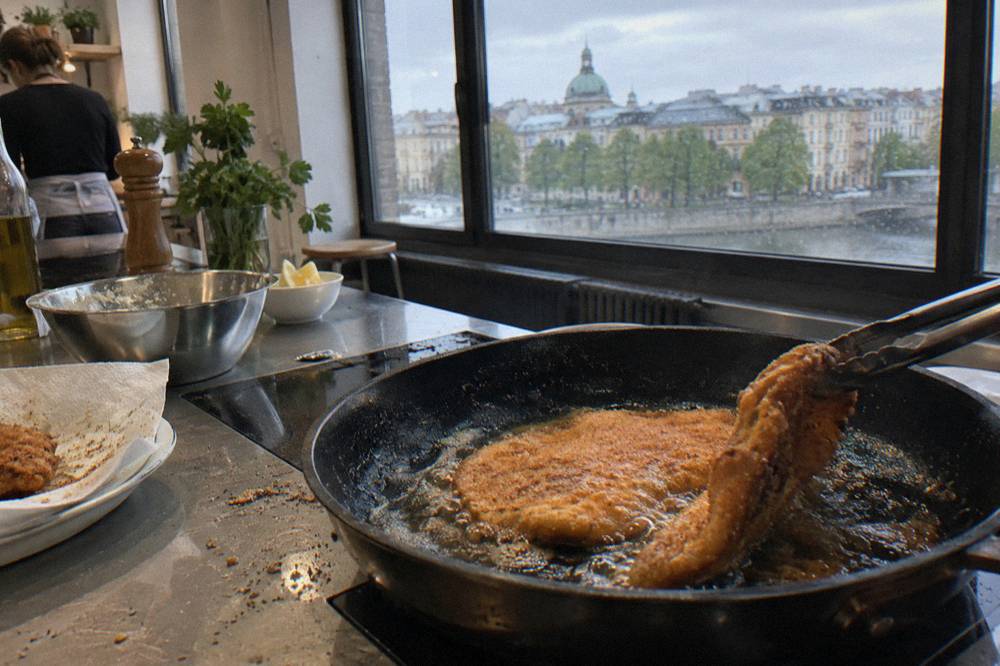
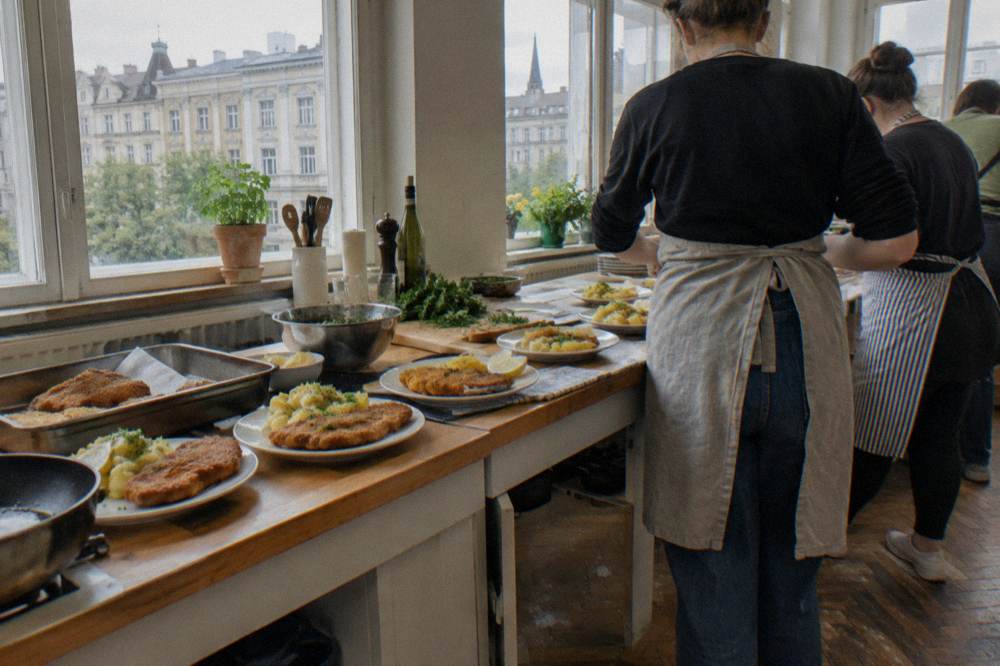
Once inside, the session usually opens with a short briefing and aprons. In the strudel classes the first stretch of the session goes to the dough, because strudel dough needs time and patience: kneading, resting, then stretching it paper-thin by hand over a floured cloth. Schnitzel work comes with the breading sequence, flour, egg, crumbs, and the pan. Kaiserschmarrn is faster: batter, pan, tear, caramelise. Instructors in the three-hour classes have room to explain each step and correct technique, which is where the format earns its length.
The class closes with the shared meal. That final half hour is not a footnote: it is when the group sits down to the schnitzel and the strudel fresh from the oven, and for most travellers it is the part they remember. If your trip is short and you want both the cooking and a broader tasting of the city, the two can pair well, and the question of which order to do them in is covered in choosing between Vienna food walks.
For travellers who want to build the class into a food-themed day, a natural pattern is a morning class followed by an afternoon at the Naschmarkt, whose stands may trade to 21:00 on weekdays and whose restaurants are allowed to serve to 23:00 Monday to Saturday, per the City of Vienna's official market hours page. A class in the morning, a market stroll before the stands thin out after 18:00 on a Saturday, and dinner nearby makes a full and unhurried food day.
Do Vienna Cooking Classes Include A Meal And Drinks?
Yes, all three cooking classes include the meal you cooked, which is the core of the format; the chocolate workshop includes a tasting. Drinks inclusions differ by class, so check the booking page's inclusions list before assuming coffee, wine or soft drinks are covered.
The meal inclusion is what separates a cooking class from a demonstration. The listings for the shared strudel and schnitzel class, the kaiserschmarrn class and Nabiel's class each describe a session that ends in eating, so budget for the class, not for a separate lunch that day. That also makes the three-hour classes decent value against a restaurant lunch plus a separate activity, though the actual price comparison depends on the current figures on the booking pages.
Drinks are the detail to verify. Austrian meals conventionally come with water or wine, and tap water in Vienna restaurants can legally carry a charge when it is listed on the menu, a habit the restaurant etiquette guide explains in full. In a class setting the operator usually provides basic drinks with the meal, but the inclusions list on the booking page is the only reliable source for what is and is not included, so read it rather than assuming.
For context on how far Vienna's own food scene has travelled, the Michelin Guide Austria 2026 added several Vienna addresses to its Bib Gourmand value list, including the revived Wirtshaus Rosi and the vegetarian TIAN Bistro am Spittelberg, per Michelin's own announcement of the new Bib Gourmands. A class teaches you the home-cooking end of that culture; the restaurant scene shows the polished one, and a trip that samples both gives the fuller picture.
Can Vegetarians Or Families Join A Vienna Cooking Class?
Families can join, and the 1 to 1.5 hour kaiserschmarrn and schnitzel class and the 1-hour chocolate workshop are the gentlest formats for children; the three-hour classes suit teenagers and adults. Vegetarian needs depend on the dishes, so message the operator before booking to confirm adaptations.
The class listings do not state dedicated vegan or gluten-free versions, so the honest advice for any dietary restriction is the same as for the city's food walks: contact the operator before booking and ask directly. Kaiserschmarrn is a pancake dessert, which naturally suits vegetarian diners, while schnitzel in its classic form is meat. Strudel comes in apple form, which is vegetarian in the traditional recipe. Operators frequently adapt, but adaptation is their call, not a promise to be assumed from a listing.
For families, duration is the honest test. Three hours of dough stretching and pan work is a long block for younger children, while the shorter kaiserschmarrn class keeps the hands-on payoff in a tighter window. The chocolate workshop, at 1 hour inside a chocolate museum with a tasting, is the most child-proof option of the four, and it doubles as a rainy-day backup. Older children who genuinely like cooking do fine in the three-hour shared class, where the group setting spreads the waiting around.
Solo travellers and couples should not read "shared" as intimidating. The shared format is a social kitchen, not a competition, and the group meal at the end gives the session a built-in dinner-table conversation that a private class deliberately does not. Private versions of Vienna classes exist on booking pages for anyone who wants the instructor's full attention, at a higher per-person price.
Is A Cooking Class Or A Food Walk Better For Your Vienna Trip?
Take a cooking class if you want to leave with a skill and a full meal you made, in 1 to 3 hours; take a food walk if you want to cover more ground, taste more dishes and learn the city's food geography. A three-hour class replaces a meal, while the longest food walk, at 5 hours 30 minutes, replaces a meal plus an afternoon.
The two formats answer different questions. A class answers "how is this made", a food walk answers "where should I be eating". Vienna's longest food walk runs 5 hours 30 minutes and moves through coffeehouses, markets and street food stands with lunch included, so it samples broadly but teaches no technique. The class is static, narrower and deeper: one venue, a few dishes, real repetitions at the counter.
| Question | Cooking class | Guided food walk |
|---|---|---|
| Best for | Learning to cook the dishes | Tasting many dishes and districts |
| Time needed | 1 to 3 hours | About 2 to 5 hours 30 minutes |
| Food included | The meal you cooked | Tastings and often lunch, per listing |
| Skill taken home | Strudel or schnitzel technique | Restaurant and market knowledge |
| Group style | Small kitchen group | Walking group |
| Weather-proof | Fully indoors | Mostly outdoors between stops |
If you lean toward the walk side of that comparison, the durations below show how much of a day each alternative eats. The longest walks are close to a full working day on your feet, while the shorter market walks and cellar tastings slot beside other plans.
| Alternative experience | Duration | Category |
|---|---|---|
| Vienna Food Tour: Coffeehouses, Markets, Lunch & Street Food | 5 hours 30 minutes | Food walks and street food |
| Authentic Vienna Food Tour with lunch, street food, 3 drinks | 5 hours | Food walks and street food |
| Vienna Typical Austrian Food Tour with Coffee House Visit | 4 hours | Food walks and street food |
| Vienna Naschmarkt Food Tasting Tour | 2 hours 30 minutes | Naschmarkt and market tours |
| Vienna Naschmarkt Guided Food Tour | 2 hours | Naschmarkt and market tours |
| Viennese Wine Tasting in a Private Hidden Wine Cellar | 45 minutes | Heuriger, wine and beer tastings |
Combining both works well on a longer trip. A common pattern is a food walk on day one to learn the map, then a cooking class later in the stay, once the dishes have been tasted in their professional versions and the curiosity about technique has a foundation. Some travellers reverse it and cook first, then judge every restaurant plate against their own attempt, which is its own kind of fun.
If timing your whole food trip around seasonal events, note that Vienna's coffee calendar peaks with the Vienna Coffee Festival, next held 10 to 12 September 2027 at Marx Halle per the festival's official site, and that the city's 2026 Christmas markets open from early November, which pairs nicely with a winter class on strudel. The best time to visit Vienna for food guide maps the rest of the year.
How Do You Prepare For A Vienna Cooking Class?
Prepare for a Vienna cooking class by confirming the meeting point and inclusions on the booking page, arriving in clothes you do not mind dusting with flour, eating lightly beforehand, and noting any dietary message you sent the operator. Nothing else is needed; ingredients and equipment are provided by the class.
The practical list is short. Wear closed shoes and avoid dangling sleeves, since pans and hot sugar are involved. Arrive a few minutes early, because a small-group kitchen cannot wait long without eating into everyone's cooking time. If you messaged the operator about a vegetarian adaptation or an allergy, bring it up again at the start of the session rather than mid-recipe. Leave the rest of the afternoon loose for the three-hour classes; the meal at the end means you will not need a second lunch.
Booking timing matters more than preparation. Small-group kitchens cap numbers, so weekend and holiday slots fill first, and the shared strudel and schnitzel class is the one most likely to sell out around Christmas market season and summer peaks. The Vienna Food Tours site's class pages link straight to each operator's booking page, where the current price, the meeting point and the cancellation terms are shown before payment. Check the cancellation window when you book, since it varies by operator, and reconfirm the meeting address a day ahead in case the venue has shifted a studio.
Common Questions About Vienna Cooking Classes
What Does A Vienna Cooking Class Actually Cover?
A class covers hands-on preparation of classic dishes, usually strudel, schnitzel or kaiserschmarrn, followed by a shared meal of what you cooked. Sessions run 1 to 3 hours, and all ingredients and equipment are provided.
How Long Is A Vienna Cooking Class?
The shared strudel and schnitzel class and Nabiel's class each last 3 hours, the kaiserschmarrn and schnitzel class 1 to 1.5 hours, and the chocolate workshop 1 hour. Current prices are on each operator's booking page.
Do Vienna Cooking Classes Include A Meal And Drinks?
All three cooking classes include the meal you prepared. Drinks inclusions vary by class, so check the inclusions list on the booking page rather than assuming coffee or wine is covered.
Which Strudel And Schnitzel Class Should You Book In Vienna?
Book the 3-hour shared class for the classic two-dish experience, the 1 to 1.5 hour kaiserschmarrn class for a tight schedule, or Nabiel's 3-hour class for a broader Austrian menu.
Can Vegetarians Or Families Join A Vienna Cooking Class?
Families fit best in the shorter kaiserschmarrn class or the chocolate workshop. Vegetarian diners should message the operator before booking to confirm adaptations, since listings do not state dedicated vegetarian versions.
Is A Cooking Class Or A Food Walk Better For Vienna?
A cooking class teaches technique and includes one full meal indoors; a food walk covers more dishes and districts across roughly 2 to 5 hours 30 minutes. Many travellers do the walk first, then the class.