What Is A Must Eat In Vienna?
The dishes worth crossing the city for: Wiener Schnitzel, Sachertorte, Melange in a coffee house, Gemischter Satz at a wine tavern, and the street food in between.
Wiener Schnitzel, Sachertorte, a Melange taken slowly in a traditional coffee house, and a glass of Gemischter Satz in a Heuriger wine tavern: if a trip only allows four eats, those four carry the most Viennese weight per bite. Around them sit the sausage stand, Käsekrainer in hand, Tafelspitz, Kaiserschmarrn and the market food of the Naschmarkt. Each classic has a right place to eat it, and this guide walks through them one by one, with the reported prices and the 2026 facts that shape the choices. Dish names are general knowledge here; the figures come from verified local reporting and official sources.
The short list that almost every local would agree on: Wiener Schnitzel, Sachertorte with whipped cream, a Melange inside a marble-floored coffee house, Gemischter Satz at a Heuriger, and a Käsekrainer from a Würstelstand late at night. That covers the four food cultures Vienna protects most loudly, the restaurant kitchen, the coffee house, the wine tavern and the sausage stand. Vienna's tourism body cites coffee house, Heuriger and sausage stand culture together as UNESCO heritage, and the city treats all three with unusual seriousness. Schnitzel, meanwhile, has become a measurable local obsession.
The numbers back that up. Delivery platforms counted 142,318 schnitzel orders in Vienna between 1 January and 31 August 2026, roughly 7.4 per 100 inhabitants, which put the city ahead of Linz and Graz and earned it the informal title of Austria's schnitzel capital. The same dataset put the national average schnitzel price at around 13.09 euros, up about six percent on the prior year, with a Viennese pork schnitzel averaging around 15.09 euros. Those are delivery figures, not restaurant menus, but they show where the city's appetite sits.
There is a sensible order to eat these things in, too. Schnitzel wants lunch, when kitchens fry it fresh. Cake and Melange belong to the long afternoon pause the coffee house was built for. Gemischter Satz is an evening drink in the wine hills at the city edge. The sausage stand covers everything after dark. For travellers with limited time, a guided walk is one way to compress several of these into a single afternoon; the four-hour Vienna: Typical Austrian Food Tour with Coffee House Visit is built exactly around this classic list, pairing the traditional dishes with a stop in a coffee house. Check the booking page for the current price, the meeting point and what is included. If you are still deciding what to pour alongside all of this, the guide to Vienna's most popular drink weighs Melange against Gemischter Satz, Sturm and beer.
For the full anatomy of each traditional dish, including Tafelspitz and Kaiserschmarrn, the companion guide to traditional Viennese dishes and what to eat goes deeper than this list can.
Where Should You Eat Wiener Schnitzel?
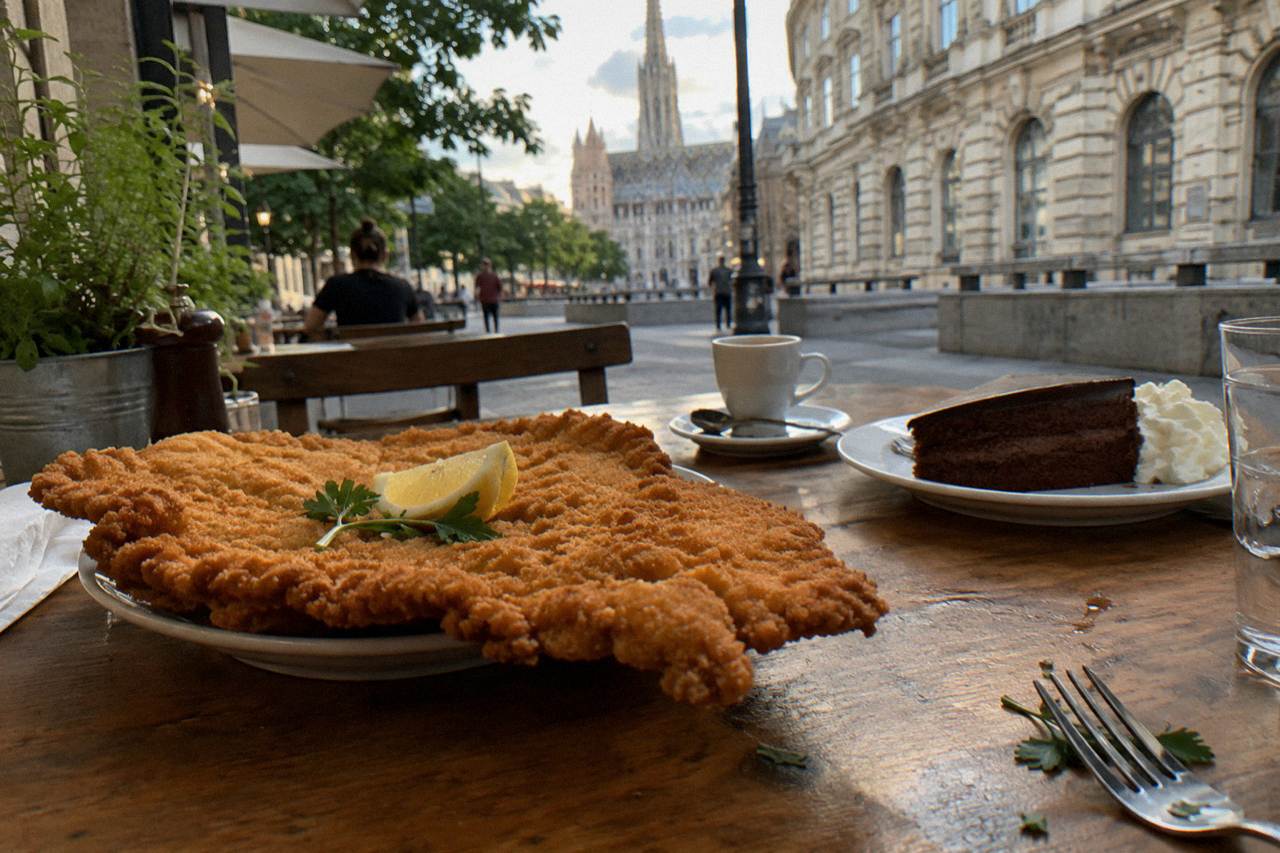
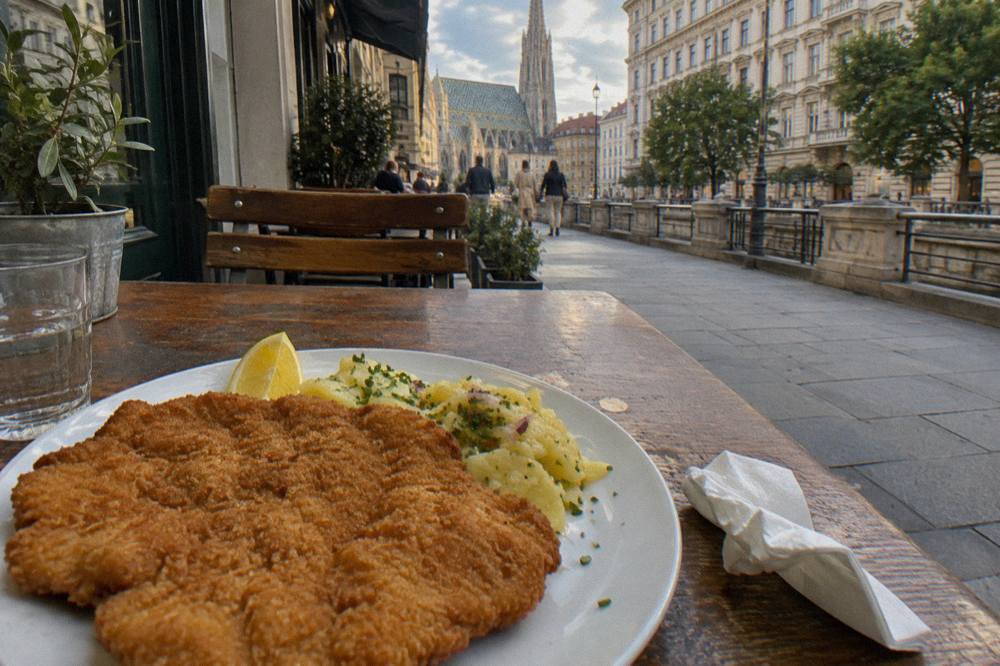
Eat Wiener Schnitzel at a traditional Beisl or Wirtshaus at lunch, freshly fried to order: the veal version is the legally named original, but pork, Schweineschnitzel, is what most Viennese actually order, and the delivery data shows they order it more than any other Austrian city does. The dish is a thin, twice-breaded cutlet fried in a shallow pan of fat or butter, served with lemon and usually potato salad or parsley potatoes. The moment it leaves the fryer matters more than the room it is served in.
Vienna's schnitzel scene got a fresh layer of interest in 2026. The Michelin Guide Austria 2026, released on 18 March 2026, kept the city's two three-star restaurants, Steirereck im Stadtpark and Amador, and the new Bib Gourmand list added three Viennese addresses including Rosi in the 15th district, a revived 1906 Wirtshaus reopened in late 2024 by a former Steirereck chef, serving a vegetarian-leaning modern Beisl menu with natural wines. A Bib Gourmand signals good cooking at moderate prices, which is exactly the schnitzel-and-Beisl end of the market. The classic schnitzel rooms of the first district still do a brisk trade, but the 2026 attention has shifted toward the neighbourhood Wirtshaus renaissance in districts further out.
| Schnitzel style | What it is | Where it fits |
|---|---|---|
| Wiener Schnitzel (veal) | The name-protected original, veal cutlet, fine breadcrumbs | Traditional first-district restaurants, higher menu prices |
| Schweineschnitzel (pork) | The everyday version most locals order | Neighbourhood Beisln, average around 15.09 euros by 2026 delivery data |
| Schnitzel vom Kalb, variants | Veal with regional twists, parsley or cranberry on the side | Modern Wirtshaus kitchens such as the 2026 Bib Gourmand additions |
Price expectations deserve a note. The delivery-index average of about 15.09 euros for a Viennese pork schnitzel is a 2026 reported figure, not a guarantee of any restaurant's menu. A classic Beisl schnitzel with sides often lands in the mid-to-high teens in euros, while veal in a grand old room in the centre costs more. Check the menu before sitting down, and expect a Gedeck, a cover charge of roughly 2 to 5 euros per person in traditional venues, listed on the menu as the law requires. The dedicated guide to where to eat Wiener Schnitzel in Vienna names the individual rooms worth the detour.
Is Sachertorte Really The Cake To Order?
Yes, one chocolate cake with apricot jam and a sealed chocolate glaze is the single most famous thing to eat in Vienna, and the honest answer is to order it where the rivalry is strongest: at Hotel Sacher for the Original, or at Demel for the rival version, ideally before noon or after four to dodge the worst queues. The two houses have feuded over the recipe ever since their long legal dispute over the right to the name. Hotel Sacher holds the "Original Sachertorte" name, with a seal and two layers of apricot jam under the glaze. Demel serves its competing cake, formerly sold as an "education torte", recognisable by a triangular seal and a single apricot layer. The legal distinction was still intact in 2026 sources.
The prices frame the decision. A slice of Original Sachertorte at the Hotel Sacher café costs around 11.50 euros, with a range of roughly 8.90 to 10.50 euros depending on serving format. Demel lists Sachertorte at 8.50 euros, Apfelstrudel at 9.50 euros and Kaiserschmarrn at 12.90 euros. Around the corner at Café Landtmann, Sachertorte is 8.50 euros, Apfelstrudel is 8.20 euros and Kaiserschmarrn is 15.70 euros. All of these prices can change; check the menu or the café's own site before going.
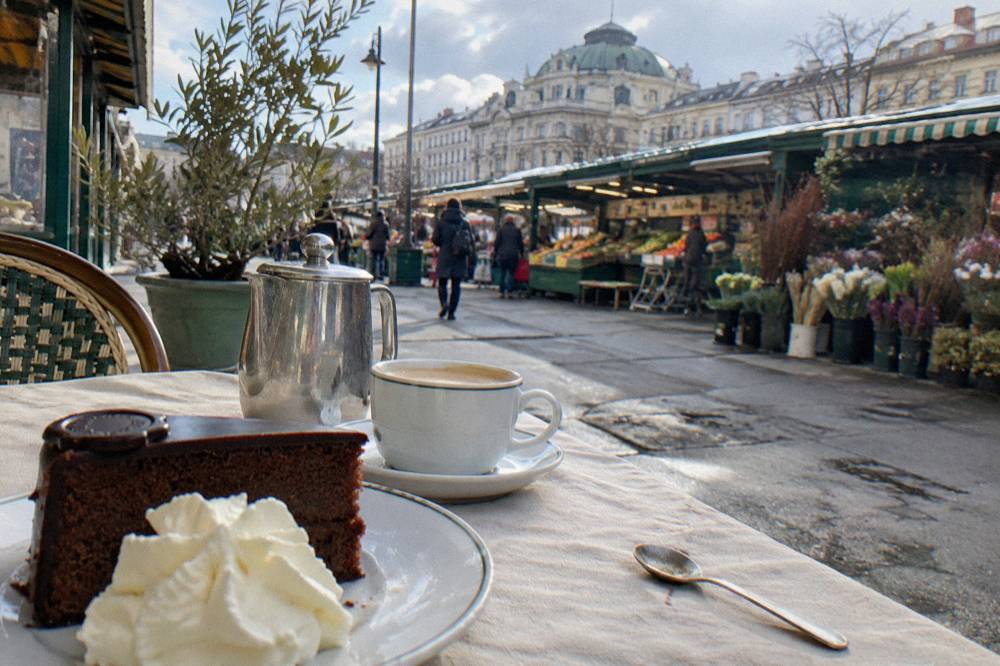
Two practical notes make the experience better. First, Sachertorte is a dense, dry-ish, deeply chocolate cake by design, meant to be eaten with a forkful of unsweetened whipped cream, Schlagobers, and a glass of water; expecting a moist dessert is the most common visitor complaint. Second, queues are real. Sacher's queue runs longest through the afternoon, while Demel's typically moves faster, and arriving early or after 16:00 is the standing 2026 guidance. One structural fact matters even more: Café Central, the grand vaulted coffee house on Herrengasse, has been closed for major renovation since 16 March 2026, with reopening planned for winter 2026, and its pop-up, Decentral, is operating meanwhile at Freyung 3 with a reported Melange at 5.40 euros and Apfelstrudel at 5.90 euros. Confirm status on the café's own site rather than assuming. The head-to-head comparison, including the full history of the cake feud, sits in Sachertorte or Demel: where to eat the cake.
| Classic coffee house item | Café Landtmann (reported menu price) | Café Demel (reported menu price) | Decentral pop-up (reported) |
|---|---|---|---|
| Melange | 6.90 euros | 6.90 euros | 5.40 euros |
| Sachertorte | 8.50 euros | 8.50 euros | not the signature here |
| Apfelstrudel | 8.20 euros | 9.50 euros | 5.90 euros |
| Kaiserschmarrn | 15.70 euros | 12.90 euros | varies |
Why Does The Coffee House Count As Eating?
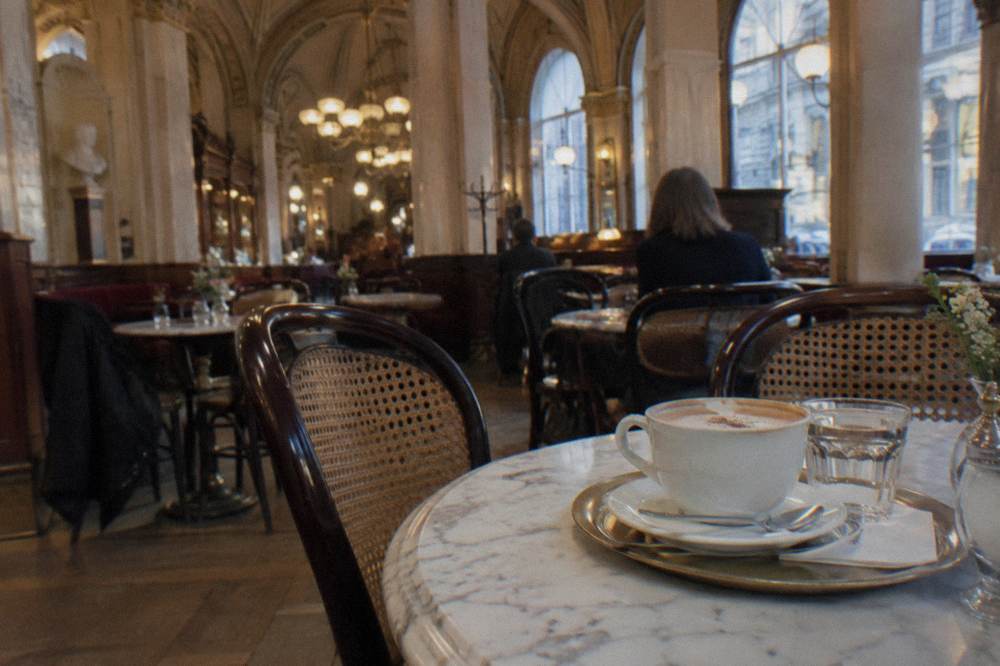
Because in Vienna the coffee house is not a café, it is a registered institution: coffee house culture was entered on Austria's national inventory of intangible cultural heritage in 2011, and the ritual of a Melange, a glass of water and a newspaper at a marble table is treated as part of the meal itself, with reported Melange prices clustering around 6.90 euros at the classic houses. Eating your way through Vienna without sitting for at least one long coffee house afternoon is to miss one of the four pillars. The order to make is the Melange, espresso with steamed milk, similar to a cappuccino but softer, or the Kaisermelange with egg and honey for the curious.
The price picture is consistent across the grand houses. A Melange costs 6.90 euros at Landtmann, and Museum and Schwarzenberg charge the same. The coffee house works as a budget valve, too: for the price of one Melange you can occupy a table for an hour or two, a habit the institution explicitly protects. Check Café Sperl's current prices in person. Landtmann takes reservations; Demel generally does not, which matters at peak cake hour.
The scene also has a calendar. The Vienna Coffee Festival ran 11 to 13 September 2026 at Marx Halle with admission reported at around 14 to 20 euros, and the 2027 edition is already set for 10 to 12 September 2027 at the same venue. That is past and future tense respectively; nothing is running this week. For the deep background, the Vienna coffee house culture guide and the companion piece on the best coffee houses in Vienna cover the rooms, the rituals and the ordering vocabulary in full. A guided version exists as well: several coffee-and-cake walks in the tour pages pair two or three houses with a guide who explains the heritage angle; details and durations are on each operator's booking page.
Should You Drink Your Meal At A Heuriger?
For one evening, yes: a Heuriger, the Viennese wine tavern licensed to serve only its own estate wine, turns dinner into a local institution, and roughly 100 genuine Buschenschanken still operate in the city, serving Gemischter Satz, the field-blend white that is Vienna's signature wine. The tourist board defines a true Heuriger by two signs: the pine bush, the Buschen, over the door, and the "Ausg'steckt" placard that signals both the wine's availability and the door being open. Heuriger culture is cited by the Vienna Tourist Board as UNESCO heritage alongside the coffee house and the sausage stand, though at national-inventory level rather than the global list.
The economics are gentle by capital-city standards. Reported 2026 norms put a self-service cold buffet plate at a neighbourhood Heuriger around 6 to 12 euros, an evening total often 8 to 15 euros, and an Achtel, an eighth of a litre of wine, around 3 to 5 euros. Those are reported ranges, not promises; tourist-oriented Grinzing rooms sit higher. The 2026 wine year behind those glasses had its own story: heat and dryness cut Vienna's harvest by 30 to 40 percent, yet quality was described as very good, and the rules for Wiener Gemischter Satz, at least three varieties in the vineyard, no single variety over half, were reaffirmed in the consolidated regulation in September 2026. The word "Heurige" itself may only describe the current vintage's wine until 11 November, St Martin's Day, after which it becomes "Alte", last year's.
Getting there is half the pleasure: tram D to Nussdorf, bus 35A to Neustift am Walde, tram 31 to Stammersdorf. Note that many traditional Buschenschanken reduce hours or close between November and March, while larger Grinzing and Nussdorf spots stay open year-round; opening periods are posted in the seasonal Ausgsteckt calendars. September's Sturm, the cloudy, partially fermented new must, is a September-to-October-only treat and is already gone for this year. The Heuriger visitor's guide covers districts, transport and etiquette in detail.
What About The Street Food And The Markets?
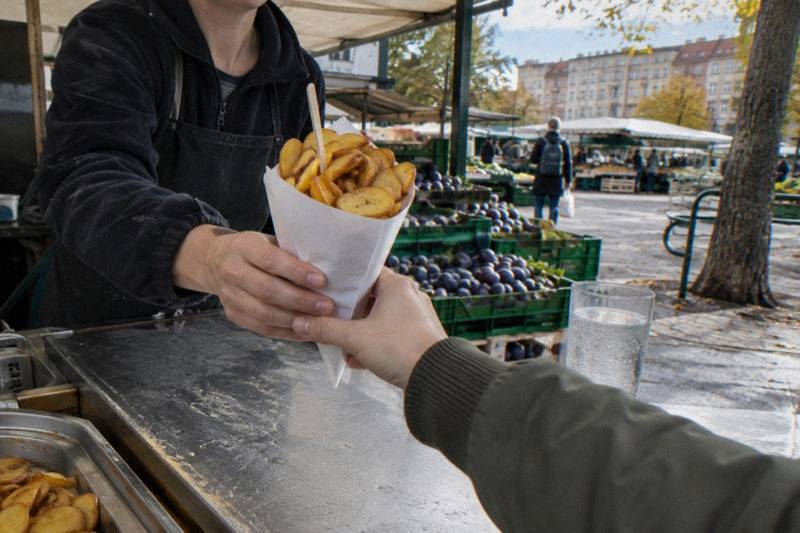
The Käsekrainer, a cheese-filled smoked sausage from a Würstelstand, is the fifth must eat, ideally with mustard and a slice of bread late at night, and the Naschmarkt, open six days a week with stands required to trade Tuesday to Friday from 15:00 to 18:00, is the daytime counterpart. The sausage stand and the market together cover the eating Vienna does standing up, and both are free to enter and browse; you pay only for what you point at.
Official city rules give the Naschmarkt structure that surprises visitors. Sales stands may open Monday to Friday until 21:00 and Saturdays until 18:00, while restaurants and bars on the market can run to 23:00 Monday to Saturday and 9:00 to 21:00 on Sundays and holidays. Every stand must be open Tuesday to Friday between 15:00 and 18:00, a rule that makes late afternoon the safest browsing window. The Saturday flea market beside it, running about 6:30 to 15:00, is closed 25 and 26 December and restricted on 12 and 19 December 2026 for the Christmas tree market. The market's own redevelopment is still mid-flight: the Naschpark green space with 70 trees is done, but full completion of the wider project slipped to February 2027.
A guided walk is the efficient way to convert browsing into tasting. The five-and-a-half-hour Vienna Food Tour: Coffeehouses, Markets, Lunch & Street Food crosses two of the must-eat categories in one day, moving through coffee houses, markets, lunch and street food stops; the operator's booking page carries the current price, meeting point and the full inclusion list, including the vegetarian lunch option the listing describes. Dietary note for all bookings: a vegetarian lunch is stated only on that walk, the authentic food walk and the private food tour; for vegan or gluten-free needs, message the operator before booking, because no listing in the current set promises either.
How Do You Fit All The Must Eats Into One Trip?
Fit them by time of day, not by district: schnitzel at lunch in a Beisl, cake and Melange mid-afternoon in a coffee house, a Käsekrainer after dark, and one evening set aside for a Heuriger in the wine hills, which is exactly the arc a guided food walk compresses when days are short. Three days is comfortable for the full list; two days works if the market and one grand meal merge. December visitors get a bonus layer: the city's official 2026 press release counts 15 Christmas markets with 814 stalls, opening from 6 November at Schönbrunn and 13 November at Rathausplatz, and the market food there, from roast chestnuts to Punsch, is a seasonal must-eat category of its own.
For anyone who wants the list eaten rather than researched, the compact option is a tasting walk. The Vienna Guided Food Tour with 7 Food Tastings and a Secret Dish runs about three and a half hours and structures the day around a set number of stops, one of them undisclosed until you arrive; the current price and meeting point are on the operator's booking page. Between that, the four-hour classic food walk with the coffee house stop and the long full-day walk above, the three formats cover short, medium and full-day appetites, and each is described on its own tour page on Vienna Food Tours.
A final layer of information gain for planners: the Michelin-starred end of Vienna is worth knowing about even if you never book it, because it explains the Beisl renaissance trickling down. The 2026 Gault&Millau guide lists four five-Hauben restaurants in the city, and the delivery schnitzel data and the Bib Gourmand additions both point the same direction, toward serious cooking moving into informal rooms at neighbourhood prices. Eating the must list in 2026 means eating well at every budget level the city offers.
Common Questions About Must Eats In Vienna
What Is A Must Eat In Vienna?
Wiener Schnitzel, Sachertorte, a Melange in a traditional coffee house, Gemischter Satz at a Heuriger and a Käsekrainer from a sausage stand are the five eats most locals would insist on. Add Tafelspitz or Kaiserschmarrn if the trip allows a second restaurant meal, and browse the Naschmarkt for the daytime grazing version of the same list.
Is Sachertorte Worth The Queue At Hotel Sacher?
That is a matter of taste and patience. The Original at Hotel Sacher, reported at around 11.50 euros a slice, is the sealed two-apricot-layer original; Demel's rival version at a reported 8.50 euros has one apricot layer and typically a shorter queue. Arriving early or after 16:00 is the standard advice for either house.
What Is The Difference Between Wiener Schnitzel And Schweineschnitzel?
The name Wiener Schnitzel legally means veal. Pork versions must be sold as Schweineschnitzel or Schnitzel vom Schwein, and pork is what most Viennese order day to day; 2026 delivery data put the Viennese pork schnitzel average around 15.09 euros. Veal in a grand restaurant costs more.
Can You Eat Cheaply At A Heuriger?
Reported 2026 norms put a self-service cold buffet plate around 6 to 12 euros and an eighth of wine around 3 to 5 euros at neighbourhood spots, with evening totals often 8 to 15 euros. Tourist-oriented rooms in Grinzing run higher, and many traditional taverns reduce opening between November and March, so check the seasonal calendars.
When Is The Naschmarkt Open?
Official city rules allow stands to open Monday to Friday until 21:00 and Saturday until 18:00, with all stands required to trade Tuesday to Friday from 15:00 to 18:00. Market restaurants may run later, to 23:00 Monday to Saturday. The Saturday flea market beside it runs about 6:30 to 15:00, with closures and restrictions around the holidays.
Is Café Central Open?
No. Café Central has been closed for major renovation since 16 March 2026, with reopening planned for winter 2026. Its pop-up, Decentral, is operating meanwhile at Freyung 3, with a reported Melange at 5.40 euros; confirm current status on the café's own site before visiting.