Is Sachertorte Supposed To Be Dry?
A direct answer to whether Sachertorte is meant to be dry, how the famous chocolate apricot cake should taste, what a slice costs in Vienna's classic coffee houses, and how a guided coffee house walk fits in.
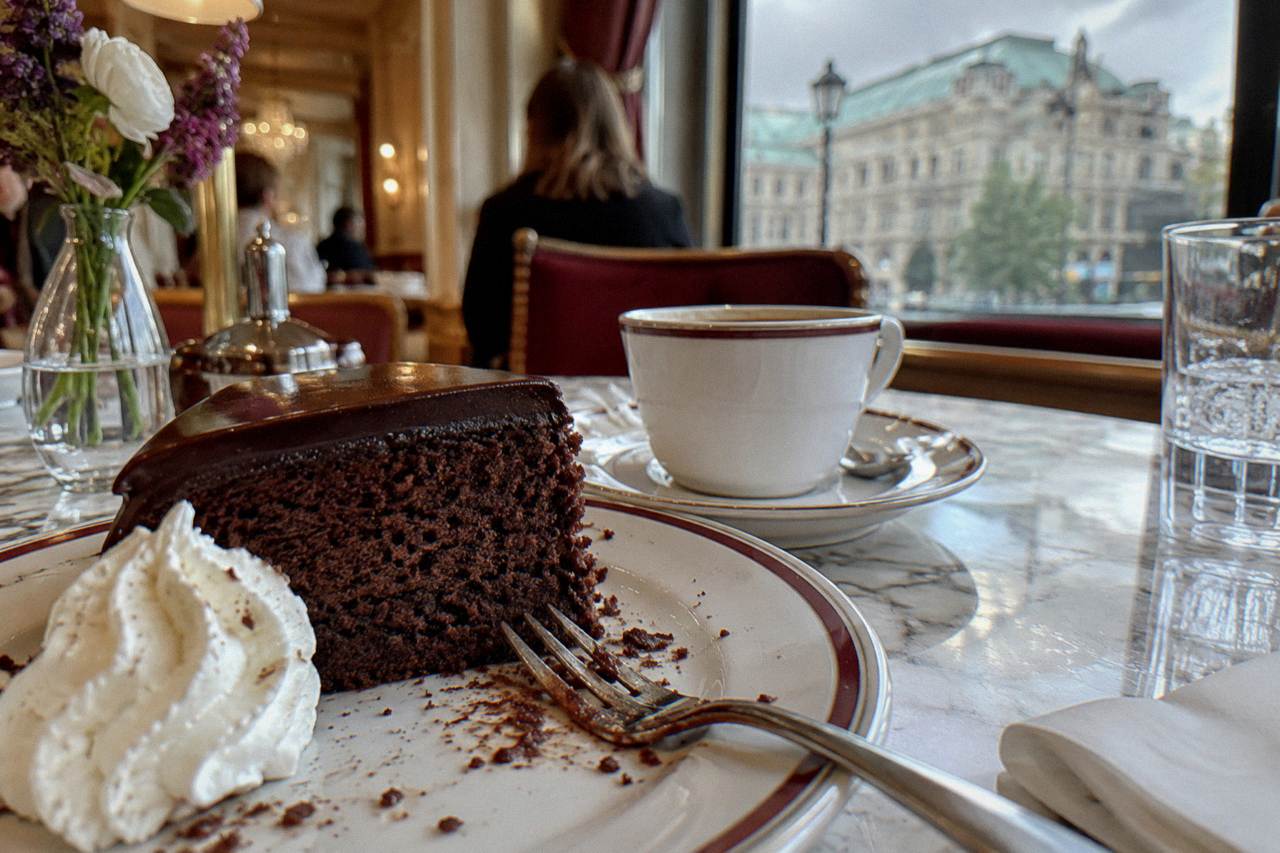
No, and yes, in a specific order. Sachertorte is deliberately dense and firm, closer to a compact chocolate sponge held together with apricot jam and a thin chocolate glaze than to a moist layer cake. A good slice reads as firm and chocolaty. A slice that crumbles to sand, fights the fork, or leaves your mouth parched has sat too long or was made cheaply, and that is a matter of the house, not the recipe.
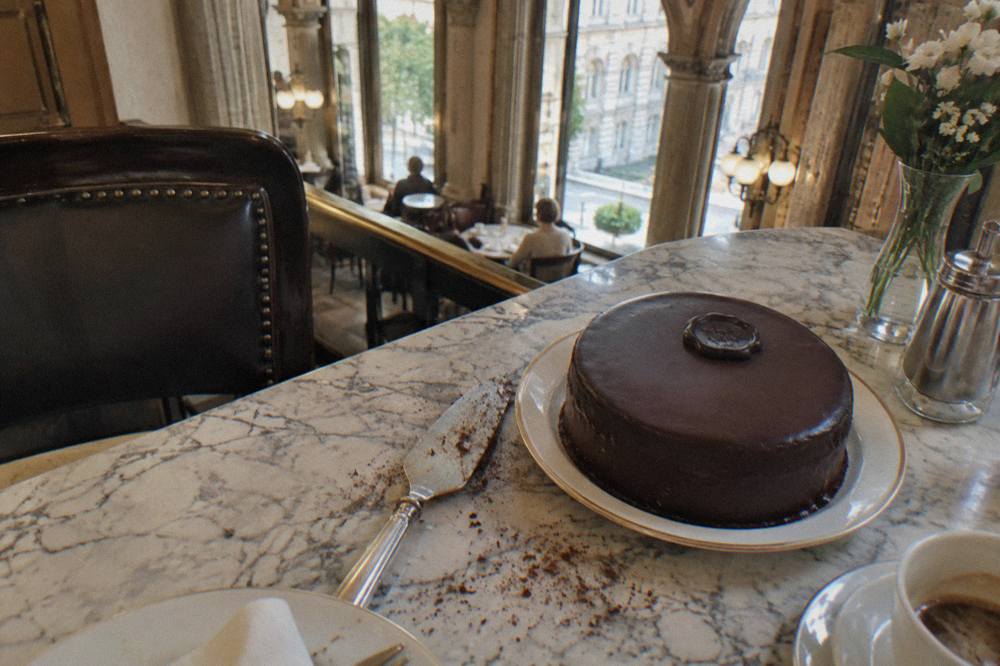
The confusion starts with the cake itself. The Sachertorte carries the name of the Sacher family, and the story attached to it, told in Vienna for generations, has a teenage apprentice named Franz Sacher improvising a dessert for a prince's table and landing on a dense chocolate sponge layered with apricot jam. Chocolate cakes of this general type had existed in Vienna for decades before the name stuck, but the Sacher version, dense chocolate sponge, a layer of apricot jam, a second jam coating under a glossy chocolate glaze, became the one that endured. The family name is still on the door of the Hotel Sacher today.
That structure explains everything about the texture. A Sachertorte is not meant to be airy. The crumb is tight, the glaze sets into a slight shell, and the apricot between the layers is there partly for flavour and partly for moisture. The tradition of serving it with a dollop of unsweetened whipped cream, Schlagobers, is not decoration. The cream is a functional part of the dish: it supplies the fat and moisture the restrained sponge withholds. Eat the slice without the cream and you are eating half a dish.
So when a visitor asks whether the cake is supposed to be dry, the honest answer splits in two. The cake is supposed to be dense, and density is often mistaken for dryness by people expecting a molten or fudgy dessert. But a genuinely dry slice, one where the crumb has gone stale and the jam has hardened into a seam, is a kitchen failure, and it happens more often at high-volume tourist counters than at the houses that cut to order. Which house you pick matters, and the question of where to eat it is genuinely contested in Vienna.
Why The Cake Is Dense By Design
Density is the recipe working, not failing. The classic formula uses a small amount of flour relative to egg and chocolate, no baking powder to speak of, and a glaze that seals the cake rather than soaking it. The result keeps for days, which was the point: this was a hotel cake that had to survive a service, a display window, and a journey to a guest's table without collapsing into crumbs.
Look at the components one by one. The sponge is built on whipped egg and melted chocolate with a modest quantity of flour, so it never rises into anything light. The apricot jam is warmed and painted on, both on top of the first layer and across the whole cake before glazing, which adds fruit acidity and a thin line of moisture. The glaze itself is a firm-setting chocolate poured hot over the cold cake, and it forms the slight crackle you break with a fork. Every element is engineered for structure and shelf life.
This is also why the cake has travelled so well as an export. A Sachertorte from the Hotel Sacher ships worldwide in a wooden box precisely because the recipe tolerates time. A Victoria sponge or a chiffon cake would not survive the post; a Sachertorte arrives more or less as it left the kitchen. The same property is what makes a stale slice possible: a cake built to last will still be edible on day four, but edible and at its best are different things.
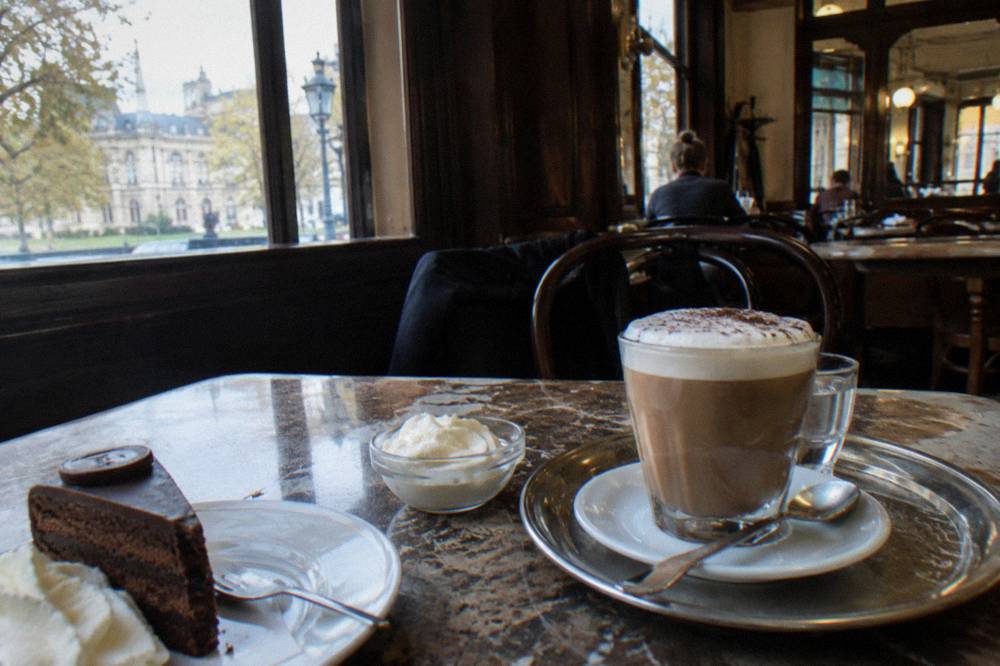
The serving ritual completes the design. The traditional order is a slice of Sachertorte, a portion of unsweetened whipped cream, and a small black coffee or a Melange. The coffee cuts the chocolate, the cream softens the crumb, and the three together balance in a way the cake alone does not. Vienna's coffee house culture, in which this ritual is embedded, was recognised on Austria's national inventory of intangible cultural heritage in 2011 under the UNESCO framework, and it remains listed. The cake is a course in that culture, not a standalone snack.
What A Proper Slice Should Taste Like
A slice at its best tastes of deep, barely sweet chocolate, a bright seam of apricot, and a firm but yielding crumb, with the glaze snapping softly under the fork. It should not taste sugary, and it should not require liquid to swallow. If you can press the crumb with a fork and it springs back slowly, holding a fingerprint, the house is doing it right.
Start with the appearance before you taste. The cut face should show a compact, even crumb with a visible apricot line roughly at the middle or just above it, depending on the house. The glaze should be smooth and thin, not a thick armour of chocolate. A thick glaze usually means the kitchen is hiding something, and a crumb with large air pockets means the batter was rushed. None of these are crimes, but they predict what the fork will find.
Then the texture. The crumb should give under pressure and separate cleanly, leaving a moist-looking surface at the break. It should coat the palate briefly and then clear, because the apricot and the coffee between mouthfuls do the resetting. The cream is not optional in this test: the classic serving is a spoonful of unsweetened whipped cream beside the slice, and the intended bite is cake, cream and coffee together. Sweetened cream, which some places serve, changes the balance toward dessert and away from the original idea.
Taste is where the houses genuinely differ, and the differences are not subtle. The Hotel Sacher's version, sold as the Original, uses two layers of apricot jam and a slightly denser chocolate. Demel, the former imperial confectioner and Sacher's historic rival, serves a version with one apricot layer and a softer, sweeter crumb. Both are legitimate Sachertorten by lineage; they simply answer the density question differently, and the rivalry between them ran through Austrian courts for years, which our Sachertorte or Demel decision guide covers in detail.
If you want the cake explained in the rooms where it is served, with a guide ordering and storytelling for you, a booked walk is the low-effort route.
Hotel Sacher Versus Demel: Two Textures, One Feud
The two canonical versions differ mainly in jam and sweetness. The Hotel Sacher's Original Sachertorte carries two apricot layers and a firmer, darker chocolate character, while Demel's version, sold as an Eduard-Sacher-Torte, uses one apricot seam and a moister, sweeter crumb. People who find Sacher too dry usually prefer Demel, and the debate is older than most visitors' grandparents.
The feud is worth knowing because it explains the seals on the cake. After Franz Sacher's death, his son Eduard refined the recipe and, for a period, supplied the cake to Demel, the confectioner near the Hofburg. When the Hotel Sacher and Demel later both sold a Sachertorte, they fought a legal battle over the right to the word Original. The settlement, still in force, gives the Hotel Sacher the exclusive Original Sachertorte label with its circular seal, while Demel sells its version with a triangular seal under the name Eduard-Sacher-Torte. The distinction persists in 2026 sources and shows no sign of going anywhere.
For the dryness question, the practical difference is this. Sacher's double apricot layer and denser sponge make a slice that leans firm and holds up well over days. Demel's single seam and softer crumb make a slice that reads moister on first bite. Neither is the wrong cake. If you have only one afternoon and one slice, taste the one that matches what you want from a chocolate cake, or do the honest thing and try both, ideally on separate days so the comparison stays fair.
Queues differ too. The Sacher cafe, especially in the afternoon, draws the longer line, while Demel's typically moves faster, and arriving early or after 16:00 helps at either. Hotel Sacher's slice of Original Sachertorte costs around 11.50 euros, with other reports landing in a range of roughly 8.90 to 10.50 euros depending on setting and serving. Demel's Sachertorte costs 8.50 euros. Treat every figure as a menu to check on the day, coffee house prices move.
What A Slice Costs At The Classic Houses
Across Vienna's named traditional houses, a Sachertorte slice runs from about 8.20 to 11.50 euros, with a Melange alongside adding roughly 5.40 to 6.90 euros. Cafe Central is the exception to plan around: it has been closed for major renovation since 16 March 2026, with reopening planned for winter 2026, and its pop-up, Decentral, is operating at Freyung 3 meanwhile.
The figures below come from the menus of the named houses. Prices at coffee houses shift with the season and the menu cycle, so treat these as planning ranges and confirm on the house's own site or at the table.
| Venue | Sachertorte slice | Other cake noted | Melange | Notes from 2026 reports |
|---|---|---|---|---|
| Hotel Sacher Cafe | Reported around 11.50 euros (other reports 8.90 to 10.50) | Not listed in this data | Not listed in this data | Longer queues, especially afternoons |
| Demel | 8.50 euros | Kaiserschmarrn 12.90 euros, Apfelstrudel 9.50 euros | 6.90 euros | Generally shorter queues |
| Cafe Landtmann | 8.50 euros | Apfelstrudel 8.20 euros, Kaiserschmarrn 15.70 euros | 6.90 euros | Takes reservations |
| Cafe Central (pop-up Decentral, Freyung 3) | Not listed in this data | Apfelstrudel 5.90 euros | 5.40 euros | Main house closed for renovation, reopening planned winter 2026 |
A few patterns are worth reading off the table. First, the spread between the most and least expensive slice of the same famous cake is only a few euros, so price should barely factor into the choice; texture preference and queue tolerance matter more. Second, the Melange, Vienna's signature milky coffee, clusters tightly around 6.90 euros at the classic houses, so budget for the coffee as a fixed companion rather than an optional extra. Third, the Decentral pop-up offers some of the cheapest reported cake-and-coffee pairings in the set, though the setting is a temporary stand-in for the palatial original room. If Sachertorte is only the start of your list, the roundup of Vienna's signature cakes and where to taste them covers strudel, Kaiserschmarrn, and the rest.
If cake prices are the hook that brought you here, the broader scene is covered in our Vienna cake and pastry guide, which walks through Apfelstrudel, Kaiserschmarrn and the rest of the display case beyond the one famous chocolate gateau.
How To Serve It Right: Cream, Coffee, And A Little Patience
Serve the slice at cool room temperature with unsweetened whipped cream and a black coffee or Melange, and eat all three together. Cold cake straight from the fridge tastes dry and muted, because the glaze hardens and the crumb tightens. Twenty minutes out of the chiller, the chocolate softens, the apricot loosens, and the same slice reads completely differently.
Temperature is the single most underrated variable. A Sachertorte is stored cold for the glaze's sake, but it is not meant to be eaten cold. If a slice arrives fridge-cold, let it sit, or take the first bite with the cream and coffee and judge from the second or third. Many a dry cake verdict has been reached on a first mouthful of chilled chocolate. This is as true of a boxed Original taken home as of a slice in a coffee house.
The cream deserves its own word. Schlagobers in this context is unsweetened or barely sweetened whipped cream, and its job is to carry the crumb. If a house serves sweetened cream, the cake plus cream plus jam tips toward cloying, and the chocolate loses its edge. Coffee does the other half of the work: a small Melange or a black coffee cleans the palate between bites so the apricot keeps registering. Even the water matters in Vienna, where a 2026 consumer-body sample of 30 venues found 23 charged for tap water, often 0.80 to 3.60 euros per half litre, so the coffee may be the cheaper companion anyway.
At home, the same rules apply to the boxed cake. Let it warm, cut it with a hot dry knife, and serve cream you have whipped without sugar. And if you are building a whole Vienna cake agenda rather than a single slice, a guided tasting walk handles the ordering, the queue timing and the history in one afternoon.
When Dry Actually Means Something Went Wrong
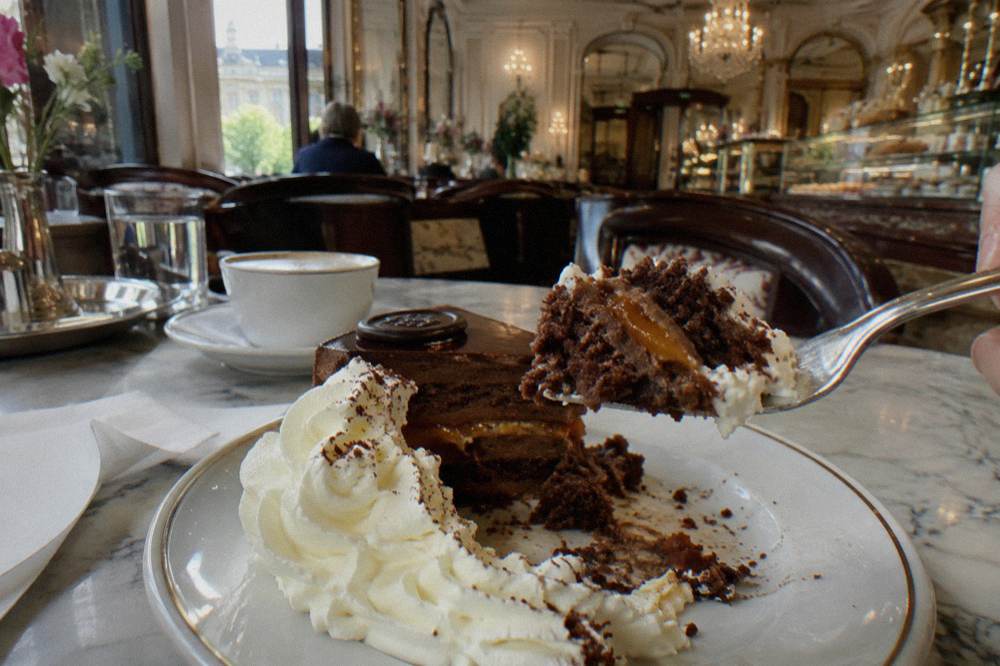
There are three honest failure modes: a cake cut many days after baking, a cake held in a chilled display with moving air, and a cheap mass-produced version with the jam and butter engineered out. In all three the crumb turns sandy, the apricot seam hardens, and no amount of cream rescues it. If your slice crumbles to dust under the fork, you are entitled to a different verdict than the recipe deserves.
Age is the first suspect. The Sachertorte's durability is a double-edged property: it stays sellable long past its peak, and a busy tourist counter can keep cutting from the same cake for days. The jam line is the tell. Fresh, it is soft and slightly glossy; past its prime, it dries to a leathery stripe that pulls away from the crumb when you cut. The glaze dulls too. A slice that looks matte rather than faintly glossy has been waiting.
Storage is the second. A chilled, ventilated display case pulls moisture out of an uncovered cut face, so the first slice from the front of the case is often worse than a fresher cut from the kitchen. Asking for a slice from a freshly cut cake is a completely normal request in a serious house, and it is the single best defence against a dry piece. The houses that cut to order, and the guided walks that bring groups into working coffee houses at busy cake times, stack the odds in your favour; the coffee house walk linked from this page is one such option, priced on the operator's listing.
The third failure is simply a bad cake. Mass-produced Sachertorten, the kind sold in shrink-wrap at airport shops, exist on structure alone: dense, sweet, low on apricot, absent of the fine crumb. If your only experience of the cake is one of those, or a slice from a random bakery at 17:00 on a Sunday, the answer to this article's question has been sampled wrong. One proper slice, in a traditional house, with the cream and the coffee, is the test that counts.
Tasting The Cake In Its Proper Setting
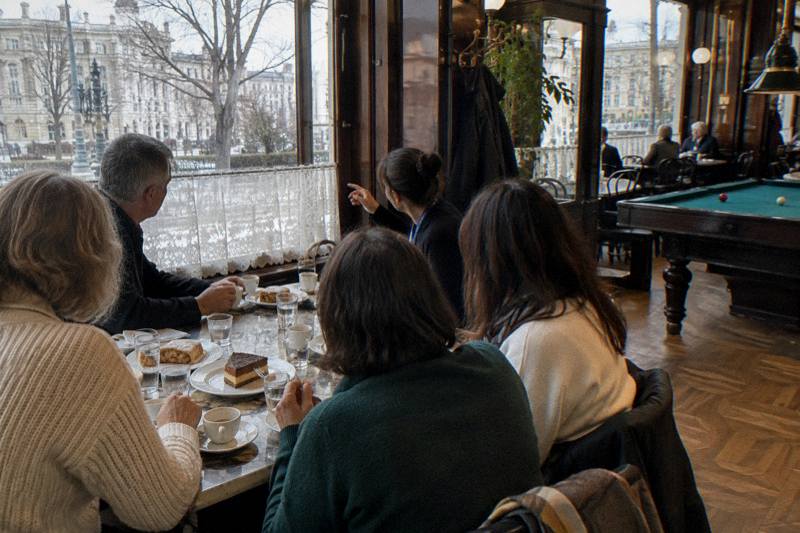
The fastest way to a fair verdict on Sachertorte is to eat it where it was built to be eaten: a traditional coffee house, mid-morning or mid-afternoon, with the cream, the coffee and time. A guided coffee house walk adds context, ordering help and a route between houses you would not find alone, which matters when two of the most famous addresses have their own quirks of queue and seal. If you want to build the whole morning around that slice, the guide to breakfast the Viennese way explains what a Fruehstueck plate includes, what coffee houses charge and where locals actually sit down.
This is where Vienna Food Tours earns its keep as a research corner: the difference between a memorable slice and a disappointing one is usually logistics, not taste. Which house, what time, cut to order or from the case, Central's renovation detour to the Decentral pop-up at Freyung 3, the reservation habits of Landtmann against the no-reservation norm at Demel, all of it is plannable, and all of it changes the cake on the plate.
The Vienna Coffeehouse Tour: Pastries, Bites & Local Stories pairs that planning with the stories, running about three and a half hours through the coffee house world with pastries along the way; the operator's listing carries the current price, meeting point and full inclusions. For a shorter, cake-forward option, there is also a dedicated coffee, cake and chocolate tasting walk that compresses the same idea into two and a half hours, with its price on the listing.
If the plan is coming together, these are the three coffee-and-cake experiences to compare for the day itself:
Common Questions About Sachertorte
Is Sachertorte Supposed To Be Dry?
It is supposed to be dense and firm, not dry. The classic recipe produces a tight chocolate crumb with apricot jam and a setting glaze, served with unsweetened whipped cream to supply moisture. A slice that crumbles or parches your mouth has sat too long or was made cheaply, which is a matter of the house rather than the cake.
Why Is Sachertorte Served With Whipped Cream?
The cream is part of the dish, not a garnish. The sponge is deliberately restrained, and the unsweetened whipped cream supplies the fat and moisture it withholds. The intended bite combines cake, cream and coffee together.
Which Is Better, Hotel Sacher Or Demel?
There is no settled answer. The Hotel Sacher's Original has two apricot layers and a firmer, darker character; Demel's version has one apricot seam and a moister, sweeter crumb. People who find Sacher too dry usually prefer Demel. Try both if time allows.
How Much Does A Slice Of Sachertorte Cost In Vienna?
Slices at the named classic houses run from about 8.20 to 11.50 euros, with the Hotel Sacher's Original around 11.50 euros and Demel's at 8.50 euros. A Melange alongside adds roughly 5.40 to 6.90 euros. Check the menu on the day.
Can I Fix A Dry Slice Of Sachertorte?
Partly. Let it warm to cool room temperature first, since chilled chocolate reads drier than it is, then pair each bite with the unsweetened cream and a sip of black coffee or Melange. A genuinely stale crumb cannot be repaired, only balanced.
Is Cafe Central Open For Cake Right Now?
No. Cafe Central has been closed for major renovation since 16 March 2026, with reopening planned for winter 2026. Its pop-up, Decentral, operates at Freyung 3 with Apfelstrudel at 5.90 euros and a Melange at 5.40 euros; confirm on the cafe's own site before going.